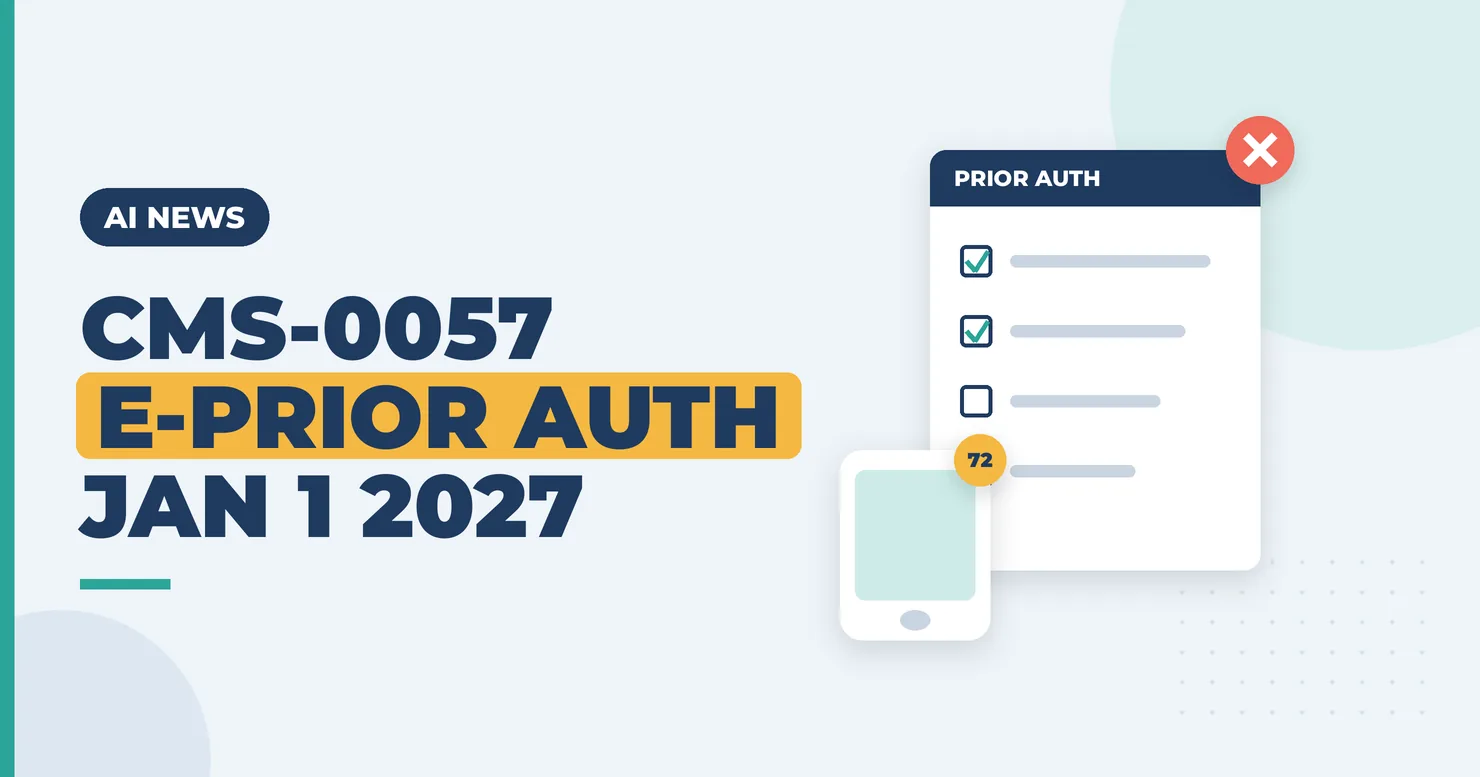
On October 12, 2026, Medical Economics published a practice-facing checklist for the January 1, 2027 Prior Authorization API deadline under CMS-0057-F — the CMS Interoperability and Prior Authorization Final Rule. The legal duty sits on impacted health plans, not physician practices. But if your EHR, billing company or AI prior-auth agent is not ready, the plan can look compliant while your staff still faxes. That gap matters more as ambient and agentic tools — including newly funded stacks that draft referrals and medication prior auths — promise to submit work for you.
This article translates the CMS fact sheet, the Medical Economics vendor questions and the September 2026 AMA letter to CMS Administrator Mehmet Oz into an operations checklist for U.S. billing and authorization teams. It pairs with our coverage of AI prior-auth agents, Alabama’s clinician-review law, WISeR in Original Medicare and human review of AI denials.
Key takeaways
- API deadline: Impacted payers must implement Prior Authorization, Provider Access and Payer-to-Payer APIs (and expand Patient Access) generally by January 1, 2027 (CMS-0057-F fact sheet). Exact dates can vary by payer type.
- Already live (2026): Standard PA decisions within 7 calendar days, expedited within 72 hours (QHP issuers on FFEs excepted from that clock in the fact sheet), specific denial reasons, and public PA metrics (first metrics due by March 31, 2026).
- Drugs are out of CMS-0057 PA API scope. Medical-benefit drug ePA and pharmacy standards are proposed under CMS-0062-P with a proposed Oct. 1, 2027 start — not final as of this writing.
- Who is covered: Medicare Advantage; Medicaid and CHIP FFS; Medicaid/CHIP managed care; QHPs on Federally Facilitated Exchanges. Not traditional (Original) Medicare FFS generally, and not most employer-sponsored commercial plans under this federal rule.
- AI angle: Agents that auto-submit PA only help if they hit the live API (or correct portal) with complete documentation. Otherwise you still get delays and CO-197-style auth failures.
How this article was checked: CMS-0057-F fact sheet; CMS-0062-P drugs proposed-rule fact sheet (April 10, 2026); Medical Economics (Hoyt Gong, Oct. 12, 2026); Fierce Healthcare on AMA’s Sept. 2026 letter to CMS; AMA letter PDF. We did not invent deadlines. Last reviewed 13 October 2026. Educational only — not legal advice.
- What CMS-0057-F already changed vs what changes Jan. 1, 2027
- Who is in — and who is still on fax
- Drugs: do not let vendor language blur CMS-0057 and CMS-0062
- Why AMA pressed CMS in September 2026
- The vendor question list (EHR, RCM, AI agents)
- What this means for billing teams this month
- What this means for insured patients
- FAQ
Table of Contents
What CMS-0057-F already changed vs what changes Jan. 1, 2027
| Topic | Timing (CMS fact sheet) | What billers feel |
|---|---|---|
| Decision clocks (standard 7 days / expedited 72 hours) | Generally Jan. 1, 2026 (excludes QHP issuers on FFEs for that clock) | SLA tracking in auth queues |
| Specific reason for denial (any submission method) | Beginning 2026 | Better appeal language — if staff capture it |
| Public prior-auth metrics on payer websites | First report by March 31, 2026 | Benchmark denial volumes by payer |
| Prior Authorization API (covered items/services, docs, request/response) | Beginning Jan. 1, 2027 | EHR/AI must connect or you stay on fax/portal |
| Provider Access API (claims/encounters, USCDI, PA info; patient opt-out) | By Jan. 1, 2027 | Potential in-chart history for auth work |
| Payer-to-Payer API | By Jan. 1, 2027 | Continuity when patients change plans |
| Patient Access API adds PA information (excluding drugs) | By Jan. 1, 2027 | Patients may see auth status in apps |
| MIPS / Promoting Interoperability Electronic Prior Authorization attestation | Clinicians: CY 2027 performance period; hospitals/CAHs: 2027 EHR reporting period | At least one successful electronic PA via CEHRT (or exclusion) |
CMS also states HHS will use enforcement discretion so covered entities that implement an all-FHIR Prior Authorization API under this rule are not enforced against for missing the HIPAA X12 278 standard in that API path. That is a standards detail for IT — not permission to skip the API.
Who is in — and who is still on fax
In the federal rule (impacted payers): Medicare Advantage organizations; state Medicaid and CHIP fee-for-service programs; Medicaid managed care plans; CHIP managed care entities; Qualified Health Plan issuers on the Federally Facilitated Exchanges.
Still outside this federal API mandate (typical practice mix): – Most employer-sponsored commercial plans (unless state law or the plan voluntarily connects). – Traditional Original Medicare fee-for-service for routine PA — except where a separate model such as WISeR adds prior auth in six states. – State-based marketplace plans in states that run their own exchanges (Medical Economics notes California, New York and about 18 others), unless state rules require similar rails.
Operational reality for January 2027: some payers will be live inside the EHR; others will still be portal/fax/phone. Dual workflows are the default, not a temporary glitch.
Drugs: do not let vendor language blur CMS-0057 and CMS-0062
CMS-0057-F’s Prior Authorization API requirements exclude drugs, including drugs administered in the office and billed to the medical benefit (CMS fact sheet; Medical Economics).
On April 10, 2026, CMS proposed CMS-0062-P to: – Bring medical-benefit drugs into the Prior Authorization API beginning October 1, 2027 (proposed). – Require certain NCPDP SCRIPT / Formulary & Benefit / Real-Time Prescription Benefit standards for pharmacy-benefit drugs at Medicaid, CHIP and FFE QHPs beginning the same proposed date. – Align faster decision clocks and specific denial reasons for drugs.
Comments closed June 15, 2026. There is no final rule yet. If a salesperson says “CMS-0057 covers your drug prior auths,” ask them to show the statutory/regulatory citation — or admit they mean a proprietary pharmacy workflow, not the 2027 non-drug API mandate.
Why AMA pressed CMS in September 2026
AMA CEO John Whyte, M.D., M.P.H., wrote CMS Administrator Mehmet Oz in mid-September 2026 urging CMS to keep the Jan. 1, 2027 date and avoid broad enforcement discretion that would leave physicians stuck with vendor gaps. Coverage in Fierce Healthcare and Becker’s summarizes the ask: EHR vendors should provide timelines, testing, training and support; plans should expose requirements through reliable APIs; proprietary workarounds should not replace standardized point-of-care exchange.
For billers, translate that letter into procurement language: get the payer-by-payer live list in writing this quarter, not a slide that says “interoperability ready.”
The vendor question list (EHR, RCM, AI agents)
Adapted from Medical Economics’ six EHR questions and CMS’s own readiness guidance, plus AI-agent controls:
- Which of my top 20 payers will be live inside ordering/auth workflow on Jan. 1, 2027 — by plan name and date?
- Is Prior Authorization API support in my current license, or a paid upgrade?
- Show one real order/request through the electronic path with one of my actual payers before January.
- When the payer asks for more information or the API is down, which work queue gets the case, with reason and timestamp?
- Does documentation auto-attach from the chart (Da Vinci DTR-style), or do staff still copy/paste?
- Who owns a stalled request — EHR, clearinghouse, AI vendor or plan — in the contract?
- For AI agents: Can the agent submit only when required elements pass a hard-stop checklist? Is there a human cancel button? Are prompts, packet snapshots and model versions retained for appeals?
- Drug vs non-drug: Separate answers for pharmacy ePA, medical-benefit drug PA and CMS-0057 non-drug items/services.
- Provider Access API: Will my EHR pull in-network PA/claims history (patient opt-out respected), and when?
- MIPS / PI: How will we document the Electronic Prior Authorization attestation (or exclusion) for 2027?
If a third-party billing or PA vendor routes everything to fax “for reliability,” that request does not count as electronic under the spirit of the rule — and may not help MIPS attestation.
What this means for billing teams this month
- Inventory channels by payer. Spreadsheet: plan, PA method today, promised API date, drug vs non-drug, status write-back yes/no.
- Baseline metrics now (Medical Economics / AMA survey context): requests per week, staff hours, days to decision, denial rate, resubmits. CMS and AMA cite heavy weekly PA burden; your local baseline is what proves whether APIs helped in Q1 2027.
- Tighten packets for AI and humans. Specific denial reasons help only if the first submit meets criteria. Use our prior authorization denial guide and medical necessity checklist.
- Watch auth-related claim edits. Missing or late authorizations still surface as CO-197 and related codes even when the “submit” was digital.
- Do not confuse WISeR with CMS-0057. WISeR adds AI-assisted prior auth to select Original Medicare services in six states. CMS-0057 APIs target MA/Medicaid/CHIP/FFE QHPs. Different populations, different playbooks — link both in staff training (WISeR guide).
- Align with state AI rules. Where states require licensed clinicians on AI medical-necessity denials (Alabama SB 63), electronic speed does not remove clinical review duties on the payer side — and your appeal still needs clinical facts.
What this means for insured patients
- Starting in 2027, more prior-auth status information should appear through payer Patient Access tools for covered non-drug services — ask your plan how to view it.
- You may still face fax-era delays for commercial employer plans and for drugs until separate rules finalize.
- Always request the specific denial reason and appeal on clinical documentation. Electronic submission is a channel, not an approval.
FAQ
Does CMS-0057 require my clinic to use electronic prior auth?
Not directly. The API obligations fall on impacted payers. Practices feel it through EHR readiness, MIPS/Promoting Interoperability attestation starting with the 2027 performance/reporting periods, and whether staff keep dual fax workflows.
Are employer commercial plans included?
Generally no under this federal rule. Many independent practices will still run API workflows for MA/Medicaid/FFE QHPs and portals/fax for large commercial book — unless a state law or voluntary payer connection says otherwise.
Are prescription drug prior auths included on Jan. 1, 2027?
No under CMS-0057-F. CMS proposed bringing medical-benefit drugs into the PA API on Oct. 1, 2027 via CMS-0062-P; that proposal is not final.
Will AI agents automatically meet the 2027 requirements?
Only if they submit through a live Prior Authorization API (or other compliant path), attach required documentation and write status back to a human-owned queue. Funding announcements for AI PA agents do not equal payer certification.
How is this different from WISeR?
WISeR is a CMS Innovation Center model adding prior auth (AI + clinician review) for selected Original Medicare services in six states. CMS-0057 is a nationwide interoperability rule for MA, Medicaid, CHIP and federal marketplace plans’ APIs and process measures. Train staff on both if you bill both populations.