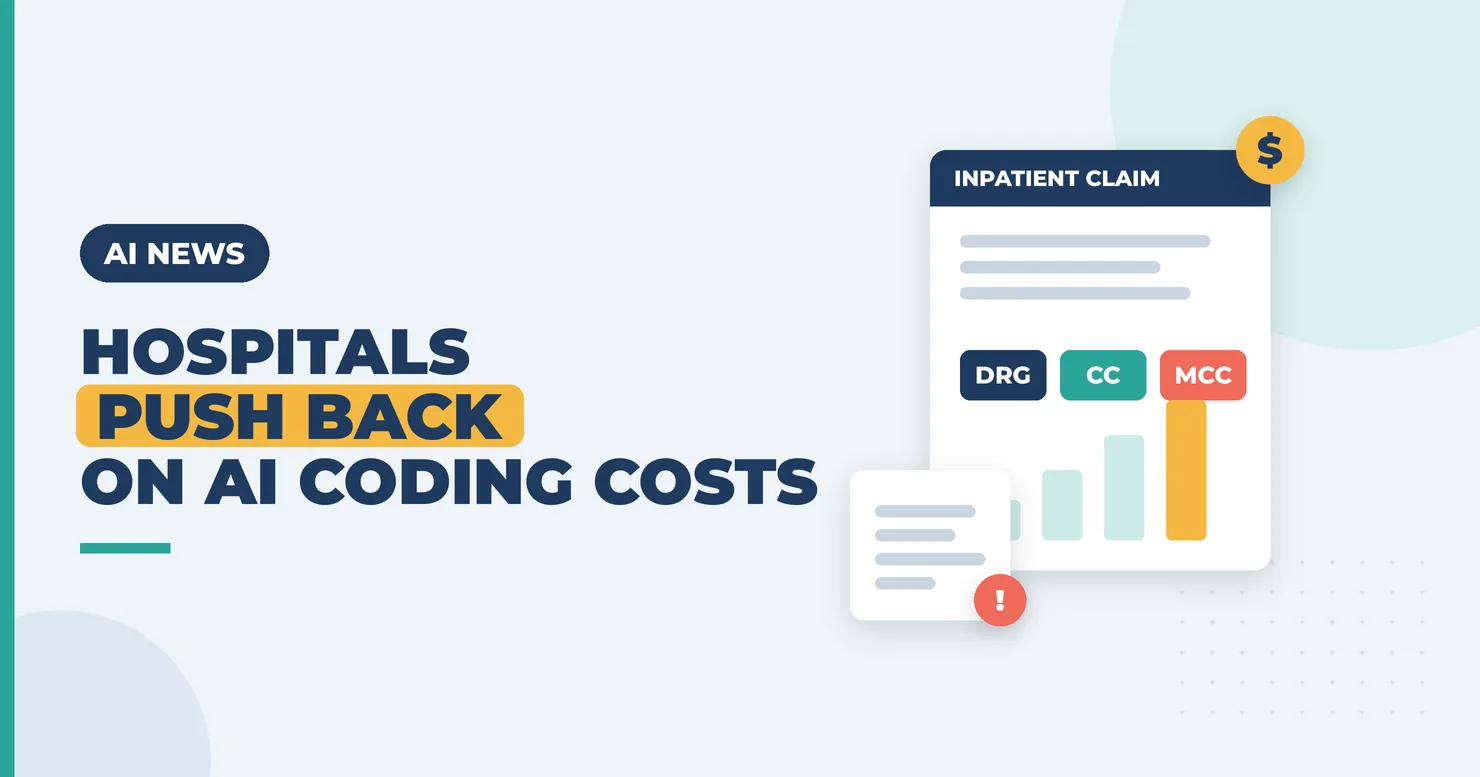
The American Hospital Association is answering Blue Cross Blue Shield Association’s claim that AI-assisted hospital coding added about $942 million to Blue plan costs from 2023 to 2025. In an October 5, 2026 AHA blog — and in follow-up coverage on October 7 — hospitals say the Blues analysis never reviewed medical records, never separated AI-touched claims from traditional coding, and underplayed rising patient complexity plus outpatient migration. This is the rebuttal round. For the full BCBSA numbers and “bump code” mechanics, see our earlier BCBSA $942M AI coding report.
Chief Healthcare Executive summarized the hospital industry response on October 7. The practical takeaway for CDI and coding teams has not changed: every secondary diagnosis still has to meet the official clinically significant test, because both sides are arming AI.
Key takeaways
- AHA’s core test: “whether the patient’s medical record supports the diagnosis” — not whether reimbursement went up.
- AHA says BCBSA did not review charts, did not isolate AI vs. traditional coding, and did not fully account for morbidity or lower-acuity care leaving the inpatient setting.
- A comorbidity can change monitoring, nursing, meds and risk without a transfusion or surgery — so “no extra procedure” ≠ “unsupported code.”
- AHA argues BCBSA’s own earlier math implies inpatient coding intensity was only a small slice of commercial premium growth vs. drugs and other drivers.
- Expect more clinical-validation audits either way. Keep AI suggestion logs and Section III documentation ready.
How this article was checked: AHA News blog by Molly Smith and Jen Holloman (Oct. 5, 2026); Chief Healthcare Executive (Ron Southwick, Oct. 7, 2026). BCBSA figures referenced only as background from our prior sourced post and the AHA response — we do not re-litigate every $942M line item here. Last reviewed 11 October 2026. Educational content, not legal advice.
Table of Contents
What is new in this round
BCBSA’s late-September report argued that hospitals’ AI-enabled revenue-cycle tools helped push more inpatient stays into higher-severity DRGs without matching treatment changes. We already covered that claim, the 37%→40% complexity share, the ~$653 million secondary-diagnosis slice and the anemia/transfusion contrast in our BCBSA analysis.
What is new is the hospital industry’s structured rebuttal:
| AHA critique | Why billers care |
|---|---|
| No medical-record review | Payer pattern analyses ≠ chart-level proof of wrong coding |
| AI vs. traditional coding not identified | You cannot defend or attack “AI” if the dataset never labels it |
| Patient morbidity / outpatient migration underplayed | Case-mix is shifting; leftover inpatients are often sicker |
| “No extra procedure” is the wrong test | CCs/MCCs can be valid without a new OR trip or transfusion |
| Premium context | Even accepting $942M, AHA says it is a thin slice of commercial cost growth vs. drugs |
AHA writers Molly Smith and Jen Holloman put it plainly: BCBSA “does not demonstrate that hospitals are coding patients inaccurately or that AI tools are driving inappropriate spending.”
AHA’s clinical standard (and why it matches ICD-10 rules)
AHA says a comorbidity can affect clinical decision-making, monitoring, nursing resources, medication management, prognosis and risk without an easily billable procedure. That lines up with Section III of the ICD-10-CM Official Guidelines: other diagnoses must be clinically significant — evaluation, treatment, diagnostic procedures, extended LOS or increased nursing/monitoring — and abnormal labs are not coded unless the provider indicates clinical significance.
So both sides, oddly, point billers to the same place: the chart. Blues want fewer unsupported bump codes. Hospitals want credit for complete documentation of complex patients. Your job is to prove the middle — each secondary diagnosis tied to provider documentation that meets Section III.
The “consistency” jab at Blue plans
AHA also argues Blue plans capture diagnoses aggressively on the Medicare Advantage side — risk adjustment, in-home assessments, voice tools, retrospective chart reviews — and cites OIG/DOJ examples of unsupported diagnoses at individual Blues entities. That is advocacy, not a finding that hospital inpatient coding is clean. For RCM staff, treat it as a reminder: payers will keep pressing clinical validation even while they maximize their own risk scores. Document like an auditor is coming. See our note on OIG audit triggers in medical billing.
What this means for coders and CDI teams
- Do not re-argue the $942M headline with payers. Argue the record. Point to evaluation, treatment, monitoring or LOS impact for each challenged CC/MCC.
- Label AI-assisted charts in your workflow. AHA is right that BCBSA did not isolate AI. Your defense file should: tool suggestion → human accept/reject → rationale.
- Query soft lab-only flags. Hyponatremia, anemia and malnutrition without clinical significance language are the first codes clinical validation will cut. Our medical necessity documentation guide still applies.
- Sample AI output like a new coder. Monthly DRG-family audits beat a once-a-year panic after a Blue plan letter.
- Watch for dual AI pressure. Hospitals code more completely; insurers review more aggressively — the same “arms race” we flagged next to AKASA’s autonomous inpatient coding and Fitch’s provider coding optimization note.
What this means for patients
- Higher DRGs can raise coinsurance on percentage-based inpatient cost sharing. Flat copays usually do not move.
- Check diagnoses on your EOB and itemized bill. If a diagnosis looks wrong, ask the hospital for a coding review and, if needed, a HIPAA record amendment.
- Expect more denials and downgrades either way. Appeal with clinical facts using our not medically necessary denial guide.
FAQ
Did the AHA say BCBSA’s $942 million figure is false?
No. AHA says the figure lacks context, that BCBSA did not prove diagnoses were unsupported, and that even accepting the number it is a small contributor to commercial premium growth compared with other drivers such as drugs.
What does AHA say BCBSA’s analysis missed?
Medical-record review, identification of which claims used AI versus traditional coding, fuller accounting for patient morbidity, and the shift of lower-acuity care out of inpatient settings.
Does “no transfusion” mean anemia coding was wrong?
Not by itself, per AHA. A comorbidity can affect monitoring, nursing, medications and risk without a transfusion or surgery. The official test is clinical significance in the record.
Should coders stop using AI documentation tools?
Neither AHA nor BCBSA called for a ban. Both sides are increasing scrutiny. Keep human review, Section III tests and an audit trail for AI suggestions.
Where can I read the original BCBSA numbers?
Our earlier explainer: Blue Cross Says AI Coding Added $942 Million to Hospital Bills.
Sources
- AHA News, Better Information, Better Care: How Coding Supports Today’s Complex Patients (Molly Smith & Jen Holloman, Oct. 5, 2026).
- Chief Healthcare Executive, Hospitals push back against claims of using AI to drive up costs (Ron Southwick, Oct. 7, 2026).
- AHA News headline, AHA blog responds to BCBS report… (Oct. 5, 2026).
- Medical Billing 101, BCBSA $942M AI coding report.
- Medical Billing 101, AKASA autonomous inpatient coding.
- Medical Billing 101, Fitch AI prior-auth human review.

Manikandan J is a CPC (AAPC) and CRCR (HFMA) certified medical billing professional with billing and RCM experience at athenahealth, Omega Healthcare, UnitedHealthcare, Blue Cross Blue Shield and Access Healthcare. He writes Medical Billing 101’s guides on denial codes, appeals and patient billing help for US billers, providers and insured patients.