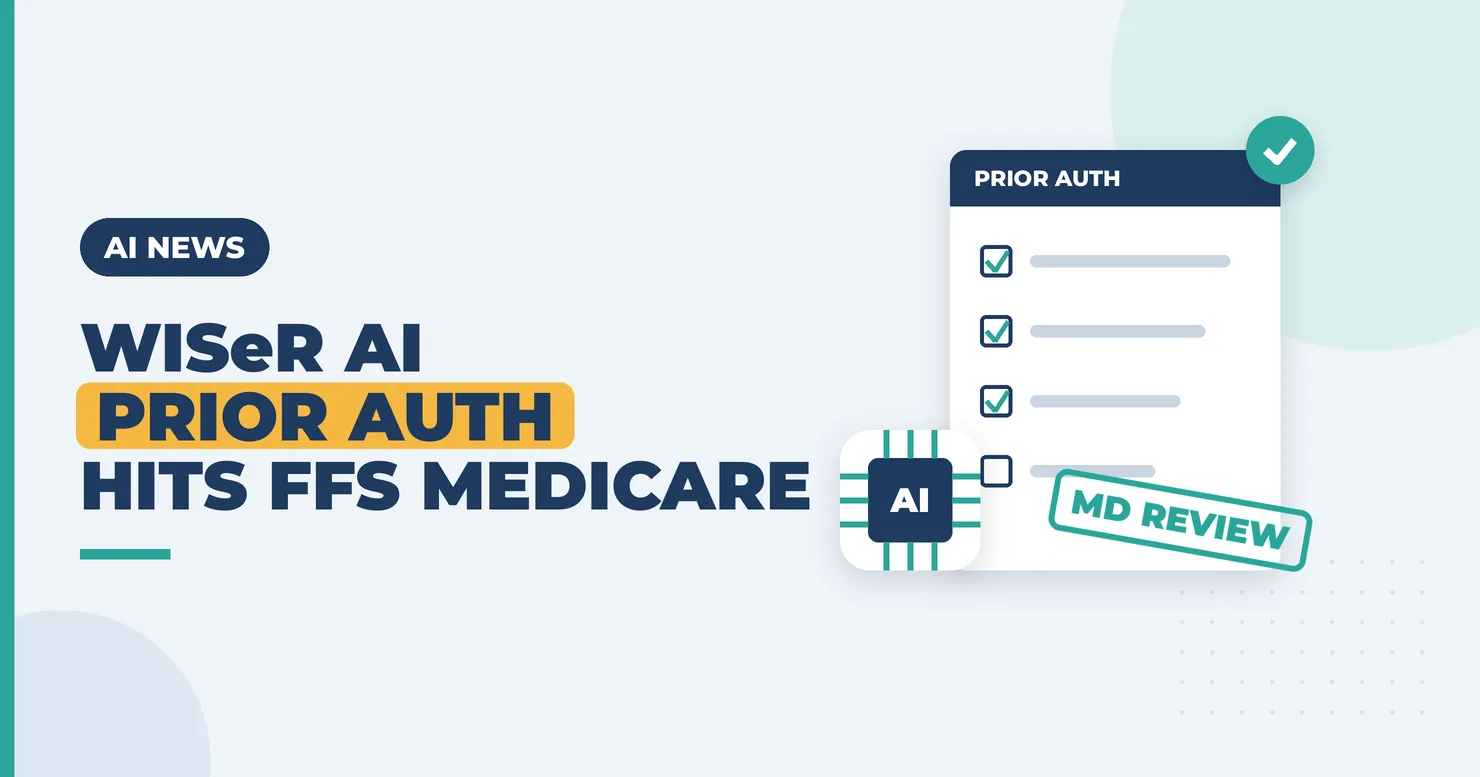
On October 9, 2026, Sens. Patty Murray (D-WA) and Ron Wyden (D-OR) held a Vancouver roundtable with Washington clinicians about CMS’s Wasteful and Inappropriate Service Reduction (WISeR) model. WISeR uses AI plus clinical review for prior authorization on select Original Medicare (fee-for-service) services in six states. Contractors are paid a share of averted spend. For billers in those states, this is not a Medicare Advantage story — it is FFS Medicare with new tracking numbers, 72-hour clocks, post-service review risk and CO-197 exposure if care proceeds without affirmation.
Rep. Suzan DelBene (WA-01) is separately pressing CMS via FOIA for the Virtix Health audit and corrective action plan after early delays. This piece folds that oversight fight into one ops-focused guide. It is distinct from our coverage of Alabama’s AI prior auth law and Fitch’s human-review credit view.
Key takeaways
- WISeR runs Jan. 1, 2026–Dec. 31, 2031 in AZ, NJ, OH, OK, TX and WA. It does not apply to Medicare Advantage.
- Vendors use AI/ML plus licensed clinicians. CMS says all non-payment recommendations need a licensed clinician. Vendors earn a percentage of averted expenditures.
- Washington’s Virtix Health denied 53% of 6,000+ decisions in Q1 2026 (EFF records / Seattle Times). Virtix later said affirmation rates moved toward ~70%. Arizona’s contractor denied under 20% in the same window.
- CMS found Virtix noncompliant with the 72-hour decision turnaround and ordered a corrective action plan. DelBene says audit/CAP docs were never released to Congress — she filed FOIA.
- Providers can submit prior auth (to the vendor or via the MAC) or skip it and face post-service/pre-payment review. Skipping affirmation and billing can land CO-197 style authorization failures.
How this article was checked: Murray Senate release and KUOW coverage of the Oct. 9, 2026 roundtable; CMS Innovation Center WISeR model page (states, dates, vendor table, payment design); Seattle Times reporting on EFF-released documents (53% WA denial rate, actuarial memo, Virtix CAP); DelBene House release on FOIA for audits/CAPs. We did not invent denial rates or quotes. Last reviewed 11 October 2026. Educational only — not legal advice.
Table of Contents
What WISeR is (and is not)
CMS’s Innovation Center describes WISeR as a six-year model that uses enhanced technology (AI and machine learning) with human clinical review to check medical necessity for a pre-selected set of Original Medicare items and services. Goals listed by CMS include cutting low-value care, lowering FFS spending and speeding decisions.
| Fact | Detail (per CMS / reporting) |
|---|---|
| Model window | Jan. 1, 2026 – Dec. 31, 2031 |
| States | Arizona, New Jersey, Ohio, Oklahoma, Texas, Washington |
| Plan type | Original Medicare FFS only — not Medicare Advantage |
| Exclusions (CMS) | Inpatient-only services, emergency services, care that would pose substantial risk if delayed |
| Example services | Skin/tissue substitutes; electrical nerve stimulator implants; knee arthroscopy for osteoarthritis; pain and incontinence treatments among those clinicians flagged at the roundtable |
| Payment to vendors | Percentage of expenditures tied to averted wasteful/inappropriate care, adjusted by process/experience measures |
CMS lists six technology participants, each tied to a MAC jurisdiction — including Virtix Health LLC (Washington / JF Noridian) and Zyter Inc. (Arizona / JF Noridian). Murray’s office and KUOW note that before WISeR, many of these services did not require prior auth in Traditional Medicare — one reason seniors choose it over Medicare Advantage.
CMS says coverage and payment policy do not change. Providers and suppliers can either submit a prior authorization request (directly to the model participant or through the MAC) or go through post-service/pre-payment review if they deliver the service without affirmation. A future “gold card” for high-compliance providers is described on the model page.
What Murray, Wyden and doctors said on Oct. 9
At the Vancouver Area Agency on Aging & Disabilities roundtable, Murray called WISeR “essentially a cut to Medicare” and said Washington seniors seeking doctor-recommended care for debilitating pain were being delayed or told Medicare would not pay. Wyden framed the pilot as grafting AI onto Traditional Medicare authorization decisions.
Clinicians on the panel — including Dr. Keren Rosenblum (The Vancouver Clinic), Dr. Leon McCook (PeaceHealth) and Dr. Ettore Palazzo (EvergreenHealth) — described prolonged pain from delayed authorizations, inconsistent processes and heavier staff workload. Rosenblum told KUOW that appeals can take months and that delays for older adults with chronic pain are not “scheduling inconveniences.”
Murray’s office notes Democrats’ CRA attempt to overturn WISeR failed when Republicans blocked it, and that Murray and Wyden previously introduced the Seniors Deserve SMARTER Care Act to stop the model. Political framing aside, the operational message for RCM teams is the same: FFS Medicare in these six states now has a prior-auth lane that behaves more like commercial/MA utilization management.
Denial rates, incentives and the DelBene FOIA
Documents obtained by the Electronic Frontier Foundation and reported by the Seattle Times (Sept. 16, 2026) showed Virtix made more than 6,000 prior authorization decisions through March 2026 and denied 53%. Arizona’s contractor denied less than 20% of about 14,300 decisions in the same period. Virtix told the Times its affirmation rate later trended toward about 70%. How many early denials were overturned on appeal was not clear from available records.
CMS’s own actuarial staff, in a memo in those records, warned that because participants are paid based on claims denied, they “will have an incentive to deny as many claims as possible.” Seattle Times reporting also said CMS pays contractors roughly 25% of historical regional cost for averted services (with adjustments), and can dock up to 10% of pay for poor performance such as slow or inaccurate determinations.
Separately, Rep. DelBene announced a FOIA for the Virtix audit and corrective action plan after CMS found the company noncompliant with the 72-hour decision deadline, plus audits/CAPs for other WISeR vendors. Her statement cites January–March Washington data: over half of claims denied and many decisions exceeding 72 hours. Neither the audit nor the CAP, she said, had been released to Congress or the public. EFF reporting also flagged possible future expansion of service categories — treat that as oversight context, not a confirmed go-live schedule, until CMS publishes it.
What this means for billing teams and providers
- Confirm you are in a WISeR state and on FFS Medicare. WISeR does not hit MA. If the patient is Original Medicare in AZ, NJ, OH, OK, TX or WA, check whether the CPT/HCPCS is on the WISeR selected list before scheduling and before claim drop.
- Choose the lane deliberately: prior auth vs. post-pay review. Skipping prior auth is allowed but puts the claim into medical review before payment. Document which path you took and keep the affirmation ID when you have one.
- Build the packet for AI triage + clinician review. Attach history, failed treatments, imaging, LCD/NCD citations and the treating clinician’s medical-necessity rationale. Incomplete packets get fast non-affirmations. See our prior authorization denial guide and medical necessity documentation checklist.
- Watch the 72-hour clock and escalate. If decisions blow past CMS’s process measure, log dates and open tickets with the vendor and MAC. DelBene’s CAP fight shows turnaround failures are already on CMS’s radar.
- Do not let “we’ll bill anyway” become an authorization denial. Proceeding without affirmation can surface as CO-197 (precertification/authorization absent) or related non-covered/medical-necessity edits. Fix the auth path when you can; if you must deliver, have a documented clinical urgency rationale and a review plan.
- Track denial language and overturn rates by vendor. Identical boilerplate, denials minutes after submission or denials that ignore attached records support peer-to-peer and congressional/complaint letters — the same pattern-logging we recommend for nH Predict-style AI denial fights.
What this means for insured patients (Original Medicare)
- Ask whether your service is under WISeR. Your doctor’s office or hospital auth team should know if the CPT is on the model’s list in your state.
- Ask for the decision letter and who reviewed it. CMS says licensed clinicians must review non-payment recommendations. Get the criteria cited and the affirmation or non-affirmation ID.
- Appeal on clinical facts, not slogans. Human-review rules and FOIA fights do not replace your Medicare appeal rights. Use them together. Start with our guide to appealing a “not medically necessary” denial.
- Know this is different from Medicare Advantage PA. Traditional Medicare historically rarely required prior auth for these services. If you chose Original Medicare to avoid MA-style gates, WISeR is a new federal pilot — not your MA plan’s rules.
FAQ
Does WISeR apply to Medicare Advantage?
No. CMS states WISeR applies to Original Medicare fee-for-service in the six model states and has no impact on people with Medicare Advantage.
Which company runs WISeR in Washington?
Virtix Health LLC (MAC JF Noridian), per the CMS Innovation Center participant table. Other states have different vendors (for example Zyter in Arizona, Cohere Health in Texas).
What denial rate did Washington see early on?
EFF-released documents reported by the Seattle Times showed Virtix denied 53% of more than 6,000 decisions through March 2026. Virtix later said affirmation rates moved toward about 70%. Arizona’s contractor denied under 20% in the same early window.
Can a provider skip prior auth under WISeR?
Yes, but CMS says the claim then faces post-service/pre-payment medical review to confirm coverage, coding and payment rules. Skipping affirmation without a review plan raises payment and patient-liability risk.
How is this different from Alabama’s AI prior auth law?
Alabama SB 63 is a state rule on licensed-clinician review for AI prior-auth denials on covered commercial plans. WISeR is a federal CMS Innovation Center pilot that adds prior auth to select Original Medicare services in six states, with vendors paid partly on averted spend. Both raise human-review and documentation stakes, but they are different legal lanes — see our Alabama AI prior auth explainer and Fitch human-review analysis.
Sources
- Senator Patty Murray, In Vancouver, Senators Murray & Wyden Affirm Commitment to Protecting Medicare from AI Prior Authorization (Oct. 9, 2026).
- KUOW, The feds are using AI to deny care to WA seniors, Sen. Murray says (Eilís O’Neill, Oct. 9, 2026).
- CMS Innovation Center, WISeR (Wasteful and Inappropriate Service Reduction) Model.
- Seattle Times, Medicare AI program hit WA with ‘staggering’ denial rate, records show (Jessica Fu, Sept. 16, 2026) — EFF document reporting.
- Rep. Suzan DelBene, DelBene Moves to Force Trump Administration to Release Files on AI Medicare Experiment.
- Medical Billing 101, Alabama AI prior authorization law.
- Medical Billing 101, Fitch: human review of AI prior-auth denials.
- Medical Billing 101, nH Predict lawsuits class certification.

Manikandan J is a CPC (AAPC) and CRCR (HFMA) certified medical billing professional with billing and RCM experience at athenahealth, Omega Healthcare, UnitedHealthcare, Blue Cross Blue Shield and Access Healthcare. He writes Medical Billing 101’s guides on denial codes, appeals and patient billing help for US billers, providers and insured patients.