
Most denial codes question a service. CO-212 questions a fee. It tells you the payer will not pay an administrative surcharge you added to the claim, such as a charge for copying records, filling in forms or handling paperwork. Under group code CO, you cannot shift that charge to the patient either. (Primary source: X12 Claim Adjustment Reason Codes)
In brief: CARC 212 reads “Administrative surcharges are not covered”. Find the fee line, check your contract for any rule that allows it, and if there is none, remove it with a corrected claim or write it off. Then stop the system from adding it again.
Part of our denial codes library. Written by Manikandan J, CPC, CRCR, who has cleaned up fee schedule and charge master problems for physician groups. Published 23 October 2026. Last updated: 23 October 2026. Code wording quoted word for word from X12.
CARC 212 in the X12 list
| Item | Value |
|---|---|
| Code | 212 |
| Description | “Administrative surcharges are not covered” |
| Start | 11/05/2007 |
| Common groups | CO; sometimes OA when a state surcharge is involved |
Source: X12 Claim Adjustment Reason Codes, checked 23 October 2026.
What counts as an administrative surcharge?
An administrative surcharge is a fee for office work around care, not for care itself. Payers treat it as part of the cost of doing business. Common examples:
- Record copying fees, such as HCPCS S9981, the HCPCS code for an administrative medical records copying fee. CMS maintains HCPCS Level II on its HCPCS overview page.
- Form completion fees for disability or school forms sent to the plan.
- Handling or processing fees added by a billing system.
- State-mandated surcharges that the payer must send to the state, not to you.
That last one has its own remark. N733 says “Regulatory surcharges are paid directly to the state.” If you see it, the surcharge is not yours to collect from the plan at all.
Example scenario (fictional names), part 1
CO-212 Denial Example: What Happened
Priya Natarajan is the billing lead at Lakeshore Orthopedic Associates, a five-surgeon group. A commercial plan asked for records to review a knee arthroscopy claim. The records team sent 60 pages.
A week later, the clinic’s next claim for the same patient went out with two lines: the follow-up visit, 99213, and a records fee, S9981.
The 835 paid the visit and returned CAS*CO*212 on the S9981 line.
Could Priya bill the patient for the copying instead? Keep reading, or jump to how the CO-212 denial was resolved.
How to work a CO-212 line
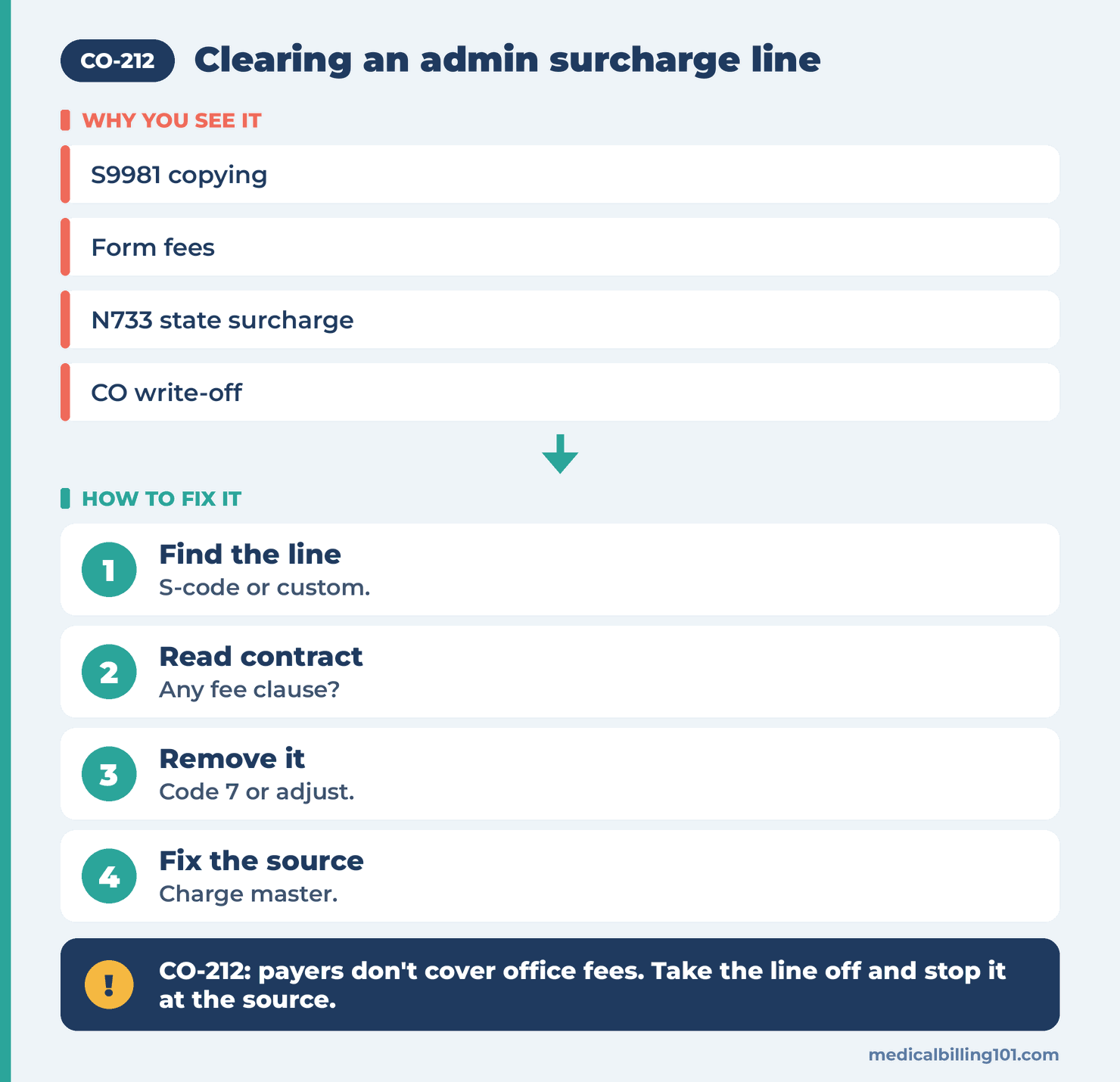
- Find the fee line. A fee line is any claim line that charges for paperwork rather than care. It is usually an S-code, a custom code or a 99080 special report line.
- Read your contract. Some workers’ compensation or legal record requests allow a fee, but a health plan contract rarely does.
- Decide: remove or write off. If the line should never have been billed, send a corrected claim without it. If your payer prefers, adjust it off with the CO-212 reason.
- Fix the source. A charge master rule or an add-on in the practice system usually created the line.
- Do not move it to the patient. CO means the contract bars it. Billing the patient can break that contract.
Records sent in response to a payer’s own request are part of the claim process. For example, a medical review request from the plan is not a billable event.
Example scenario (fictional names), part 2
How the CO-212 Denial Was Resolved
Priya checked the contract. It had no clause for record fees, and the payer’s provider manual said requested records are supplied at no charge.
Fix: She sent a corrected claim with frequency code 7 that showed only the 99213 line, and the original claim number in Box 22. The records team’s add-on that created S9981 for every outgoing chart was turned off for health plan requests.
Outcome: The claim closed with no open balance. Legal and life-insurance record requests still get billed to the requester, outside the claim.
Names and details are illustrative; no real patient data.
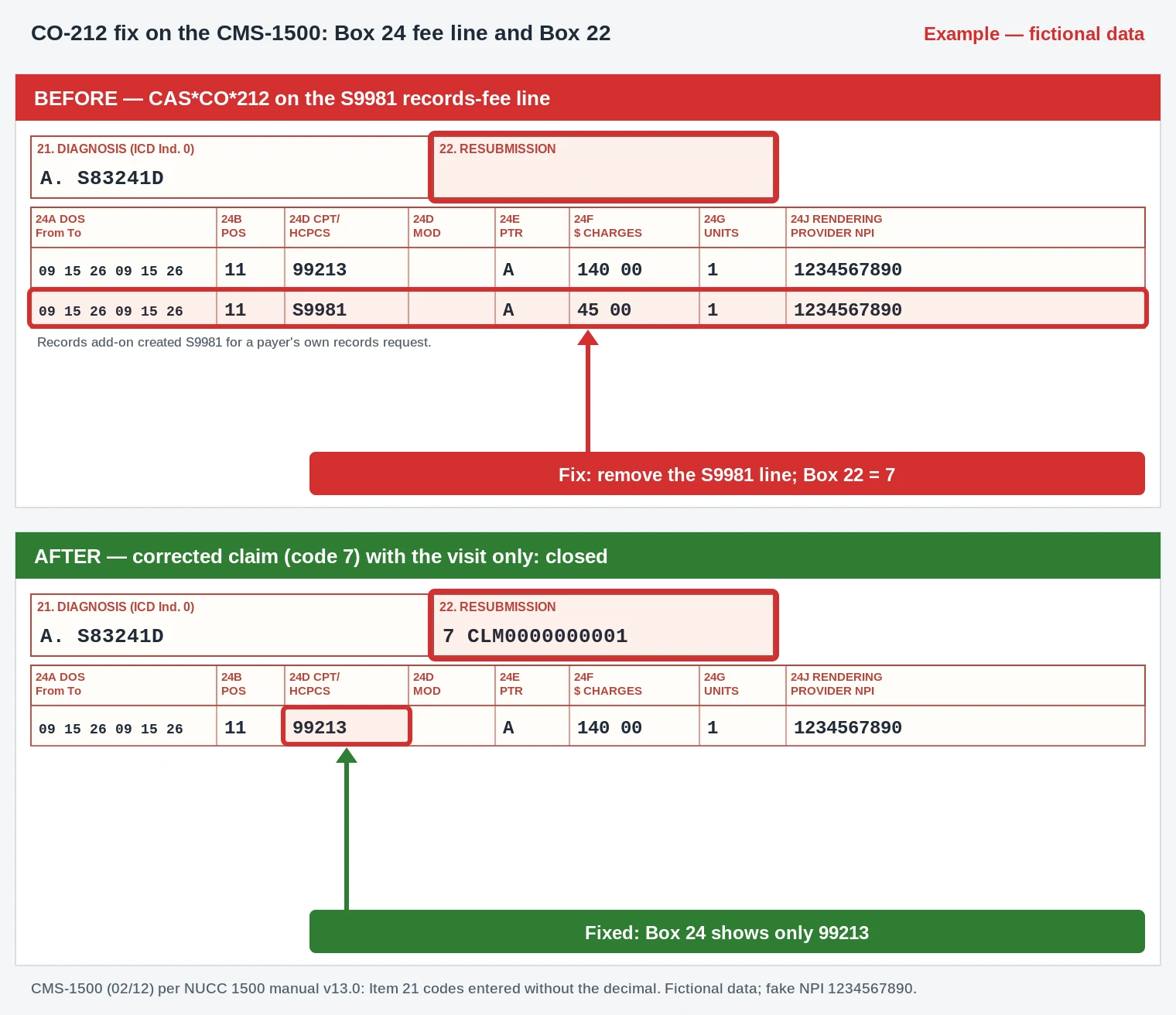
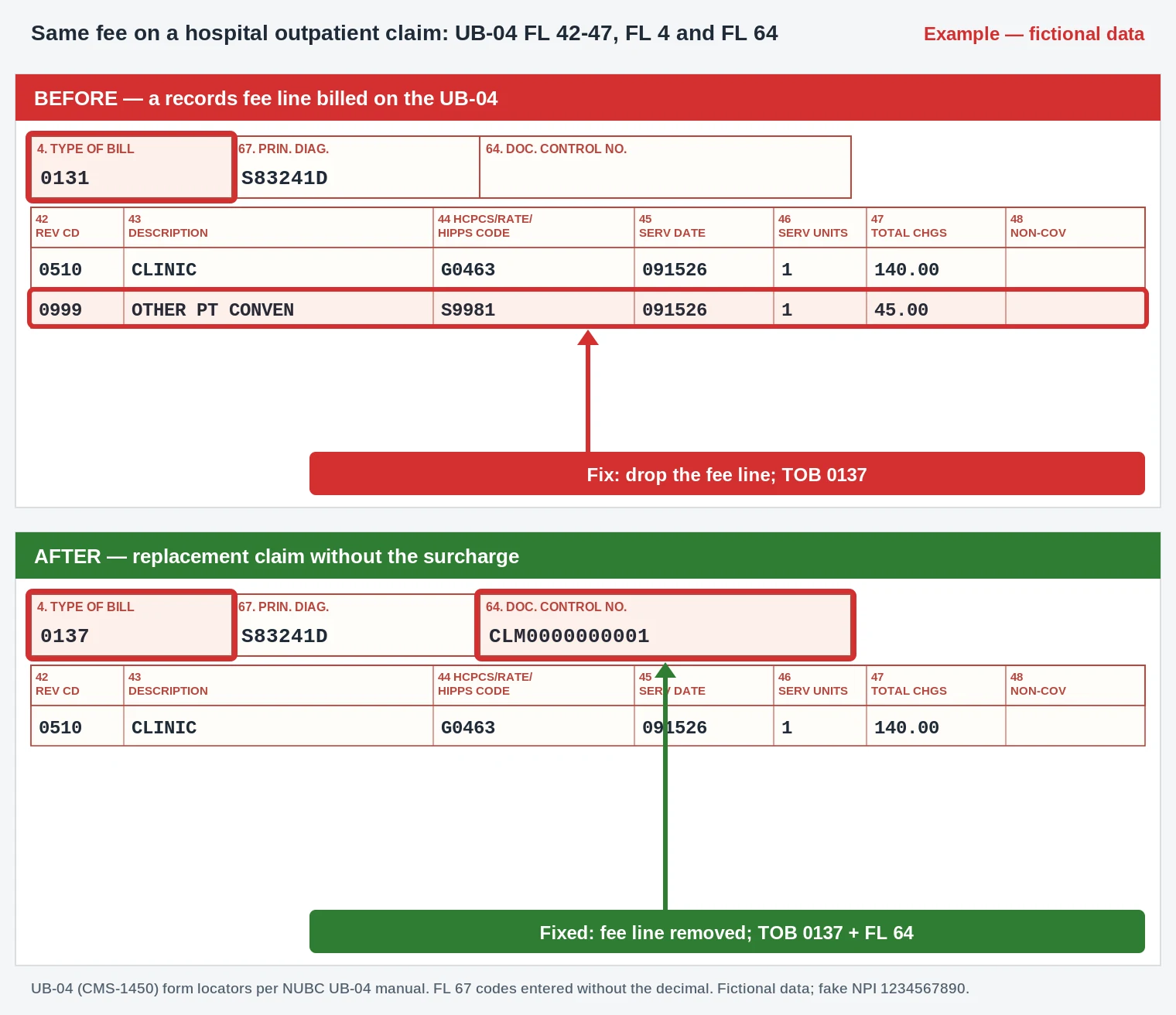
- Box 24 / FL 42-47: the S9981 records copying fee line removed from the claim.
- Box 22 / FL 4 + FL 64: frequency code 7 with the original claim number (type of bill 0137).
- Box 21 / FL 67: S83.241D (entered as S83241D) and the 99213 / G0463 visit are unchanged.
CO-212 and similar non-covered codes
| Code | Plain meaning | Who pays? |
|---|---|---|
| CO-212 | Admin surcharge not covered | Provider writes off |
| CO-96 | Non-covered charge | Depends on group code |
| CO-97 | Bundled into another service | Provider |
| CO-234 | Procedure not paid separately | Provider |
| CO-45 | Charge over the fee schedule | Provider |
Our claim denial statistics page shows how small denials add up across a year.
Preventing CO-212
- Keep record fees out of the claim stream. Bill them to the requester on an invoice.
- Review custom charge codes once a year. Old fees hang around.
- Set a claim scrubber rule that stops S9981 and similar codes for health plan claims. Our clearinghouse scrubbing setup guide shows how.
FAQ
What does CO-212 mean?
The payer does not cover administrative surcharges, such as record copying or handling fees.
Can I bill the patient for a CO-212 line?
No. With group code CO, the contract makes the provider responsible.
Should I remove the line or appeal?
Remove it or write it off unless your contract clearly allows the fee. An appeal rarely works for this code.
What is remark N733?
It says regulatory surcharges are paid directly to the state, so the payer sends that money to the state rather than to the provider.
Is S9981 ever payable?
Some payers may pay it under a specific contract or program, but most health plans do not. Check the contract first.
Sources
How we checked: each code quote on this page was matched word for word with the X12 CARC and RARC lists on 23 October 2026.
- X12, Claim Adjustment Reason Codes (CARC 212). Accessed 23 Oct 2026.
- X12, Remittance Advice Remark Codes (N733). Accessed 23 Oct 2026.
- CMS, HCPCS Level II codes. Accessed 23 Oct 2026.
- NUCC, 1500 Claim Form Reference Instruction Manual. Accessed 23 Oct 2026.
Last updated: 23 October 2026 · Educational content; not legal advice.
Related denial codes
- CO-256: Service Not Payable Per Contract
- N381: Consult Our Contractual Agreement
- CO-205: Pharmacy Discount Card Processing Fee
- PR-204: Not Covered Under the Patient’s Current Benefit Plan
- PR-202: Non-Covered Personal Comfort or Convenience Services
- CO-222: Provider Cap Explained
- CO-223: When a Law Sets the Payment
- CO-235: Sales Tax on the Remit