
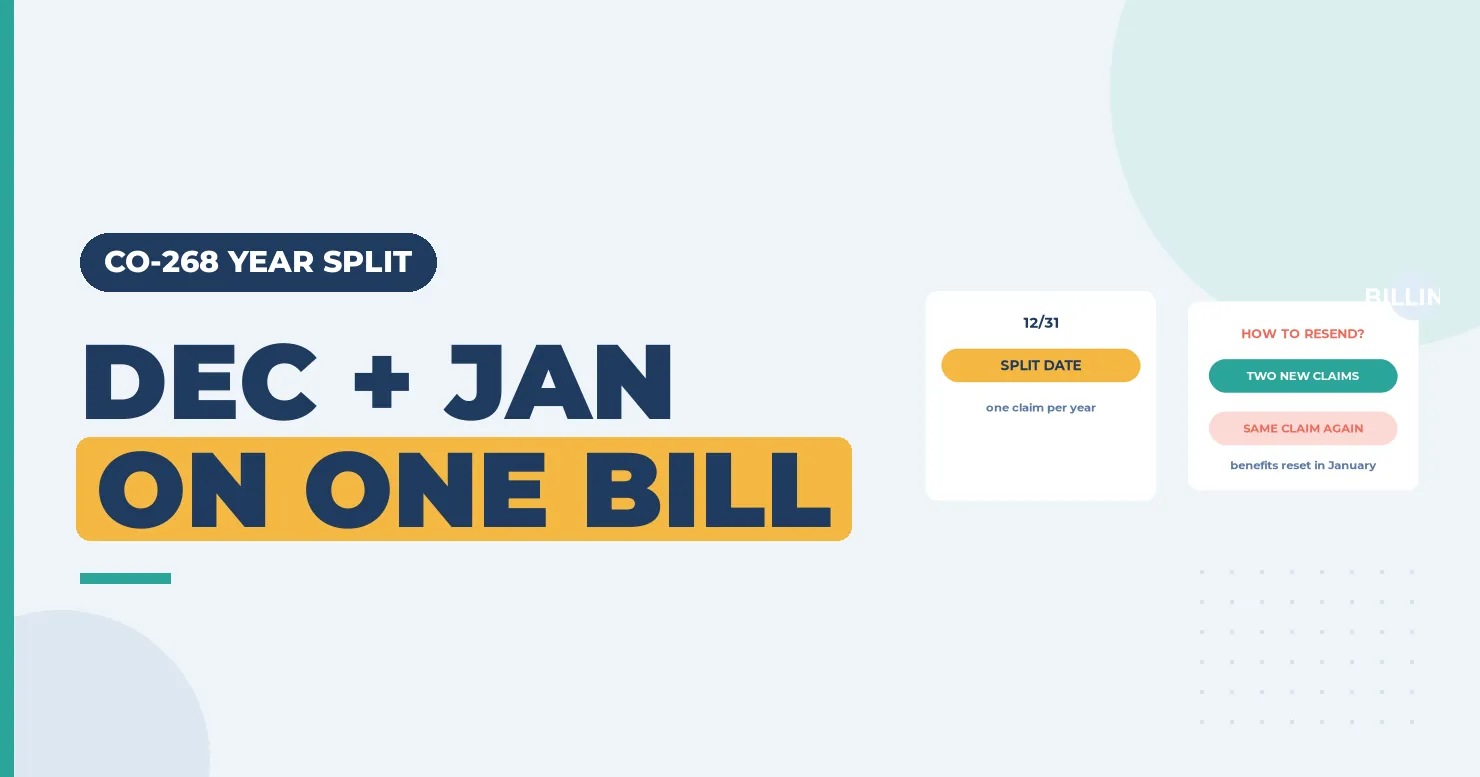
CO-268 shows up most in January. A claim was sent with services from late December and early January on the same bill. The payer needs each year on its own claim. Deductibles, out-of-pocket limits, fee schedules and benefit counts all reset on 1 January. One claim can’t sit in both years. (Primary source: X12 Claim Adjustment Reason Codes)
In brief: CARC 268 reads “The Claim spans two calendar years. Please resubmit one claim per calendar year.” Split the services at 31 December. Send one new claim for the old year and one for the new year, each with its own dates and charges.
Part of our denial codes library. Written by Manikandan J, CPC, CRCR, who has cleaned up January claim splits for therapy clinics and hospital outpatient departments. Published 24 October 2026. Last updated: 24 October 2026. Code wording quoted word for word from X12. Read about the author and our editorial policy, or contact us to report an error.
CARC 268 wording
| Field | Value |
|---|---|
| Code | 268 |
| Description | “The Claim spans two calendar years. Please resubmit one claim per calendar year.” |
| Start | 11/01/2014 |
Source: X12 Claim Adjustment Reason Codes, checked 24 October 2026.
Key terms: A CARC is a Claim Adjustment Reason Code from the X12 list, and it says why a line was paid differently than billed. A RARC is a Remittance Advice Remark Code that adds detail to the CARC. The group code is the two-letter prefix on the adjustment; CO means contractual obligation: the provider owns the balance and it cannot be billed to the patient.
Methodology: the code wording above is copied from the X12 list, and each fix step below links to the payer or CMS page it comes from.
Example scenario (fictional names), part 1
CO-268 Denial Example: What Happened
Owen Price bills for Bayside Rehab, a fictional outpatient therapy clinic. A patient had therapy on 29 December 2025 and 5 January 2026.
Both visits went out on one claim in mid-January. The remit showed CAS*CO*268 and nothing paid.
How does Owen get both visits paid? Keep reading, or jump to how the CO-268 denial was resolved.
Why the year line matters to payers
- Deductibles reset. For example, the deductible met in December does not carry into January for most plans.
- Out-of-pocket limits reset. The out-of-pocket maximum starts again each plan year.
- Fee schedules change. New rates, codes and edits usually start on 1 January.
- Visit limits reset. Therapy and other benefit counts start over.
- Batch habits. Clinics that bill a series of visits at once are most likely to cross the line.
Splitting a claim at 31 December
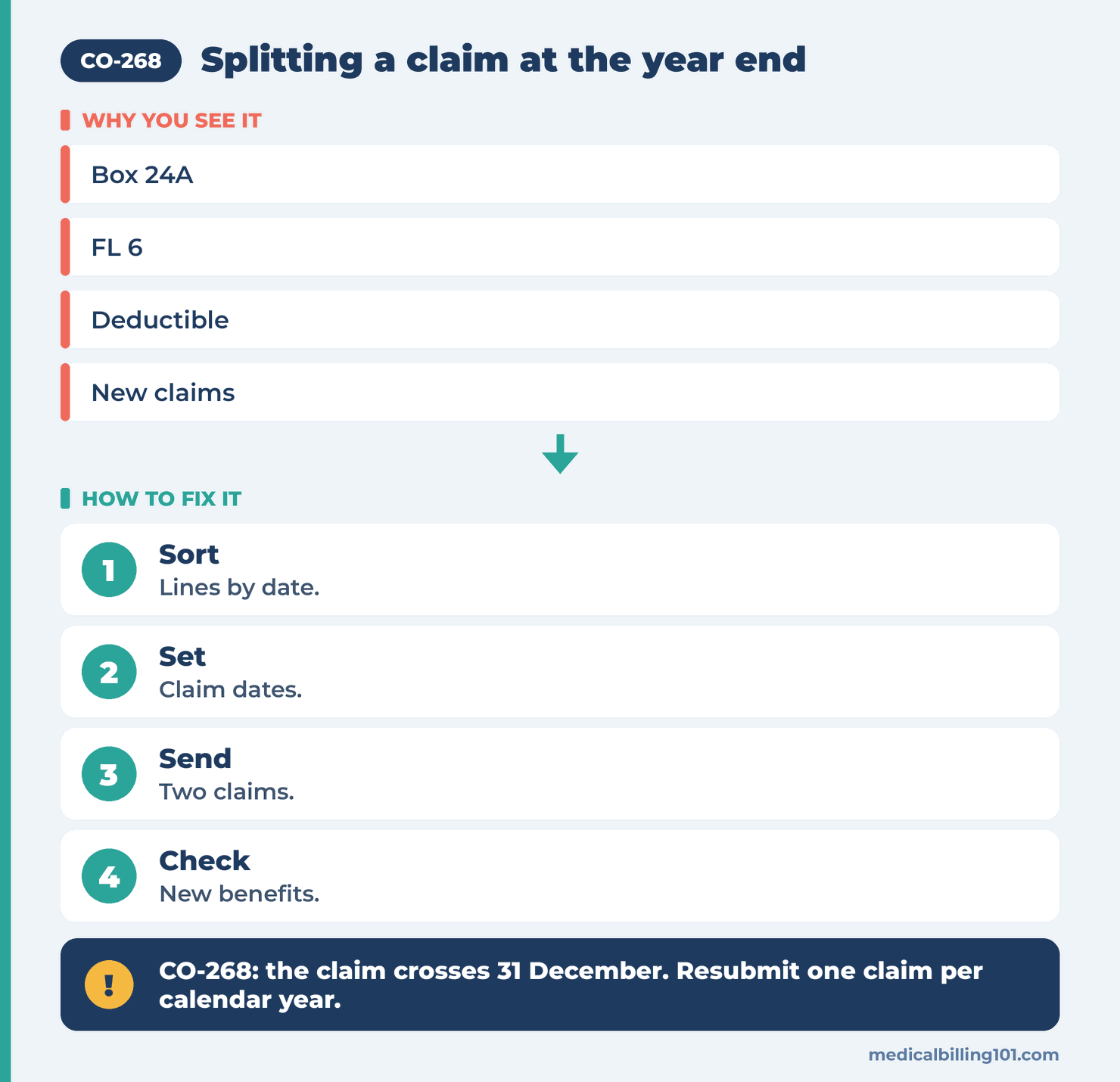
- Sort lines by date. Put December lines on one claim and January lines on another.
- Set claim dates. On the UB-04, FL 6 must stay inside one year on each claim. On the CMS-1500, each Box 24A date belongs to that claim’s year.
- Send new claims. Because the original was denied, most payers want two new claims, not a corrected one. Check the payer’s rule.
- Check the new year’s benefits. Verify the deductible, copay and visit limit for January.
- Add a year-end check. Hold series billing so no claim crosses 31 December.
Line dates on the CMS-1500 follow the NUCC instructions. Facility statement periods follow the NUBC UB-04 manual.
Example scenario (fictional names), part 2
How the CO-268 Denial Was Resolved
Owen pulled the denied claim and split it by year.
Fix: He sent one new claim for the 29 December 2025 visit and another for the 5 January 2026 visit. The hospital-based clinic did the same on its UB-04, with FL 6 inside each year.
Outcome: Both visits paid. The January visit went toward the patient’s new deductible. The clinic now closes series billing on 31 December.
Names and details are illustrative; no real patient data.
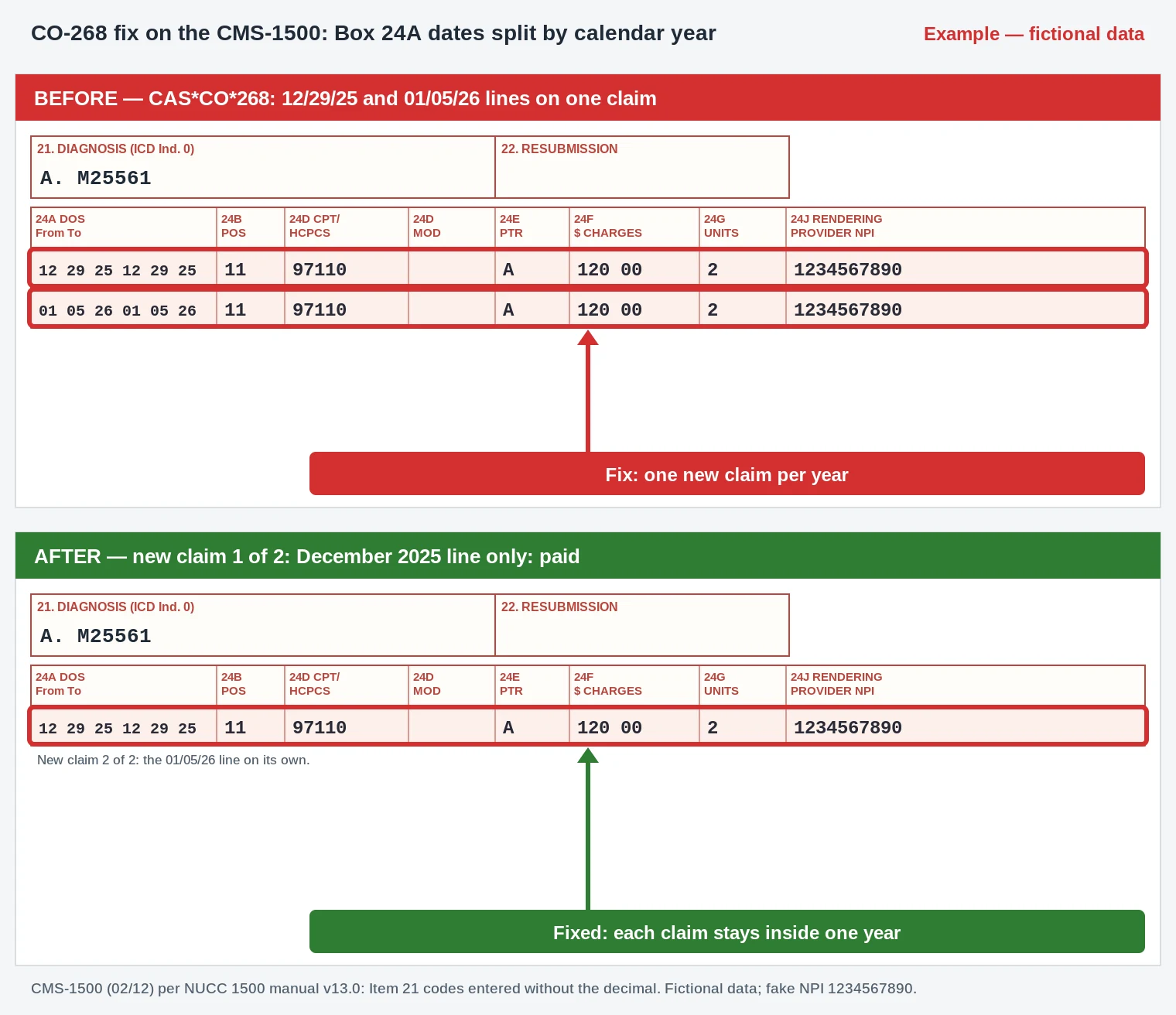
- Box 24A: the 12/29/25 line on new claim 1 and the 01/05/26 line on new claim 2.
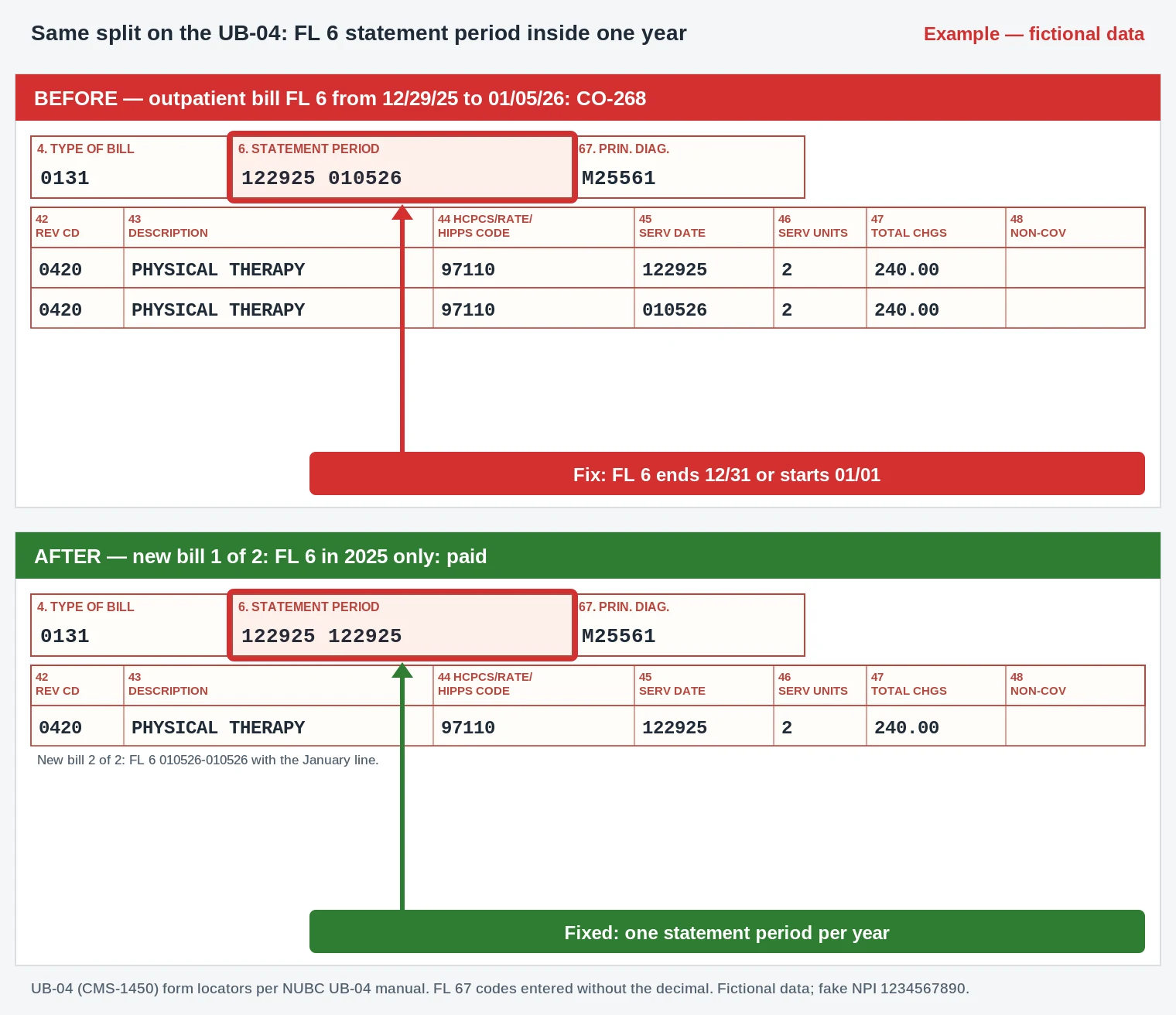
- FL 6: 12/29/25 to 12/29/25 on bill 1 and 01/05/26 to 01/05/26 on bill 2.
- Box 22 / FL 4: left as new claims (0131), because the original was denied, not paid.
- Box 21 / FL 67: M25.561 (entered as M25561) is unchanged on both claims.
- Benefits: the January claim applies to the new year’s deductible.
CO-268 vs other date edits
| Code | Problem | Fix |
|---|---|---|
| CO-268 | Crosses calendar years | One claim per year |
| CO-267 | Crosses months | One claim per month |
| CO-29 | Filed too late | Timely filing proof |
| CO-16 | Claim data missing | Add the missing item |
FAQ
What does CO-268 mean?
The claim has dates in two calendar years, and the payer wants a separate claim for each year.
Do I send a corrected claim for CO-268?
Usually not. The first claim was denied, so most payers want two new claims. Follow the payer’s guidance.
Does CO-268 happen on CMS-1500 claims?
Yes. A claim with lines dated in both December and January can be denied.
Why is the year so important?
Deductibles, out-of-pocket limits, fee schedules and visit counts all reset on 1 January for most plans.
Can the patient be billed for CO-268?
No. It is a billing format issue for the provider to fix.
Sources
How we checked: the code quote on this page was matched word for word with the X12 CARC list on 24 October 2026.
- X12, Claim Adjustment Reason Codes (CARC 268). Accessed 24 Oct 2026.
- NUCC, 1500 Claim Form instructions. Accessed 24 Oct 2026.
- HealthCare.gov, Deductible. Accessed 24 Oct 2026.
- NUBC, National Uniform Billing Committee. Accessed 24 Oct 2026.
Last updated: 24 October 2026 · Educational content; not legal advice.
Related denial codes
- CO-273: Coverage Guidelines Exceeded
- CO-222: Provider Cap Explained
- CO-154: Information Submitted Does Not Support This Day's Supply
- CO-153: Information Submitted Does Not Support This Dosage
- CO-152: Information Submitted Does Not Support This Length of Service
- CO-151: Frequency or Units of Service Not Supported
- CO-150: Information Submitted Does Not Support This Level of Service
- PR-149: Lifetime Benefit Maximum Reached