
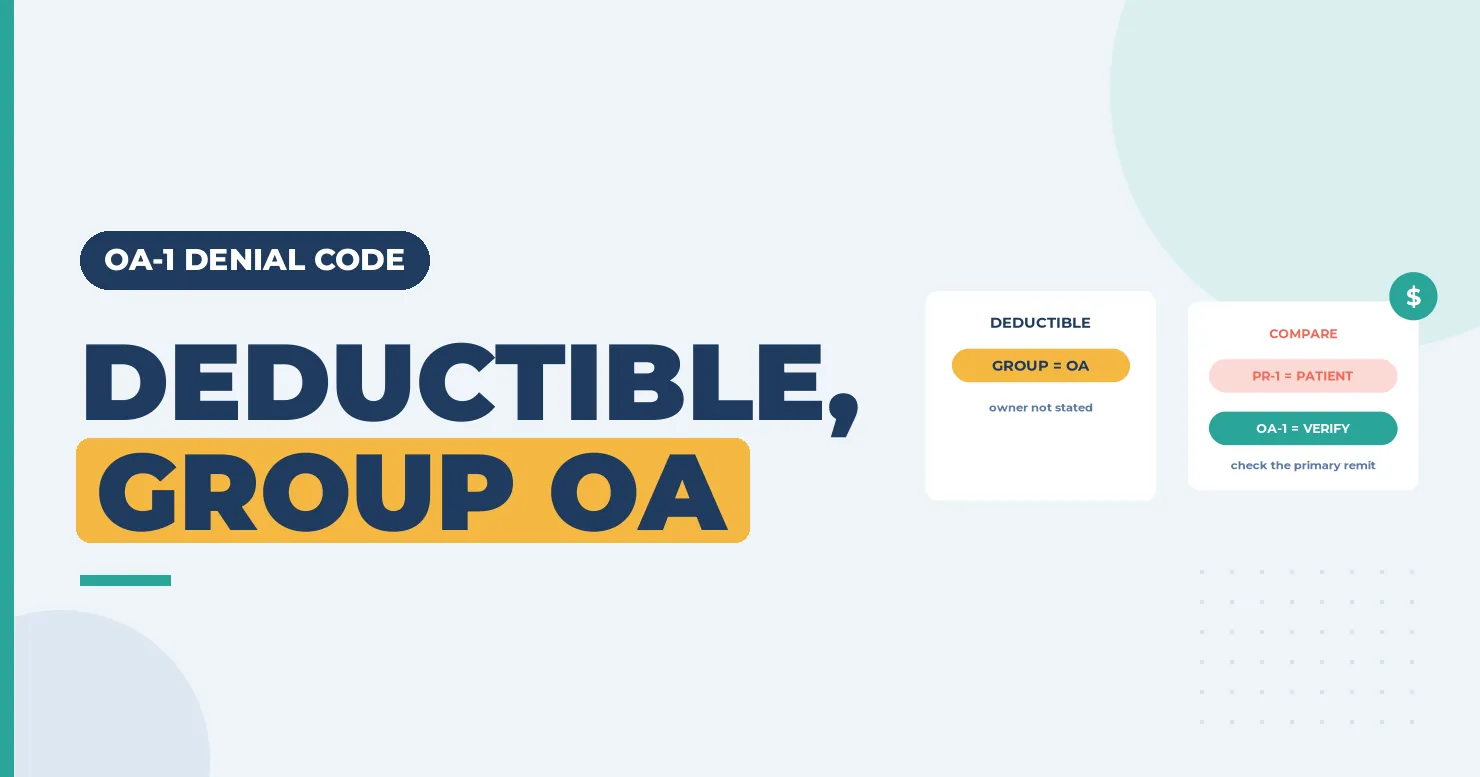
OA-1 is Claim Adjustment Reason Code 1 with group code OA. CARC 1 is the deductible reason code. OA means Other Adjustment. The deductible usually comes back as PR-1 and the amount belongs to the patient. When the same reason comes back under OA, the remit does not say who owns the money. You have to work that out before you post it or bill anyone. Many people search for “oa 1 denial code”, and that is the phrase this page answers. (Primary sources: X12 Claim Adjustment Reason Codes · X12 Claim Adjustment Group Codes · CMS Claims Processing Manual, Ch. 22, §60.1)
Quick answer: OA-1 is not a denial. It is a deductible amount filed under “Other Adjustment.” Do not bill the patient from the OA-1 line alone. Compare it with the primary payer’s remit and the patient’s benefit details. Then decide if it is patient deductible, a contract adjustment, or an amount a prior payer already handled.
Part of our denial codes library. Written by Manikandan, a revenue cycle management specialist with more than 10 years of US medical billing experience. Last reviewed: 16 October 2026. Official code wording is quoted word for word from X12; Medicare rules link to their CMS source.
OA-1 denial code description (official X12 wording)
X12 Claim Adjustment Reason Code 1, verbatim:
“Deductible Amount”
Source: X12 Claim Adjustment Reason Codes, checked 16 October 2026. Start: 01/01/1995. X12 lists no later “Last Modified” date and no group code restriction for this code.
The group code is a separate field. X12 lists OA as “Other Adjustment.” CMS Claims Processing Manual, Ch. 22, §60.1 says OA “shall be used when no other group code applies to the adjustment.”
What OA-1 means in plain English
- The reason is clear. A deductible amount was applied to the claim or line. For example, the plan may have counted part of the allowed amount toward the annual deductible.
- The owner is not clear. The group code tells you who carries the amount. OA says only “other.”
- PR-1 is the usual pairing. CMS says the PR group “would typically be used for deductible and copay adjustments.”
- OA-1 is the exception. Treat it as a line to check, not a line to post on autopilot.
- It is not a coverage decision. The service may have paid, paid in part, or moved into cost-sharing, such as deductible and coinsurance.
OA-1 vs PR-1, CO-1, OA-23 and lookalikes
| Code | Official X12 idea | What it tells you |
|---|---|---|
| OA-1 | Deductible Amount, group OA | Deductible with no stated owner. This page |
| PR-1 | Deductible Amount, group PR | Patient (or a secondary plan) owes it. See PR-1, PR-2 and PR-3 |
| CO-1 | Deductible Amount, group CO | Contract write-off. See CO-1 |
| 281 | Deductible waived per contractual agreement (CO only) | Plan waived the deductible by contract |
| 66 | Blood Deductible | A separate blood deductible |
| OA-23 | Impact of prior payer adjudication (OA only) | Prior payments and adjustments on a secondary remit. See OA-23 |
| OA-18 | Exact duplicate claim/service | A duplicate, not a deductible. See OA-18 |
Why group codes matter for a deductible
CMS Ch. 22 §60.1 defines the three groups used on Medicare remits:
- CO (Contractual Obligations): adjustments that are “generally… considered a write off for the provider and are not billed to the patient.”
- PR (Patient Responsibility): an amount that “may be billed to the patient or insured.”
- OA (Other Adjustments): used “when no other group code applies.”
X12’s own guidance for secondary claims draws the same lines. In its Coordination of Benefits example, remaining patient responsibility goes under PR. Prior payer payments and adjustments (other than patient responsibility) go under OA with CARC 23. Extra contractual write-offs go under CO. A deductible filed under OA does not match any of those three jobs. That is why it needs a second look.
What to rule out when you see an OA-1 line
X12 does not say why a payer picks OA for a deductible. So confirm each case on your own remit. These are the questions worth answering:
- Did a prior payer already handle it? On a secondary claim, compare the amount with the primary remit.
- Does the patient owe it? Check the benefit details and the remaining deductible. If the patient owes it, the remit should have said PR-1.
- Does a Medicare rule limit what you can charge? Consider the case of a patient with group health plan coverage. CMS Medicare Secondary Payer rules limit what you can charge a beneficiary when a group health plan paid, or could have paid, an amount that covers the deductible or coinsurance.
- Did the contract waive it? If so, CARC 281 with group CO is the cleaner pairing.
Where OA-1 shows up in the 835
CLP*PCN55120*2*300.00*60.00*0.00*12*CLAIM778123~
SVC*HC:99214*300.00*60.00**1~
CAS*CO*45*100.00~
CAS*OA*1*140.00~
- The line paid $60.
- CAS*CO*45*100.00 is a contractual reduction.
- CAS*OA*1*140.00 is a deductible amount filed under OA, so the owner is open.
- This sample is illustrative only. Real remits vary. Save the full CAS segments and any remark codes.
How to handle OA-1: decision path
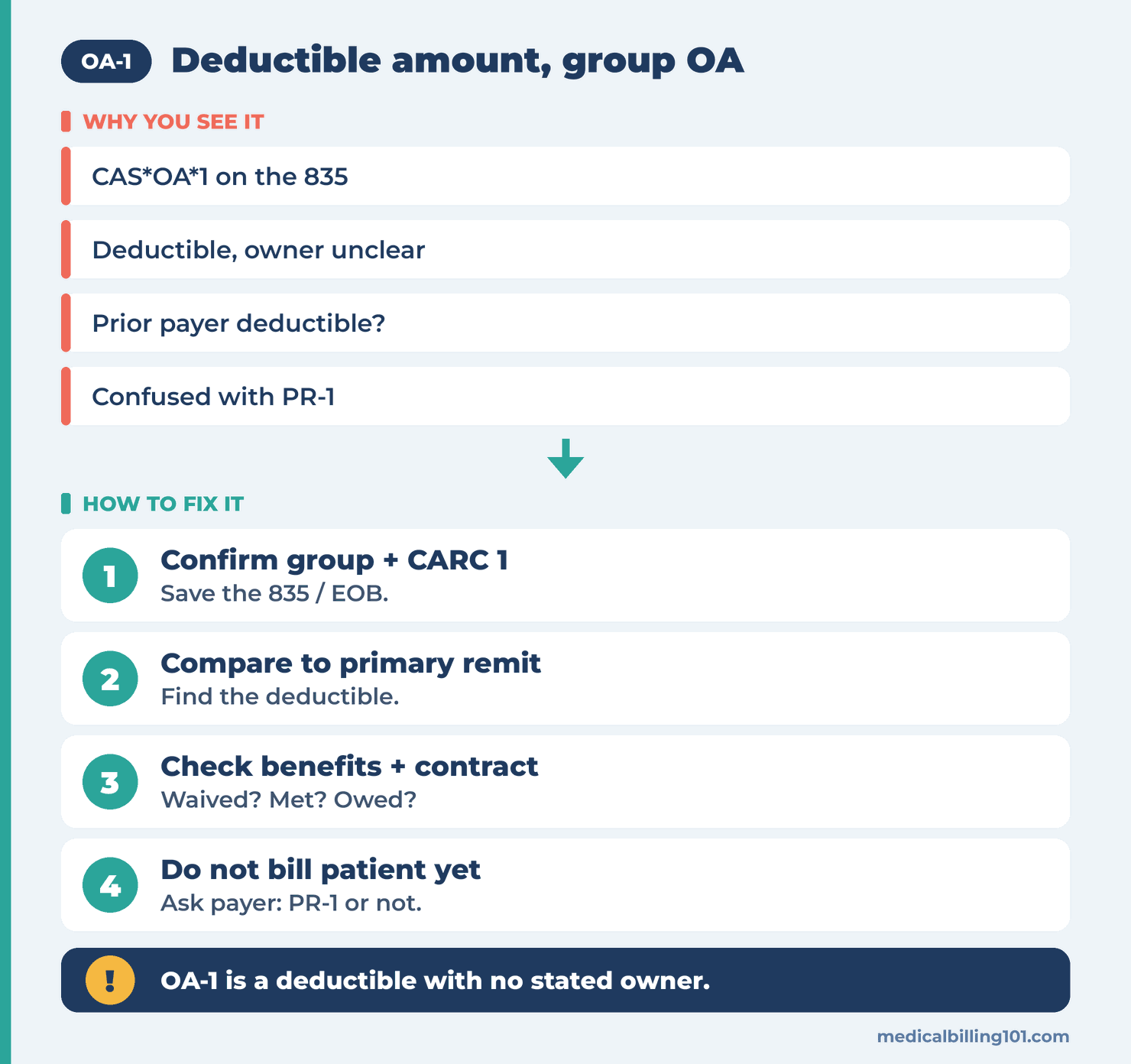
- Confirm the CAS segment. Check the group code (OA), the reason (1), and the dollar amount. Save the 835 or EOB.
- Check for a prior payer. If another plan paid first, open its remit. Find the deductible it applied.
- Check eligibility. Look at the remaining deductible and the plan year on the portal or the 271 response.
- Check the contract. See whether the plan waived or absorbed the deductible. If it did, CARC 281 with group CO is the cleaner X12 pairing.
- Decide the owner. Patient, secondary payer, or provider write-off. Write the reason in the account notes.
- Do not bill the patient until the owner is clear. For Medicare, review CMS MSP Manual Ch. 3, §10.1 first when a group health plan was involved.
- Ask the payer to correct the group code if the amount is a patient deductible filed under OA. Ask for a corrected remit or a written explanation.
- Post only what you verified. Move the amount to the patient, the secondary claim, or a contractual adjustment. Do not leave it as an unexplained write-off.
Medicare, commercial and Medicaid notes
Medicare. CMS lists CO, OA and PR as the valid group codes on Medicare remittances. If you see OA-1 on a Medicare remit, compare it with the primary payer’s payment and the MSP data on file.
Commercial. Ask the payer to explain in writing why it used OA for a deductible. Keep the answer with the account notes.
Medicaid. State plans may set their own remit rules. Check the state companion guide before you adjust the account.
Worked example (illustrative)
A patient has two commercial plans. The primary plan applied a $140 deductible. The secondary remit shows CAS*OA*1*140.00 on the same line.
Reading it: The payer named the deductible but not the owner.
Check: The primary remit shows the same $140 as PR-1. The secondary plan paid $60 on the line.
Action: The biller does not send a patient statement for the $140. The biller posts the secondary payment. Then the biller asks the secondary payer which group code applies and why it used OA. The $140 stays on hold until the written answer arrives.
Second scenario: The patient has only one plan. The booklet shows a $500 deductible not yet met. The remit shows OA-1 for $140. Here the amount looks like a true patient deductible. The biller asks the payer for a corrected PR-1 remit before billing.
Prevention checklist
- [ ] Read the group code on every deductible line before posting.
- [ ] Route every OA-1 line to a short review queue, not auto-posting.
- [ ] Keep the primary remit attached to every secondary claim.
- [ ] Track which payers send OA-1 and how they answer your questions.
- [ ] Do not mix OA-1 with OA-23 or OA-18.
- [ ] Keep the CARC and RARC guide handy for staff training.
Related denial codes
- CO-1: the same deductible reason under group CO.
- PR-1, PR-2 and PR-3: the usual patient cost-sharing trio.
- OA-23: prior payer impact on a secondary remit.
- CO-45: the charge exceeds the fee schedule or contract.
- CARC and RARC guide.
Key takeaways
OA-1 means a deductible amount filed under “Other Adjustment.” The reason is clear, but the owner is not. Check the primary remit and the contract. Do not bill the patient from the OA-1 line alone.
FAQ
What is the OA-1 denial code description?
X12 describes CARC 1 as “Deductible Amount.” OA-1 is that reason with group code OA, which CMS says is used when no other group code applies.
Is OA-1 the same as PR-1?
No. Both name a deductible. PR-1 puts the amount in the patient responsibility group. OA-1 puts it in the “Other Adjustment” group, so you must confirm who owns it.
Can I bill the patient for OA-1?
Not from the OA-1 line alone. Confirm the deductible on the benefit details and the primary remit. If the patient owes it, ask the payer for a PR-1 correction first.
Is OA-1 a denial?
No. It is a deductible adjustment. The line may have paid, paid in part, or moved fully into cost-sharing.
Why would a payer send OA-1 instead of PR-1?
X12 does not give a reason. It may be a mapping choice, a prior payer’s deductible, or an error. Ask the payer to explain the group code in writing.
How is OA-1 different from CO-1?
CO-1 is the deductible reason under the contractual group. CMS says CO amounts are generally a provider write-off. OA-1 carries no stated owner.
Quick facts
| Item | Value |
|---|---|
| X12 code | 1 |
| X12 start | 01/01/1995 |
| Last modified | None listed |
| Official wording | Deductible Amount |
| Group code | OA (Other Adjustment) |
| Usual deductible pairing | PR-1 |
| Last reviewed | 16 October 2026 |
Sources
- X12, Claim Adjustment Reason Codes (CARC 1, 23, 45, 66, 281). CARC 1 Start 01/01/1995. Accessed 16 Oct 2026.
- X12, Claim Adjustment Group Codes. CO, OA, PI, PR listed. Accessed 16 Oct 2026.
- X12, Example 07: Coordination of Benefits. Accessed 16 Oct 2026.
- CMS, Medicare Claims Processing Manual (IOM 100-04), Ch. 22, §60.1 Group Codes. Accessed 16 Oct 2026.
- CMS, Medicare Secondary Payer Manual (IOM 100-05), Ch. 3, §10.1. Accessed 16 Oct 2026.
- Medical Billing 101, CO-1 guide.
Code wording and Medicare rules on this page were checked on 16 October 2026 against X12 and CMS sources.
Last reviewed: 16 October 2026 · This page is educational and doesn’t replace payer-specific contracts or coding rules.
Related denial codes
- PR-1, PR-2 and PR-3: Deductible, Coinsurance and Copay (Patient Responsibility)
- CO-1: Deductible Amount (When the Group Code Is CO)
- PR-2: Coinsurance Amount (Patient Responsibility)
- OA-2: Coinsurance Amount With Group Code OA
- CO-2: Coinsurance Amount (When the Group Code Is CO)
- PR-3: Copay Amount, Posting and Refunds
- CO-3: Co-payment Amount (When the Group Code Is CO)
- PR-66: Blood Deductible the Patient Owes