
The PR-18 denial code means the payer treated a claim or line as an exact duplicate and put the amount under patient responsibility. The fix is to check whether the first claim already paid, then hold the patient bill. If the service was truly repeated, send a corrected claim with the right modifier. (Primary source: X12 Claim Adjustment Reason Codes)
In brief: reason code 18 reads “Exact duplicate claim/service (Use only with Group Code OA except where state workers’ compensation regulations requires CO)”. X12 does not list PR for this code. So a PR-18 line is a payer labeling issue, and the duplicate amount should not go to the patient.
Part of our denial codes library. Written by Manikandan J, CPC, CRCR, who has worked duplicate-claim denials for lab, oncology and hospital outpatient billing teams. Published 3 November 2026. Last updated: 3 November 2026. Code wording quoted word for word from X12. Read about the author and our editorial policy, or contact us to report an error.
What does denial code PR-18 mean?
Denial code PR-18 means the payer matched this claim or line to one it already received. The match uses the same patient, date, code, units and charge. PR tells you the payer assigned the line to the patient. For a duplicate, that label is almost always wrong, because the patient did not cause a second bill.
| Field | Value |
|---|---|
| Code | 18 |
| Description | “Exact duplicate claim/service (Use only with Group Code OA except where state workers’ compensation regulations requires CO)” |
| Allowed groups | OA, or CO for state workers’ compensation |
| Start | 01/01/1995 |
| Last modified | 06/02/2013 |
Source: X12 Claim Adjustment Reason Codes, checked 3 November 2026.
Methodology: the code wording is copied from the X12 lists, and the form fields come from the NUCC and CMS manuals cited below.
Key terms: A CARC is a Claim Adjustment Reason Code that says why a line paid differently than billed. A group code is the two-letter prefix, such as PR for patient responsibility or OA for other adjustment. An exact duplicate is a line that repeats an earlier one in every key field.
PR-18 vs OA-18 vs CO-18: what is the difference?
PR-18, OA-18 and CO-18 share one reason: the payer saw a duplicate. Only the group differs. OA-18 is the standard form. CO-18 is allowed only where a state workers’ comp rule needs it. PR-18 falls outside the X12 note, so treat it as a group-code error.
| Version | Who the payer says owns it | What you do |
|---|---|---|
| OA-18 | Nobody; it is an informational duplicate | Track the original claim |
| CO-18 | Provider, under state workers’ comp rules | Write off or correct the repeat |
| PR-18 | Patient, which conflicts with the X12 usage note | Hold the statement and ask the payer to fix the group |
In my AR work, a PR-18 line once pushed a small lab charge onto a statement before anyone read the remit. Catch it in posting, not after the patient calls.
Why do payers send a duplicate as PR?
Payers send PR-18 when their duplicate edit copies the group code from the original line. If the first line had coinsurance, the repeat can inherit PR. Some plans also default every denial on a member-level edit to PR. Either way, the X12 note for code 18 limits it to OA, with CO only for state workers’ comp.
Common triggers we see, for example in lab and imaging billing:
- A claim was resent before the first one finished processing.
- A repeat lab test, X-ray or procedure was billed without a repeat modifier.
- A clearinghouse rejected a batch, and the office resent claims the payer had already accepted.
- Two providers in one group billed the same service for the same visit.
Example scenario (fictional names), part 1
PR-18 Denial Example: What Happened
Marisol Ortega is the billing lead at Lakeview Oncology Associates, a fictional cancer clinic. A patient on chemotherapy had a CBC, CPT 85025, drawn before her infusion. She ran a fever that afternoon, and the nurse drew a second CBC at 3:40 PM.
The claim listed 85025 twice for the same date, both with no modifier. The 835 paid the first line. The second line came back with CAS*PR*18*32.00 and remark M86, “Service denied because payment already made for same/similar procedure within set time frame.”
The $32 had already moved to the patient’s statement queue.
Was the second CBC really a duplicate, and who should pay for it? Keep reading, or jump to how it was resolved. Keep reading, or jump to how the PR-18 denial was resolved.
Can I bill the patient for a PR-18 denial?
No, not until you prove the patient truly owes it. A duplicate means the payer already handled the service once. If the first claim paid, the second has no balance to collect. If the service was a real repeat, the payer owes it after a corrected claim. Billing the patient first creates refunds and complaints.
Our posting rule is simple. Any PR line with reason code 18 goes to a hold queue, not to the statement. A biller reviews it within two business days.
How do I fix a PR-18 denial?
To fix a PR-18 denial, find the original claim, decide whether the service was repeated, then correct or close the line. Do not send a new copy of the same claim. A new copy usually earns another duplicate denial and can delay the timely filing clock you need for a real appeal.
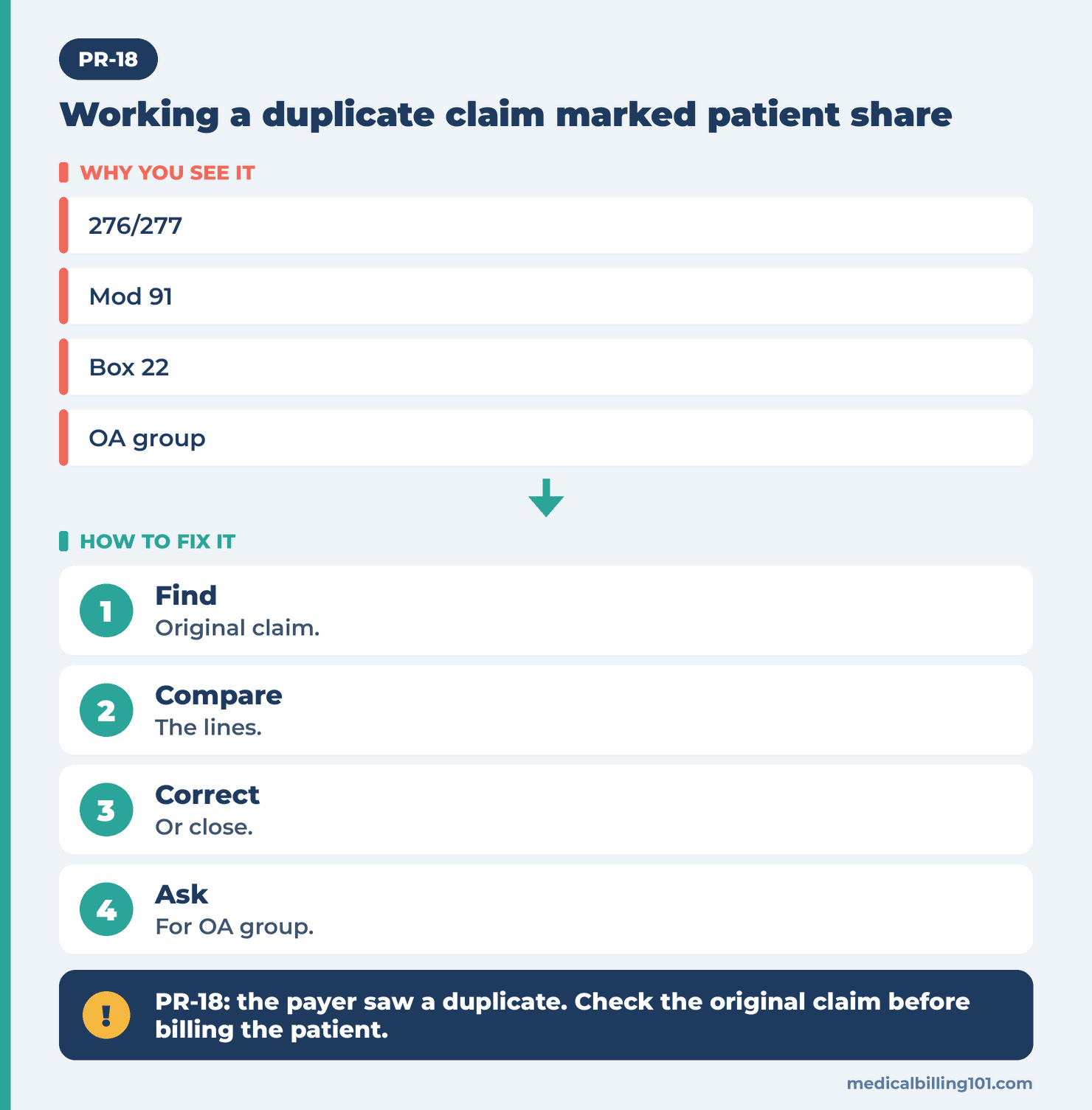
- Find the original claim. Search the payer portal or a 276/277 claim status check for the same patient and date.
- Compare the lines. Match the CPT or HCPCS code, units, modifiers and charge between both claims.
- Close a true duplicate. If the original paid, post the repeat as a zero-balance adjustment and remove it from the patient bill.
- Correct a real repeat. Send a corrected claim with frequency code 7 and the original claim number in Box 22 (NUCC 1500 claim form instructions).
- Ask for the group fix. Tell the payer that X12 restricts code 18 to OA, and request a reprocessed remit.
When is a repeat service not a duplicate?
A repeat service is not a duplicate when it was performed again for a separate medical reason on the same day, for example a second draw after a fever. The claim must show that with a modifier. Without one, the payer’s edit sees two identical lines and denies the second. The notes must support the second time, place or side.
| Situation | Modifier | Example |
|---|---|---|
| Repeat lab test, same day | 91 | Second CBC after a fever |
| Repeat procedure, same physician | 76 | Second chest X-ray after a line placement |
| Repeat procedure, another physician | 77 | Second ECG read by a different cardiologist |
| Same service, other side | RT / LT or 50 | Knee injection on both knees |
Modifier 91 is for a repeat clinical lab test done to get new results. The CPT definition excludes reruns to confirm a result or to replace a bad specimen.
Example scenario (fictional names), part 2
How the PR-18 Denial Was Resolved
Marisol pulled both lab results. The first CBC printed at 8:10 AM and the second at 3:40 PM, with a fever note in between. The test was a real repeat ordered for a new reason.
Fix: she sent a corrected claim with frequency code 7 and the original claim number in Box 22. She added modifier 91 to the second 85025 line and pointed it to the fever diagnosis R509.
Outcome: the payer paid the second CBC at the contract rate. Marisol removed the $32 from the patient statement. The payer’s provider rep also agreed the duplicate edit should report OA, not PR, and logged a ticket.
Names and details are illustrative; no real patient data.
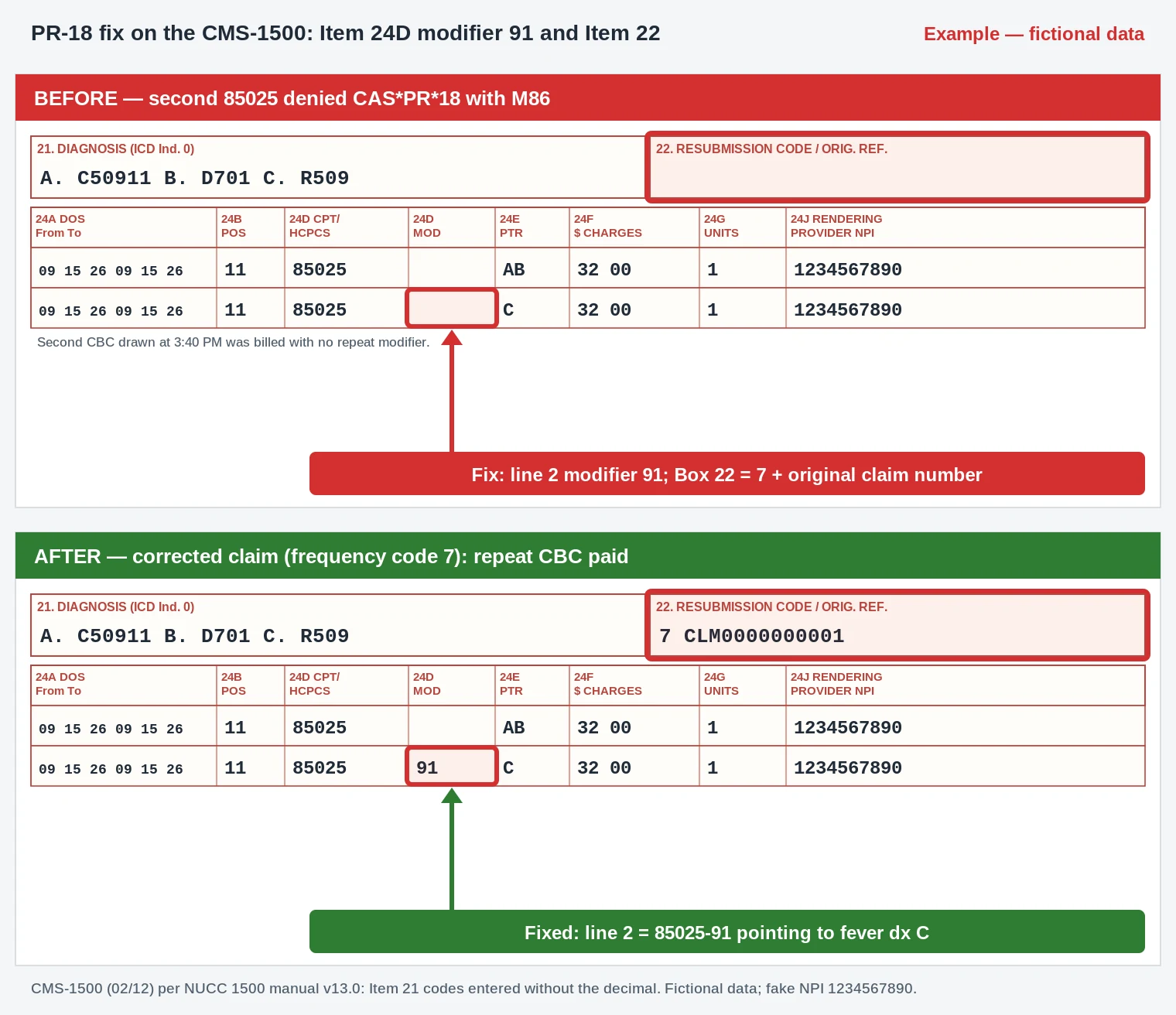
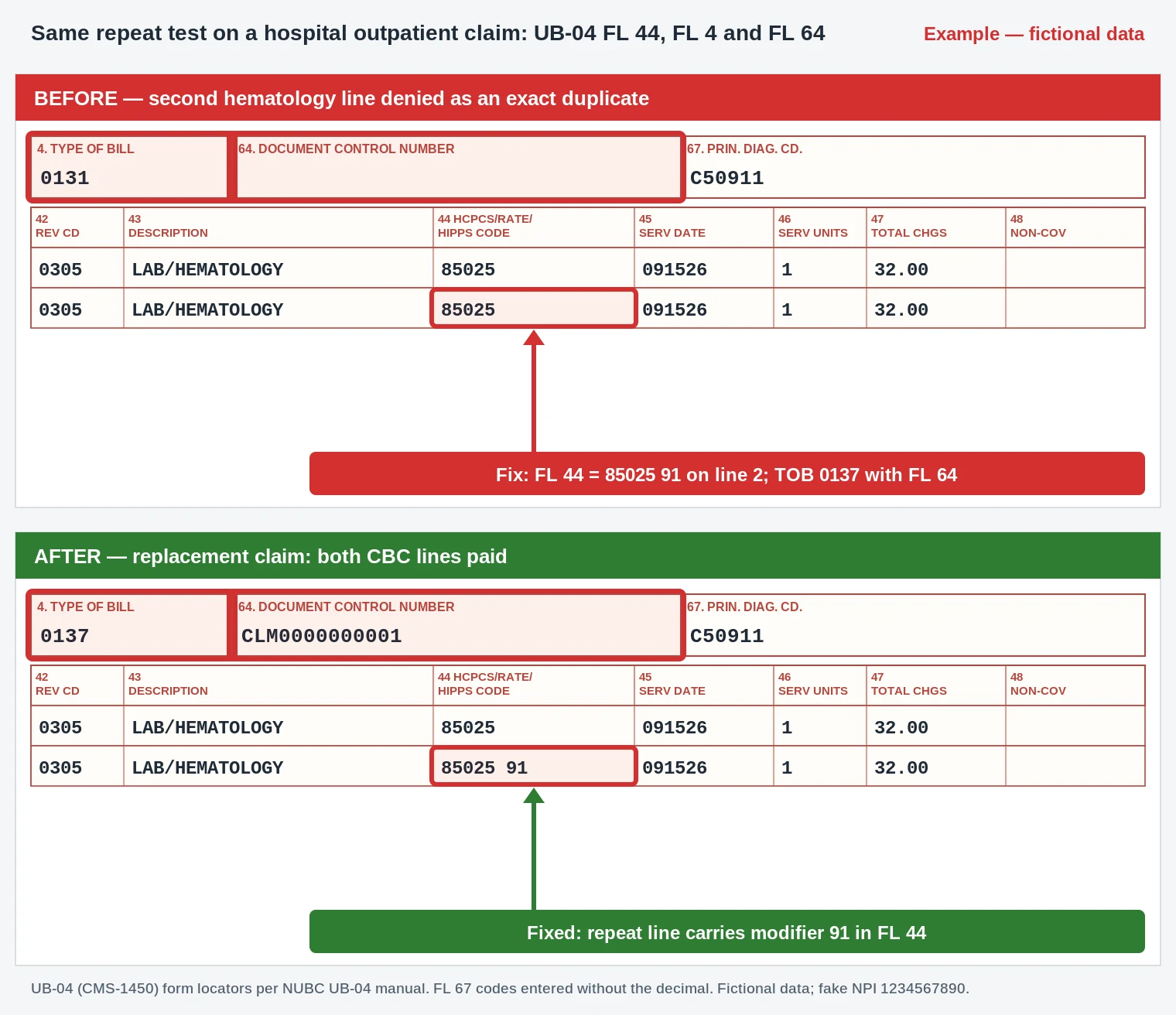
- Box 24D / FL 44: modifier 91 added to the second 85025 line, because the afternoon CBC was a new test for a new reason.
- Box 24E: line 2 points to diagnosis C, R50.9 (entered as R509), the fever that prompted the repeat draw.
- Box 22 / FL 4 + FL 64: frequency code 7 with the original claim number (bill type 0137 on the UB-04).
- Box 21 / FL 67: C50.911 (entered as C50911) and D70.1 (entered as D701) are unchanged.
How do I prevent duplicate claim denials?
You prevent duplicate claim denials by checking claim status before resending and by coding real repeats at charge entry. Most duplicate denials we fix come from a resend, not a true double bill. A short scrubber rule and a resend checklist stop most of them before they reach the payer.
- Wait for the 277CA acceptance report before resending any claim.
- Run a 276/277 status check if a claim is older than 30 days with no remit.
- Add a scrubber edit for the same code twice on one date with no 76, 77 or 91 modifier.
- Use a corrected claim, frequency code 7, for any change to a processed claim.
- Post every PR-18 and OA-18 line to a hold queue, never straight to the patient.
Related codes
| Code | Meaning |
|---|---|
| OA-18 | Same duplicate reason, standard OA group |
| CO-18 | Duplicate under state workers’ comp rules |
| CO-97 | Service included in another paid service |
| CO-151 | Payment does not support the number or frequency |
| CO-4 | Modifier missing or inconsistent with the code |
FAQ
What does PR-18 mean on an EOB?
It means the payer flagged an exact duplicate claim or line and assigned it to the patient.
Is PR-18 a valid denial code?
Reason code 18 is valid, but X12 limits it to group OA, or CO for state workers’ comp. PR is a payer labeling issue.
Should I resubmit a claim denied PR-18?
Not as a new copy. Find the original claim first, then send a corrected claim only if the service was a real repeat.
Which modifier fixes a duplicate lab denial?
Modifier 91 marks a repeat clinical lab test done the same day for a new result.
Does the patient owe a PR-18 balance?
Usually not. The patient did not cause the duplicate, so hold the statement until the payer reprocesses.
Sources
How we checked: the CARC 18 and M86 text was compared word for word with the X12 lists on 3 November 2026.
- X12, Claim Adjustment Reason Codes (CARC 18). Accessed 3 Nov 2026.
- X12, Remittance Advice Remark Codes (M86). Accessed 3 Nov 2026.
- X12, Claim Adjustment Group Codes. Accessed 3 Nov 2026.
- NUCC, 1500 claim form instructions. Accessed 3 Nov 2026.
- CMS, Medicare Claims Processing Manual, chapter 25. Accessed 3 Nov 2026.
Last updated: 3 November 2026 · Educational content; not legal advice.