
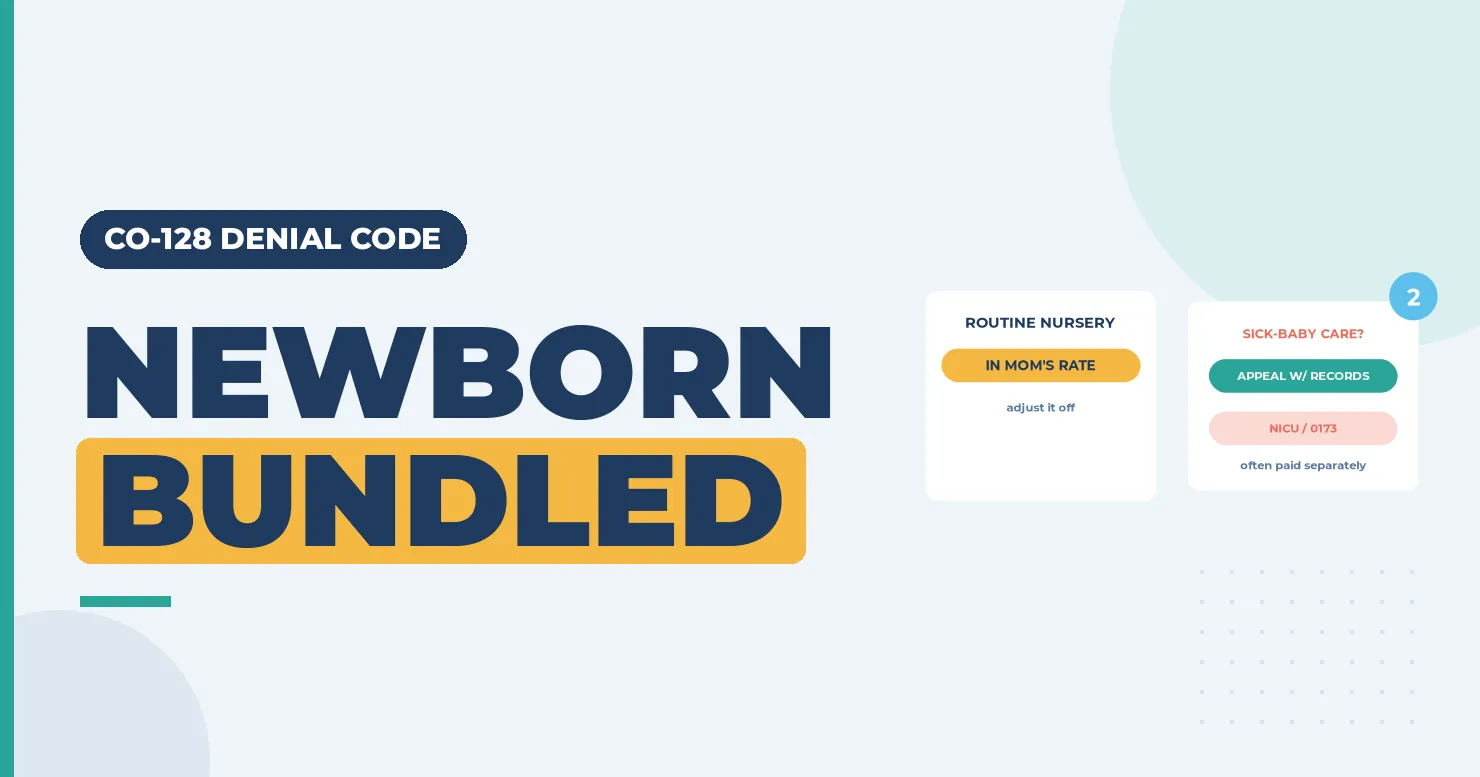
CO-128 means the payer won’t pay the newborn’s claim because it says the baby’s care was already paid as part of the mother’s payment. This happens most with routine nursery care after a normal delivery, when a contract or plan rule bundles the healthy baby’s stay into the mother’s rate. It’s often correct for well-baby care. It’s often wrong for sick-baby care, such as a special care or NICU stay. The CO group means the patient’s family can’t be billed for it. (Primary source: X12 Claim Adjustment Reason Codes)
Short version: CARC 128 reads “Newborn’s services are covered in the mother’s Allowance.” Write it off for routine nursery care when your contract bundles it. Appeal with records when the baby needed care beyond routine nursery.
From the denial codes library. By Manikandan J, CPC, CRCR, who has worked labor and delivery billing for hospital clients. Published 21 October 2026. Last updated: 21 October 2026. Code text is copied word for word from X12.
Official X12 wording for CARC 128
| Field | X12 text |
|---|---|
| Code | 128 |
| Description | “Newborn’s services are covered in the mother’s Allowance.” |
| Start | 02/28/1997 |
Source: X12 Claim Adjustment Reason Codes, checked 21 October 2026.
Who sees CO-128
- Hospitals billing a separate newborn facility claim.
- Birthing centers with combined mother and baby rates.
- Pediatric groups, less often, when a plan bundles the newborn exam.
A mother’s allowance is the amount the payer set for the delivery stay. Some contracts build routine newborn care into that amount. Others pay the baby’s stay as its own claim. Your contract decides which.
Example scenario (fictional names), part 1
CO-128 Denial Example: What Happened
Rosa Delgado works the newborn claims at Bayview Women’s Hospital. Baby boy Okafor was born by vaginal delivery and spent two days in the nursery. On day two he needed a special care stay for low blood sugar. The facility claim billed routine nursery (revenue code 0171) and one special care day (0173) under the baby’s own ID.
The fictional Medicaid plan, Harborline Health, denied the whole claim. The 835 showed CAS*CO*128. The mother’s delivery claim had paid in full a week earlier.
Should Rosa write off the whole claim, or only part of it? Keep reading, or jump to how the CO-128 denial was resolved.
Write off or appeal: a quick guide
| Situation | Likely right? | What to do |
|---|---|---|
| Routine nursery, contract bundles it | Yes | Adjust off |
| Special care or NICU days | Often no | Split or appeal with records |
| Baby’s separate procedures (for example, circumcision) | Check the contract | Read the newborn terms |
| Baby has own coverage and the contract pays separately | No | Appeal with the contract |
The Medicaid angle
A deemed newborn is a baby born to a mother on Medicaid, who is treated as eligible without a separate application. The federal rule is 42 CFR 435.117. The baby being eligible doesn’t settle how the plan pays. A plan can still pay routine nursery care through the mother’s rate under its contract.
So read both the eligibility and the payment terms. One answers whether the baby is covered. The other answers which claim pays.
Remark code you may see
| RARC | X12 wording |
|---|---|
| N15 | “Services for a newborn must be billed separately.” |
N15 is the opposite case. It appears when a payer wants the baby’s care on its own claim, not the mother’s. Check the X12 RARC list for others.
Steps to work a CO-128 denial
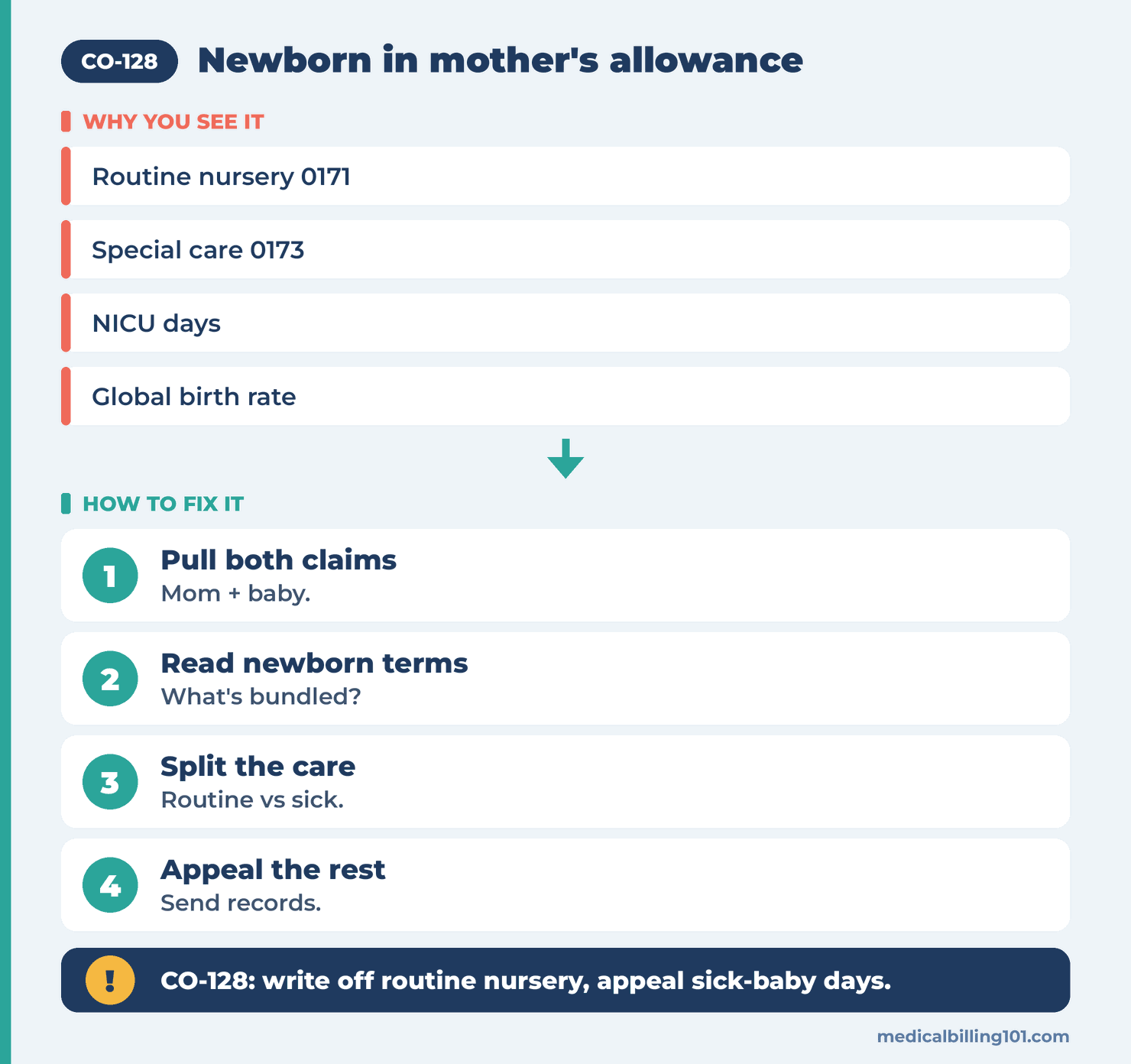
- Pull both claims. Look at the mother’s paid claim and the baby’s denied claim.
- Read the newborn terms. Find what the mother’s rate includes.
- Separate routine from sick-baby care. List days and services beyond routine nursery.
- Adjust the bundled part. Write off what the contract includes.
- Rebill or appeal the rest. Send records that show medical need, such as glucose results and orders.
- Fix your setup. Teach the system which newborn revenue codes to hold.
Example scenario (fictional names), part 2
How the CO-128 Denial Was Resolved
Rosa read Harborline’s newborn terms. They bundled routine nursery days into the delivery rate. They paid special care days on the baby’s own claim.
Fix: Rosa adjusted off the routine nursery day. She sent a corrected claim with only the special care day, plus the glucose readings and the physician’s transfer order.
Outcome: Harborline paid the special care day. Rosa added a rule that flags newborn claims with both 0171 and 0173 for review.
Names and details are illustrative; no real patient data.
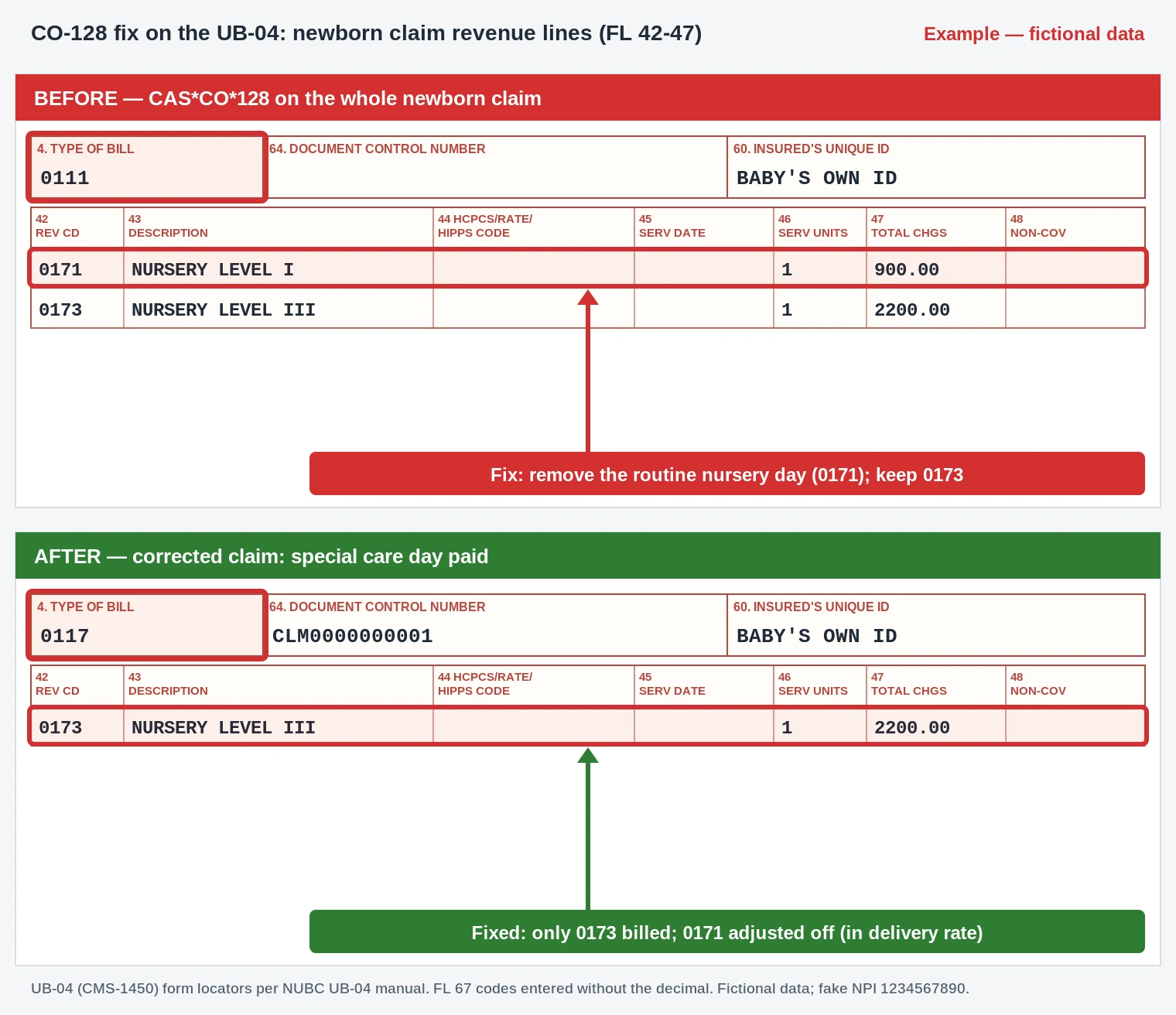
CMS-1500 not shown: newborn nursery days are a hospital charge billed only on the UB-04 facility claim.
- FL 42-47, line 1: routine nursery, revenue code 0171, removed and adjusted off. Harborline bundles it into the mother’s delivery rate.
- FL 42-47, line 2: special care day, revenue code 0173, kept on the baby’s own claim (FL 60 = baby’s ID).
- FL 4 + FL 64: corrected claim, frequency digit 7 (type of bill 0117), with the original claim number. Glucose readings and the transfer order go with it.
Worked example (illustrative)
A birthing center bills a healthy newborn’s stay separately for a commercial patient. The plan denies it with CO-128. The center’s contract pays one global rate for mother and baby. The biller adjusts the claim off. For example, she also checks that the global payment matched the contract rate, and it did.
Errors to avoid
- Writing off sick-baby days. Special care often pays separately.
- Billing the family. CO means no.
- Appealing routine nursery care when the contract clearly bundles it.
- Mixing up the IDs. Baby claims under the wrong ID cause other denials, such as CO-31.
Codes worth knowing
- CO-31: patient can’t be identified as our insured.
- CO-16: claim lacks information or has billing errors.
- CO-45: charge exceeds the fee schedule.
Summary
CO-128 says the baby’s care was paid in the mother’s allowance. That’s often right for routine nursery care and often wrong for special care. Pull both claims, read the newborn terms, adjust what’s bundled and appeal the rest with records.
FAQ
What does CO-128 mean?
It means “Newborn’s services are covered in the mother’s Allowance.” The payer says the mother’s payment already covered the baby’s care.
Can I bill the parents for CO-128?
No. The CO group makes it a provider adjustment.
Is CO-128 right for NICU care?
Often not. Many contracts pay NICU and special care separately. Read your terms and appeal with records.
What is the difference between CO-128 and N15?
CO-128 says the baby’s care is in the mother’s payment. N15 says the baby’s care must be billed on its own claim.
Does Medicaid cover newborns of Medicaid mothers?
Yes, under the deemed newborn rule. How the plan pays the first stay still depends on its contract.
Should I bill the newborn under the mother’s ID?
Follow the payer’s rules. Some programs allow it briefly; most want the baby’s own ID as soon as possible.
Sources
Our check: every quoted code on this page matches the X12 CARC and RARC lists as of 21 October 2026.
- X12, Claim Adjustment Reason Codes (CARC 128, 31, 16, 45). Accessed 21 Oct 2026.
- X12, Remittance Advice Remark Codes (N15). Accessed 21 Oct 2026.
- 42 CFR 435.117, Deemed newborn children (Cornell LII). Accessed 21 Oct 2026.
Last updated: 21 October 2026 · Educational content, not legal advice.
Related denial codes
- CO-122: Psychiatric Reduction
- CO-135: Interim Bills Cannot Be Processed
- CO-118: ESRD Network Support Adjustment
- CO-117: Transport Only Covered to the Closest Appropriate Facility
- CO-78: Non-Covered Days or Room Charge Adjustment
- CO-76: Disproportionate Share (DSH) Adjustment
- CO-75: Direct Medical Education (DGME) Adjustment
- CO-74: Indirect Medical Education (IME) Adjustment