
CO-147 is a contract loading problem on the payer’s side, or a gap in your contract. The plan looked for your negotiated rate for that service and date and found nothing active. Maybe the contract term ended before the renewal was signed. Maybe a new location, tax ID or provider wasn’t added. Or the rate sheet was never loaded for that code. Your claim isn’t wrong. The fix runs through the payer’s contracting or provider data team, and then the claims get reprocessed. (Primary source: X12 Claim Adjustment Reason Codes)
In brief: CARC 147 reads “Provider contracted/negotiated rate expired or not on file.” Pull your signed contract and rate exhibit, find which piece the payer is missing, send it to provider relations, and ask for a reprocessing project for every affected claim.
From our denial codes library. Written by Manikandan J, CPC, CRCR, who has worked payer contract loads and claim reprocessing projects for multi-site groups. Published 21 October 2026. Last updated: 21 October 2026. Code wording quoted word for word from X12.
X12 wording for reason code 147
| Field | X12 text |
|---|---|
| Code | 147 |
| Description | “Provider contracted/negotiated rate expired or not on file.” |
| Start | 06/30/2002 |
Source: X12 Claim Adjustment Reason Codes, checked 21 October 2026.
Three places a contract rate can go missing
A rate exhibit is the part of a payer contract that lists what the plan pays, often as a share of a fee schedule or a list of codes and prices. A contract load is the payer’s process of entering those terms into its claims system. A provider record is the plan’s file of your tax ID, NPIs, locations and specialties.
| Where it breaks | Typical trigger | Who fixes it |
|---|---|---|
| Contract term | Renewal signed late, or never signed | Your contracting lead and the plan |
| Rate exhibit | New code, new service line or new fee year not loaded | The plan’s contract load team |
| Provider record | New location, new NPI or tax ID change | Credentialing and provider data teams |
Example scenario (fictional names), part 1
CO-147 Denial Example: What Happened
Jamal Whitfield manages revenue cycle for Summit Ridge Orthopedics. The group opened a new ambulatory surgery suite in May and billed its first cases under the new location’s NPI. One was a carpal tunnel release, 64721-RT, for right carpal tunnel syndrome (G56.01).
The remit from Copperline Health Plan, a fictional commercial plan, paid nothing. It showed CAS*CO*147 for the full charge with remark LQ*HE*N448, “This drug/service/supply is not included in the fee schedule or contracted/legislated fee arrangement.” Office visits from the main clinic were paying fine.
What was the plan missing, and how could Jamal get every surgery claim paid? Keep reading, or jump to how the CO-147 denial was resolved.
Remark codes that pair with CARC 147
| RARC | X12 wording |
|---|---|
| N448 | “This drug/service/supply is not included in the fee schedule or contracted/legislated fee arrangement.” |
| N381 | “Alert: Consult our contractual agreement for restrictions/billing/payment information related to these charges.” |
| N95 | “This provider type/provider specialty may not bill this service.” |
See the X12 RARC page for others. N95 points more to the provider record than the rate.
How to fix a CO-147 denial
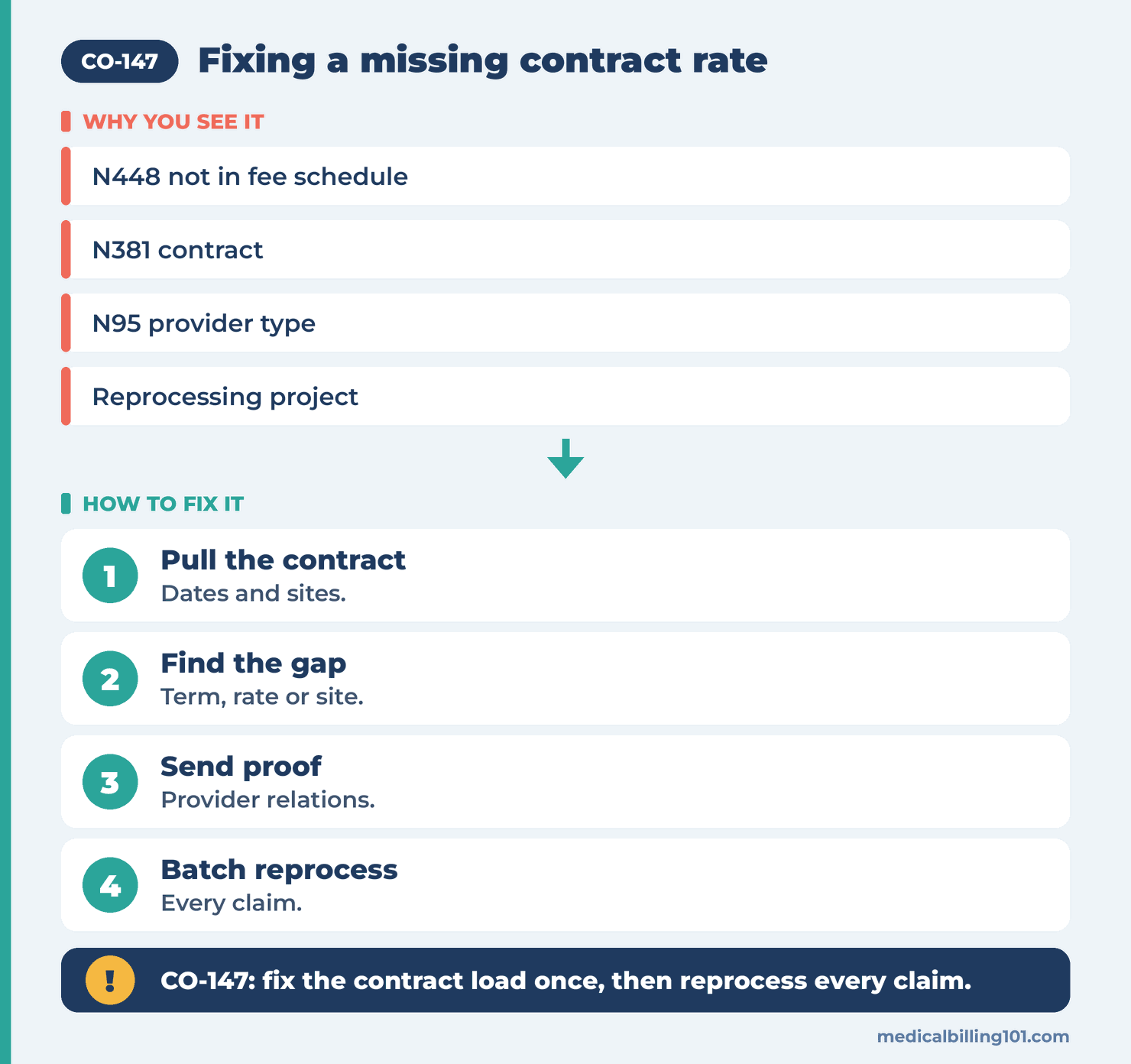
- Pull the contract and rate exhibit. Check the start and end dates, the codes covered and the locations listed.
- Pin down the gap. For example, is the contract expired, is the code missing from the exhibit, or is the location not on the provider record? Confirm the NPI and address in the NPPES NPI registry match what you billed.
- Send proof to provider relations. Include the signed contract page, the exhibit and the location or NPI details.
- Ask for a load date that covers the service dates. A load that starts today won’t fix last month’s claims.
- Request a reprocessing project. List every affected claim so the plan reprocesses them together, not one by one.
- Hold new claims or keep sending them. Follow the plan’s advice, and keep timely filing proof either way.
- Track renewals. Set a reminder well before each contract end date.
Example scenario (fictional names), part 2
How the CO-147 Denial Was Resolved
Jamal compared the contract with the plan’s online provider directory. The contract listed only the main clinic. The new surgery suite had been credentialed but never added to the contract’s location list, so no rates applied to its NPI.
Fix: his contracting lead sent the plan an amendment request adding the suite, with the original rate exhibit attached. The plan backdated the load to the suite’s opening date. Jamal then sent a spreadsheet of every CO-147 claim for a reprocessing project.
Outcome: the plan reprocessed the claims as a batch and paid them at the contract rate. Summit Ridge now adds every new site to its contracts before the first patient is booked.
Names and details are illustrative; no real patient data.
Worked example (illustrative)
Consider a cardiology group whose contract renewal sat unsigned for two months after the old term ended. Claims in that gap deny with CO-147. Once the renewal is signed, the group asks the plan to make the new term start the day after the old one ended. With no gap in dates, the plan reprocesses the claims at the new rates.
Mistakes that keep CO-147 claims stuck
- Appealing claim by claim. It’s slow, and each appeal waits on the same contract fix.
- Billing the patient. The CO group means the patient doesn’t owe it.
- Accepting a load date of today. Ask for a date that covers the service dates.
- Ignoring tax ID changes. A merger or new tax ID can break every rate at once.
Related codes
- CO-45: charge exceeds the contracted fee arrangement.
- CO-16: claim lacks information needed for adjudication.
- PR-242: services not provided by network or primary care providers.
Recap
CO-147 means the plan has no active rate for you on file for that service and date. Find the gap in the contract term, rate exhibit or provider record, send proof to provider relations, ask for a load date that covers the claims and request a reprocessing project. Then track every renewal and new site.
FAQ
What does denial code CO-147 mean?
The payer has no active contract rate for you on file. It reads “Provider contracted/negotiated rate expired or not on file.”
Is CARC 147 my billing mistake?
Usually not. It’s most often a contract gap or a payer loading problem.
Can I bill the patient for a CO-147 denial?
No. It’s a CO adjustment, so work it with the payer.
How do I fix reason code 147 for many claims?
Fix the contract load first, then ask for a reprocessing project that covers every affected claim.
Does CO-147 happen after a contract renewal?
Yes. If the renewal starts late or isn’t loaded, claims in the gap can deny.
What if the plan says I’m out of network?
Check whether the location or NPI is on the contract. If not, add it by amendment.
Sources
How we checked: each code quote on this page was matched word for word with the X12 CARC and RARC lists on 21 October 2026.
- X12, Claim Adjustment Reason Codes (CARC 147, 16, 45, 242). Accessed 21 Oct 2026.
- X12, Remittance Advice Remark Codes (N448, N381, N95). Accessed 21 Oct 2026.
- CMS, NPPES NPI registry. Accessed 21 Oct 2026.
Last updated: 21 October 2026 · Educational content; not legal advice.
Related denial codes
- CO-144: Incentive Adjustment, e.g. Preferred Product/Service
- CO-143: Portion of Payment Deferred
- CO-139: Contracted Funding Agreement, Subscriber Employed by the Provider
- CO-137: Regulatory Surcharges, Assessments, Allowances or Health Related Taxes
- CO-134: Technical Fees Removed From Charges
- CO-161: Provider Performance Bonus
- CO-132: Prearranged Demonstration Project Adjustment
- CO-131: Claim-Specific Negotiated Discount