
CO-139 shows up mostly at hospitals and health systems that cover their own employees through a self-funded health plan. When an employee or family member gets care at the employer’s own facility, the plan and the provider may have a contracted funding agreement that says how that care is paid. Often no money changes hands on the claim because the employer funds the plan and owns the provider. The remit shows the adjustment with CARC 139. The CO group means you don’t bill the patient for it. (Primary source: X12 Claim Adjustment Reason Codes)
In brief: CARC 139 reads “Contracted funding agreement – Subscriber is employed by the provider of services. Use only with Group Code CO.” Post it as the agreement says. Question it only when the subscriber doesn’t work for your organization, or the agreement doesn’t cover that service.
Part of our denial codes library. Written by Manikandan J, CPC, CRCR, who has posted remits for health systems with their own employee health plans. Published 21 October 2026. Last updated: 21 October 2026. Code wording quoted word for word from X12.
The official wording of reason code 139
| Field | X12 text |
|---|---|
| Code | 139 |
| Description | “Contracted funding agreement – Subscriber is employed by the provider of services. Use only with Group Code CO.” |
| Start | 06/30/1999 |
| Last modified | 05/01/2018 |
Source: X12 Claim Adjustment Reason Codes, checked 21 October 2026.
Key terms behind CARC 139
A self-funded plan is a health plan where the employer pays claims from its own money instead of buying insurance. A third-party administrator is the company that processes those claims for the employer. A contracted funding agreement is the written deal that says how care at the employer’s own sites is funded and recorded.
HealthCare.gov’s self-insured plan entry describes the setup: the employer pays its employees’ claims and may hire an administrator to process them. When that employer also runs the hospital, the agreement decides how its own care is paid.
Example scenario (fictional names), part 1
CO-139 Denial Example: What Happened
Aisha Barrow works in patient accounts at Meridian Valley Health System. A Meridian nurse brought her son to the system’s urgent care for ear pain from impacted earwax in the right ear (H61.21). The claim went out with 99203-25 and 69210 for the earwax removal, to the employee plan run by Oakmont Benefit Services, a fictional administrator.
The 835 paid nothing. It showed CAS*CO*139 for the full allowed amount with remark LQ*HE*N828, “Alert: Payment is suppressed due to a contracted funding.” A second claim for a non-employee on the same plan had paid normally.
Should Aisha appeal, rebill or just post it? Keep reading, or jump to how the CO-139 denial was resolved.
Remark codes that pair with CARC 139
| RARC | X12 wording | What it tells you |
|---|---|---|
| N828 | “Alert: Payment is suppressed due to a contracted funding.” | The agreement covers it; no payment is sent |
| N381 | “Alert: Consult our contractual agreement for restrictions/billing/payment information related to these charges.” | Read the agreement terms |
| N25 | “This company has been contracted by your benefit plan to provide administrative claims payment services only. This company does not assume financial risk or obligation with respect to claims processed on behalf of your benefit plan.” | The administrator doesn’t carry the risk |
See the X12 RARC list for the rest.
How to work a CO-139 adjustment
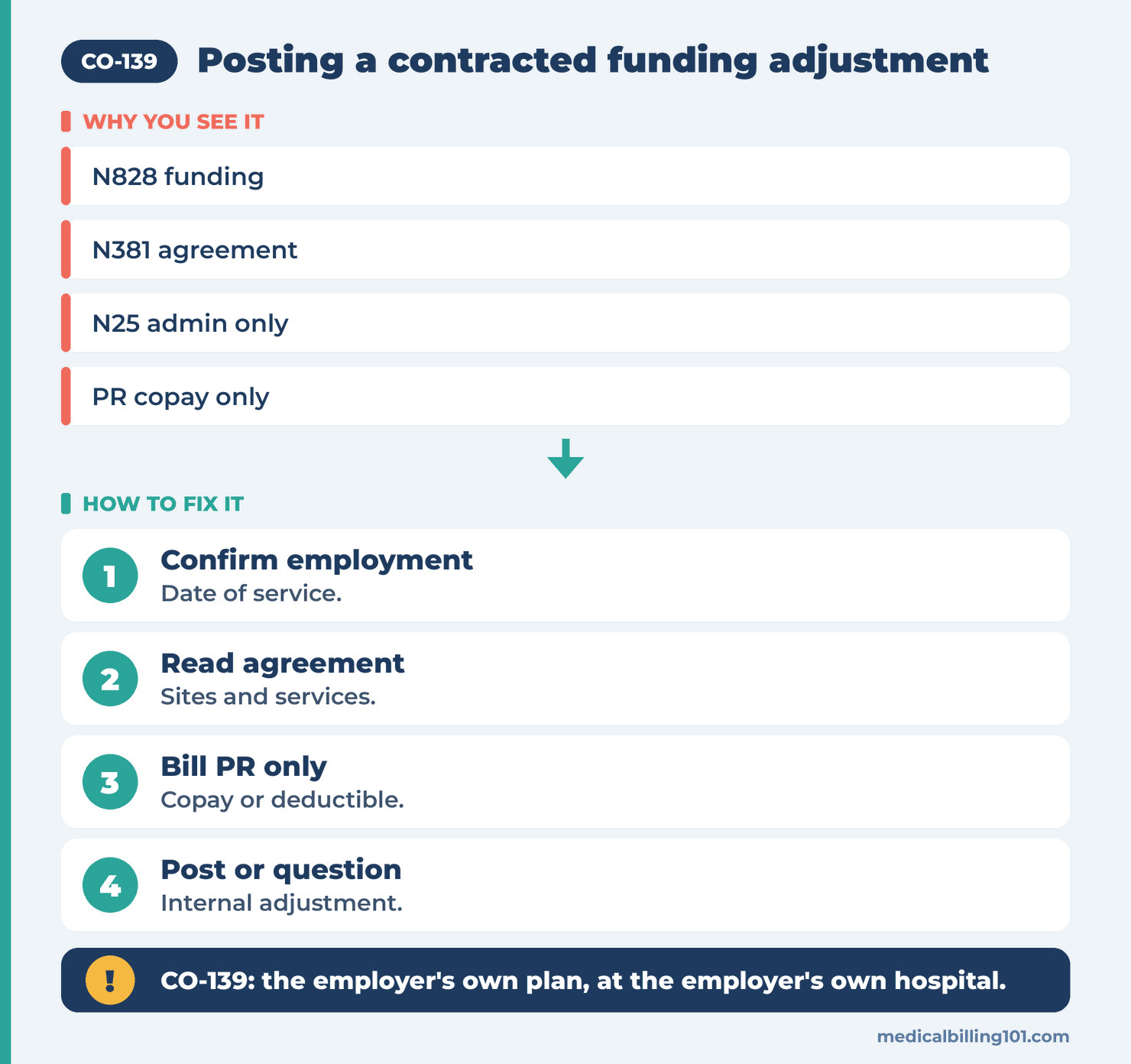
- Confirm employment. Check that the subscriber worked for your organization on the date of service. For example, HR can confirm a start or end date.
- Read the funding agreement. Find which entities, sites and services it covers, such as hospital care but not a separate physician group.
- Check the patient’s share. The plan may still assign a deductible or copay as PR. Bill only that.
- Post the CO-139 amount as the agreement says. Many systems use a special adjustment code so it doesn’t count as bad debt or a denial.
- Question mismatches. If the subscriber left the job, or the billing entity is outside the agreement, ask the administrator to reprocess.
- Report it apart from denials. Keep CO-139 out of denial dashboards so the numbers stay honest.
Example scenario (fictional names), part 2
How the CO-139 Denial Was Resolved
Aisha checked with HR. The nurse was a current employee, and the urgent care was part of Meridian. The funding agreement covered all Meridian facilities, and the remit showed a small PR copay for the visit.
Fix: no appeal was needed. She posted the CO-139 amount to the system’s internal funding adjustment code and billed the family only the copay.
Outcome: the account closed cleanly. Aisha also flagged a second CO-139 on a former employee’s claim. The administrator reprocessed that one as a normal claim and paid it.
Names and details are illustrative; no real patient data.
Worked example (illustrative)
Consider a university health system whose employee plan covers its hospital and its own faculty practice. A staff member sees an outside specialist who is in network with the plan. That claim pays normally, with no CARC 139, because the specialist isn’t the employer. CARC 139 applies only where the subscriber’s employer is also the provider billing the claim.
When CO-139 is wrong
| Sign | Likely problem | Action |
|---|---|---|
| Subscriber left the job before the visit | Old employment data | Send proof and ask to reprocess |
| Provider is a separate legal entity | Agreement doesn’t cover that tax ID | Ask for a review under normal terms |
| Patient was billed the full charge | Posting error | Refund and rebill only the PR share |
Related codes
- CO-45: charge exceeds the contracted fee arrangement.
- CO-24: charges covered under a capitation agreement or managed care plan.
- CO-132: prearranged demonstration project adjustment.
Recap
CO-139 means a funding agreement applies because the subscriber works for the provider billing the claim. It’s usually correct. Confirm employment and agreement scope, bill only any PR share, and post the rest to an internal funding adjustment. Ask for reprocessing when the employment or entity doesn’t match.
FAQ
What does denial code CO-139 mean?
A contracted funding agreement applies because the subscriber is employed by the provider. No payment may be sent for the covered amount.
Is CARC 139 a denial?
Not really. It’s an adjustment under the employer’s funding agreement. Post it, don’t appeal it, when the facts match.
Can I bill the patient for CO-139?
No. Bill only amounts the remit lists as PR, such as a copay.
Which group code goes with reason code 139?
Only CO. X12 says to use it only with Group Code CO.
What if the employee left before the visit?
Send the end date to the administrator and ask it to reprocess the claim under normal terms.
Does CO-139 apply to outside providers?
No. It applies only when the subscriber’s employer is the provider billing the claim.
Sources
How we checked: each code quote on this page was matched word for word with the X12 CARC and RARC lists on 21 October 2026.
- X12, Claim Adjustment Reason Codes (CARC 139, 24, 45, 132). Accessed 21 Oct 2026.
- X12, Remittance Advice Remark Codes (N828, N381, N25). Accessed 21 Oct 2026.
- HealthCare.gov, Self-insured plan (glossary). Accessed 21 Oct 2026.
Last updated: 21 October 2026 · Educational content; not legal advice.
Related denial codes
- CO-137: Regulatory Surcharges, Assessments, Allowances or Health Related Taxes
- CO-143: Portion of Payment Deferred
- CO-144: Incentive Adjustment, e.g. Preferred Product/Service
- CO-134: Technical Fees Removed From Charges
- CO-132: Prearranged Demonstration Project Adjustment
- CO-147: Provider Contracted/Negotiated Rate Expired or Not on File
- CO-131: Claim-Specific Negotiated Discount
- CO-130: Claim Submission Fee