
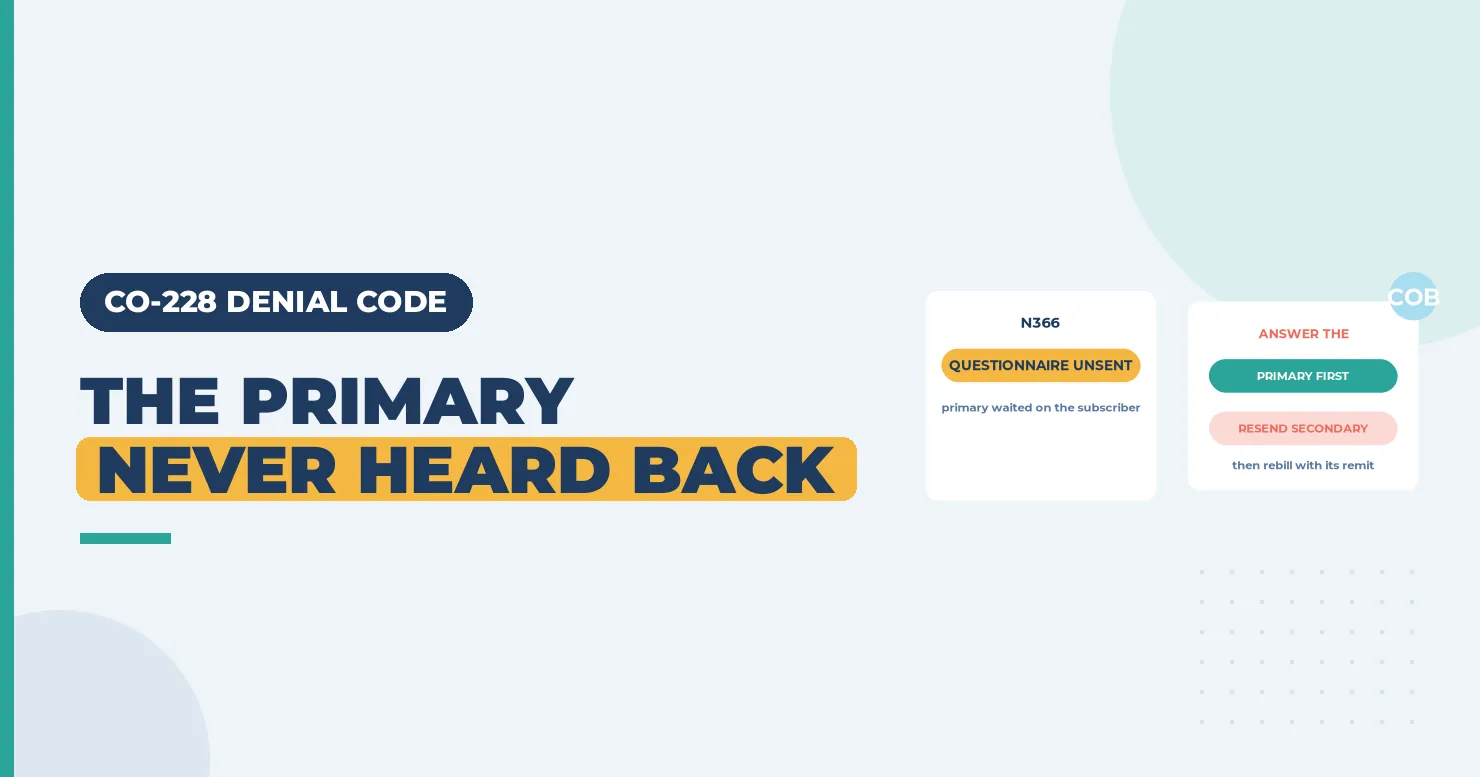
A secondary payer waits for the primary to finish. If the primary asked for something, an accident questionnaire, a records request or other coverage details, and nobody answered, the primary never really adjudicated the claim. CO-228 is the secondary payer saying it will not step in to cover for that gap. (Primary source: X12 Claim Adjustment Reason Codes)
In brief: CARC 228 reads “Denied for failure of this provider, another provider or the subscriber to supply requested information to a previous payer for their adjudication”. Find out what the primary asked for and from whom, get it answered, let the primary reprocess, and send the secondary a new claim with the primary’s final remit.
Part of our denial codes library. Written by Manikandan J, CPC, CRCR, who has cleared stuck secondary claims for multi-specialty and imaging groups. Published 23 October 2026. Last updated: 23 October 2026. Code wording quoted word for word from X12.
The X12 wording
| Field | Value |
|---|---|
| Code | 228 |
| Description | “Denied for failure of this provider, another provider or the subscriber to supply requested information to a previous payer for their adjudication” |
| Start | 09/21/2008 |
Source: X12 Claim Adjustment Reason Codes, checked 23 October 2026.
Notice the three parties. The missing answer could have been owed by this provider, another provider (such as the hospital or a referring doctor), or the subscriber, the person who holds the policy.
Terms to know
A previous payer is any payer that processed the claim before this one, usually the primary. A subscriber questionnaire is a form a payer mails the policyholder, for example asking about other coverage or how an accident happened. Adjudication is the payer’s final decision to pay, deny or adjust.
The primary’s remit often holds the clue. N366 reads “Requested information not provided. The claim will be reopened if the information previously requested is submitted within one year after the date of this denial notice.”
Example scenario (fictional names), part 1
CO-228 Denial Example: What Happened
Marcus Bell is an AR specialist at Pinecrest Imaging. A knee MRI for a teenage soccer player was denied by the mother’s employer plan, the secondary, with CAS*CO*228.
The primary was the father’s plan. Its remit, filed in the system weeks earlier, showed the claim denied with remark N366. Nobody had noticed because the primary balance was moved straight to secondary.
What did the primary ask for, and who was supposed to answer? Keep reading, or jump to how the CO-228 denial was resolved.
How to clear CO-228
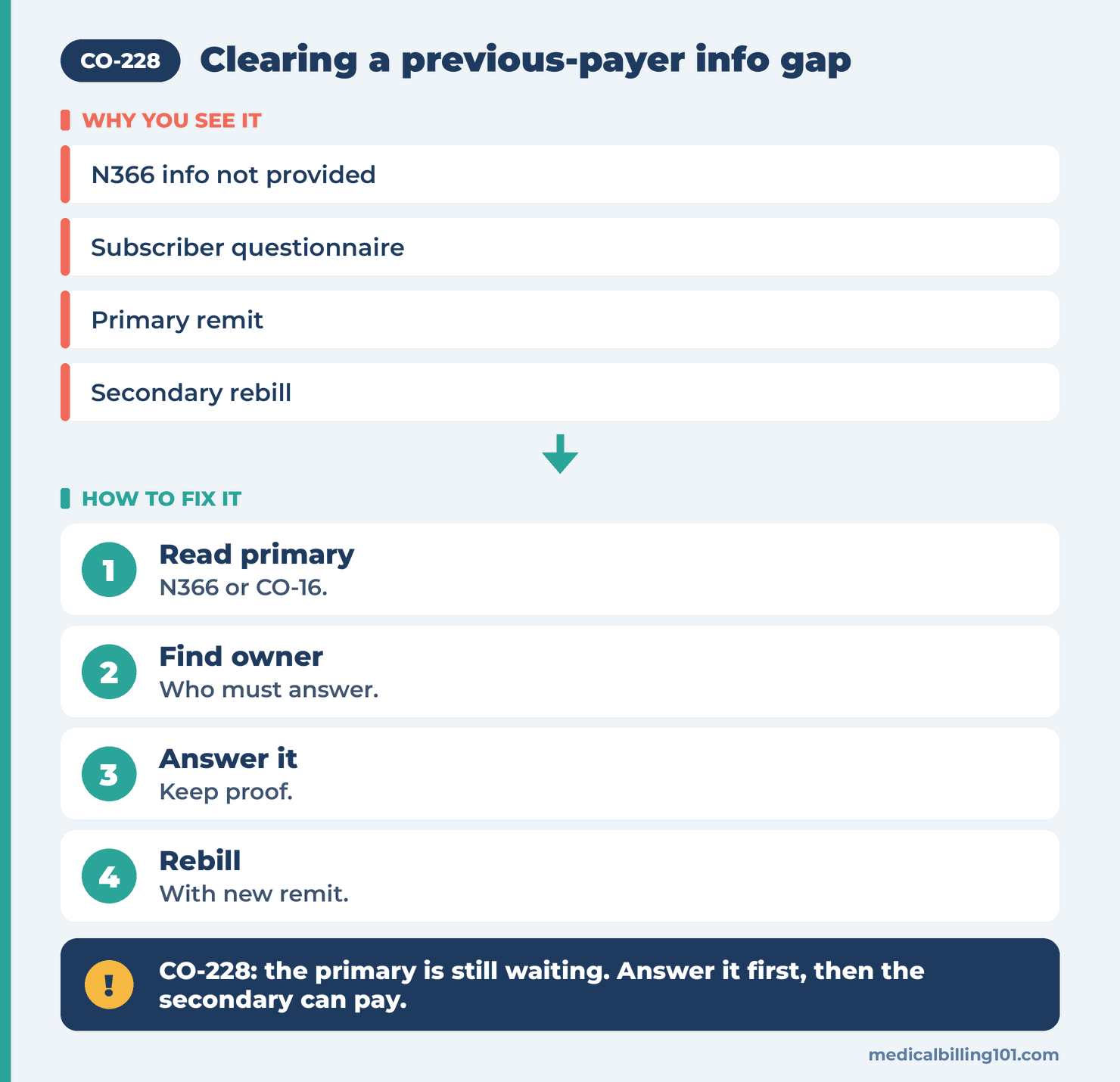
- Read the primary remit. Look for N366, CO-16 or a letter about a questionnaire or records request.
- Identify the owner. For instance, an accident questionnaire goes to the subscriber; a records request goes to the provider.
- Get it answered. Call the subscriber or send the records. Keep proof of the date sent.
- Let the primary reprocess. Ask the primary to reopen the claim once the information is in.
- Rebill the secondary with the primary’s new remit attached or sent electronically.
- Check timely filing. Both payers’ windows matter. Our timely filing calculator helps track dates.
No claim field was wrong, so there is no form correction here. The claim just needs a real primary decision first.
Example scenario (fictional names), part 2
How the CO-228 Denial Was Resolved
Marcus called the father’s plan. It had mailed an accident questionnaire to the father, because the MRI diagnosis was a sports injury, and never got it back.
Fix: Marcus called the father, who completed the questionnaire by phone with the plan that afternoon. The primary reopened the claim and paid it, leaving coinsurance. Marcus then sent the secondary claim with the new primary remit.
Outcome: The mother’s plan paid the remaining balance. Pinecrest now stops any secondary claim from going out while the primary remit shows N366.
Names and details are illustrative; no real patient data.
CO-228 and related coordination codes
| Code | Meaning | Fix |
|---|---|---|
| CO-228 | Info never supplied to the previous payer | Answer the primary, then rebill |
| CO-22 | Another payer may be primary | Update COB order |
| OA-23 | Impact of prior payer adjudication | Read the primary EOB |
| CO-16 | Claim lacks information | Supply the missing data |
| MA130 | Incomplete or invalid claim | Fix and send a new claim |
Read our full coordination of benefits denial guide, and CMS explains Medicare’s side in its coordination of benefits and recovery overview.
FAQ
What does CO-228 mean?
The secondary denied because the provider, another provider or the subscriber never gave the previous payer the information it asked for.
How do I find what was requested?
Check the primary’s remit for N366 or CO-16, and ask the primary for any letters it sent.
Can I bill the patient?
Not under group code CO. Get the primary to finish adjudication first.
What if the subscriber will not respond?
Explain that both plans will deny until the form is done. The secondary cannot pay without it.
Do I need to send a corrected claim?
Usually a new secondary claim with the primary’s final remit, not a field correction.
Sources
How we checked: each code quote on this page was matched word for word with the X12 CARC and RARC lists on 23 October 2026.
- X12, Claim Adjustment Reason Codes (CARC 228). Accessed 23 Oct 2026.
- X12, Remittance Advice Remark Codes (N366). Accessed 23 Oct 2026.
- CMS, Coordination of Benefits and Recovery Overview. Accessed 23 Oct 2026.
- NUCC, 1500 Claim Form Instructions. Accessed 23 Oct 2026.
Last updated: 23 October 2026 · Educational content; not legal advice.
Related denial codes
- CO-219: Extent of Injury Explained
- CO-215: Subrogation After a Settlement
- OA-209: Don't Bill the Patient, Bill the Next Payer
- CO-254: Send It to the Medical Plan
- PR-201: Patient Responsible Through a Set-Aside Arrangement
- OA-195: Refund Issued to an Erroneous Priority Payer
- CO-270: Bill the Patient's Dental Plan
- OA-136: Failure to Follow Prior Payer's Coverage Rules