
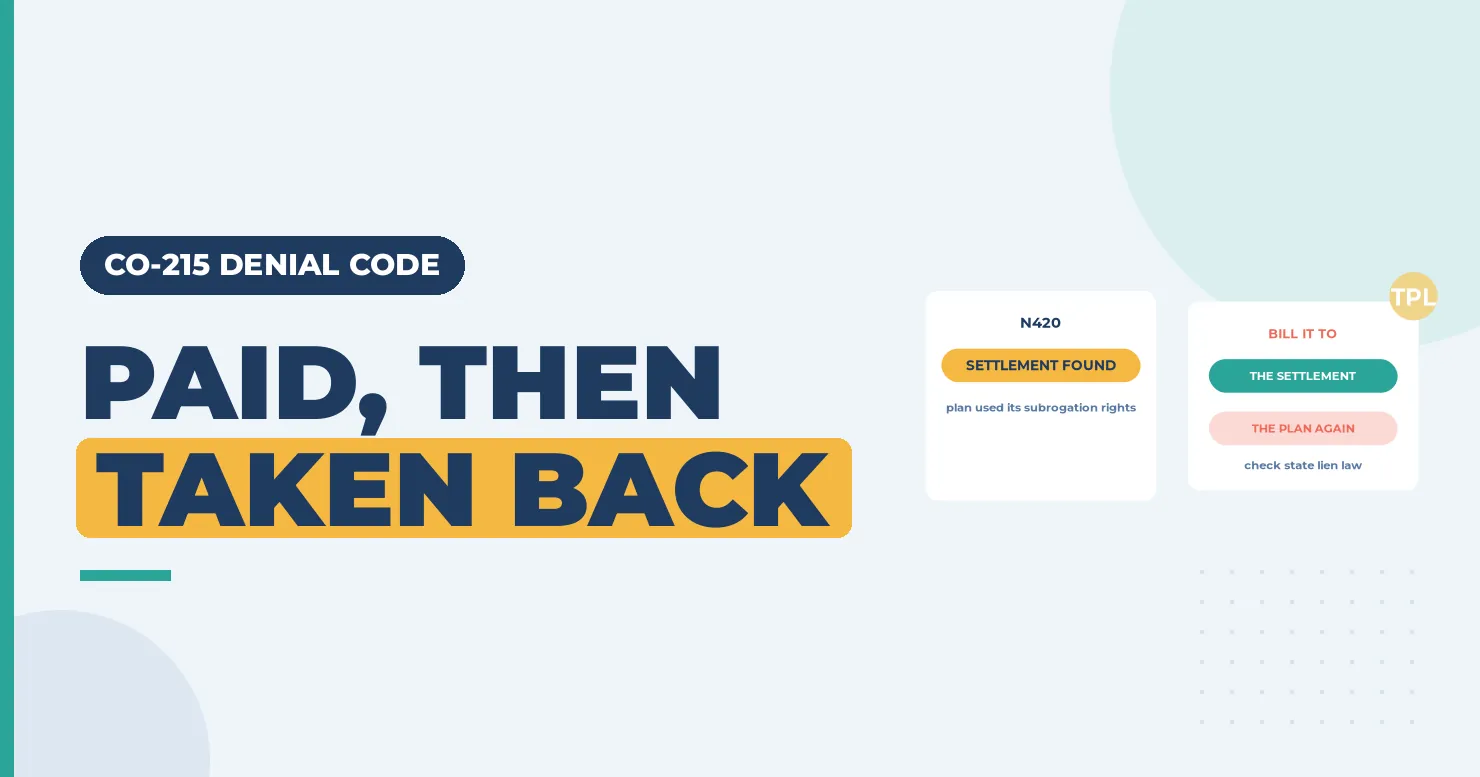
Picture a claim that paid months ago, then quietly comes back as a negative line on a new remit. That is the typical CO-215. The patient’s injury was caused by someone else, the patient settled with that party, and the health plan has used its subrogation rights. The plan now says the settlement, not the plan, should cover the care. (Primary source: X12 Claim Adjustment Reason Codes)
In brief: CARC 215 reads “Based on subrogation of a third party settlement”. Confirm the settlement and the date of injury, match the recouped claims to that injury, then bill the liability, auto or other responsible carrier, or work with the patient’s attorney, inside your state’s lien and contract rules.
Part of our denial codes library. Written by Manikandan J, CPC, CRCR, who has untangled accident and liability recoupments for emergency and orthopedic billing teams. Published 23 October 2026. Last updated: 23 October 2026. Code wording quoted word for word from X12.
Key terms behind CO-215
Subrogation is a payer’s right to step into the patient’s shoes and recover what it paid from the party that caused the injury. A third-party settlement is the money the patient gets from that party or its insurer, usually an auto or liability carrier. A recoupment is when the payer takes back an earlier payment by offsetting it against new claims.
| X12 item | Value |
|---|---|
| Code | 215 |
| Description | “Based on subrogation of a third party settlement” |
| Start | 01/27/2008 |
Source: X12 Claim Adjustment Reason Codes, checked 23 October 2026.
Two remarks often ride along. N420 reads “Claim payment was the result of a payer’s retroactive adjustment due to a Coordination of Benefits or Third Party Liability Recovery.” N585 reads “Benefits are no longer available based on a final injury settlement.”
Example scenario (fictional names), part 1
CO-215 Denial Example: What Happened
Hannah Brooks posts payments for Cedar Valley Emergency Physicians. A remit arrived with a negative $1,180 line, CAS*CO*215, against an ER visit and a CT scan from eight months earlier. Remark N420 was attached.
The patient had come in after a car crash. The plan had paid in full at the time. Nothing in the account notes mentioned an attorney or a settlement.
Where should Hannah send this balance now? Keep reading, or jump to how the CO-215 denial was resolved.
Why payers send CO-215
- The patient settled an injury case. The plan’s recovery vendor found the settlement and reversed related claims.
- The plan has a reimbursement clause. For example, many employer plans require the member to repay the plan from any settlement.
- Medicare is secondary to liability. Medicare has its own recovery process for liability, no-fault and workers’ compensation cases, explained on the CMS coordination of benefits and recovery overview.
Working a CO-215 recoupment
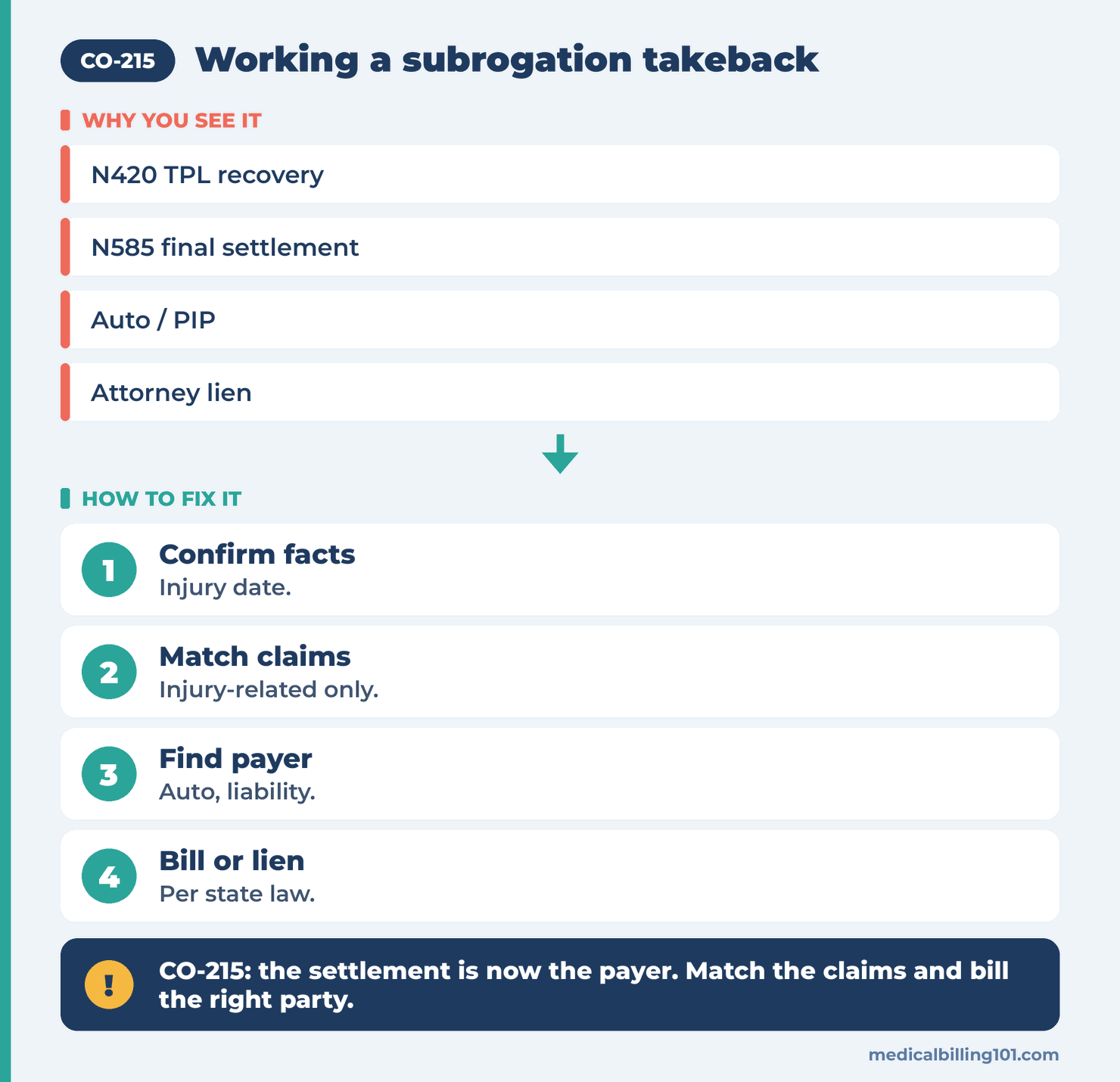
- Confirm the facts. Call the plan or its recovery vendor. Get the date of injury, the claim numbers reversed and the settlement status.
- Match the claims. Only services tied to that injury should be reversed. A flu visit in the same window should not be.
- Find the next payer. Auto medical payments, personal injury protection (PIP), a liability carrier or an attorney handling the case.
- Check your rules. State lien laws and your payer contract decide whether and how you can bill the settlement, the carrier or the patient.
- Bill or file the lien. Send the itemized bill and records the next payer asks for, and track it as a separate account.
- Dispute wrong reversals. If a service is unrelated to the injury, appeal that line with the records.
The original claim fields were correct, so no corrected claim is needed. The fix is a payer change, not a form change.
Example scenario (fictional names), part 2
How the CO-215 Denial Was Resolved
Hannah called the plan’s recovery vendor. The patient had settled with the other driver’s insurer two months earlier, and the plan had recovered its payments from the settlement.
Fix: Hannah asked for the reversal letter, then contacted the patient’s attorney, who was still holding funds. She sent the itemized bill and ER records, and filed the claim under the state’s hospital and physician lien process.
Outcome: The attorney paid the balance from the settlement funds. Registration now asks every accident patient for auto and attorney details at check-in.
Names and details are illustrative; no real patient data.
CO-215 vs related codes
| Code | Plain meaning | Usual next step |
|---|---|---|
| CO-215 | Recovered from a third-party settlement | Bill the settlement or carrier |
| OA-23 | Impact of a prior payer | Read the prior payer’s EOB |
| CO-22 | Another payer may be primary | Update COB |
| CO-19 | Work-related injury | Bill workers’ comp |
| CO-21 | Liability of a no-fault carrier | Bill auto or no-fault |
Our guide to coordination of benefits denials covers the primary and secondary order in detail.
FAQ
What does CO-215 mean?
The payer adjusted the claim based on subrogation of a third-party settlement, so it says the settlement should pay.
Is CO-215 always a takeback?
Often, yes. It usually shows up as a reversal of a claim that was paid before the settlement.
Can I bill the patient after CO-215?
It depends on state lien law and your contract. Group code CO limits patient billing, so check both before sending a statement.
Do I need a corrected claim?
No. The claim data was right. The responsible payer changed.
What remark codes come with CO-215?
N420 and N585 are common companions.
Sources
How we checked: each code quote on this page was matched word for word with the X12 CARC and RARC lists on 23 October 2026.
- X12, Claim Adjustment Reason Codes (CARC 215). Accessed 23 Oct 2026.
- X12, Remittance Advice Remark Codes (N420, N585). Accessed 23 Oct 2026.
- CMS, Coordination of Benefits and Recovery Overview. Accessed 23 Oct 2026.
- CMS, Recovery process for liability and no-fault cases. Accessed 23 Oct 2026.
Last updated: 23 October 2026 · Educational content; not legal advice.
Related denial codes
- CO-219: Extent of Injury Explained
- OA-209: Don't Bill the Patient, Bill the Next Payer
- CO-228: Previous Payer Never Got Its Info
- PR-201: Patient Responsible Through a Set-Aside Arrangement
- OA-195: Refund Issued to an Erroneous Priority Payer
- CO-254: Send It to the Medical Plan
- CO-270: Bill the Patient's Dental Plan
- OA-136: Failure to Follow Prior Payer's Coverage Rules