
CO-246 is the payer confirming it received a line that was never meant to pay. It attaches to codes that exist only to report data. Quality measure codes are the usual example, such as CPT Category II codes and some HCPCS G-codes. Most of the time the right response is to post it at zero and move on. The trouble starts when the line carries a charge. (Primary source: X12 Claim Adjustment Reason Codes)
In brief: CARC 246 reads “This non-payable code is for required reporting only.” Do not appeal it. Check that the reporting code is the one the measure needs. Bill it at the charge your payer specifies, usually $0.00 or $0.01, and keep it out of your denial queue.
Part of our denial codes library. Written by Manikandan J, CPC, CRCR, who has set up quality reporting codes and scrubber rules for physician groups. Published 24 October 2026. Last updated: 24 October 2026. Code wording quoted word for word from X12.
What CO-246 tells you
| Field | Value |
|---|---|
| Code | 246 |
| Description | “This non-payable code is for required reporting only.” |
| Start | 09/30/2012 |
Source: X12 Claim Adjustment Reason Codes, checked 24 October 2026.
A reporting code carries clinical or quality data, not a billable service. A blood pressure result coded with a CPT Category II code is a common case. Payers collect these to score quality programs, including the Medicare Quality Payment Program.
Payers may add one of these remarks:
- N620: “Alert: This procedure code is for quality reporting/informational purposes only.”
- N565: “Alert: This non-payable reporting code requires a modifier. Future claims containing this non-payable reporting code must include an appropriate modifier for the claim to be processed.”
- N572: “This procedure is not payable unless appropriate non-payable reporting codes and associated modifiers are submitted.”
N572 is the one to act on fast, because it can hold up the paid service on the same claim.
Example scenario (fictional names), part 1
CO-246 Denial Example: What Happened
Tomás Rivera bills for Hillcrest Internal Medicine, a fictional clinic. For each diabetic patient, the doctors reported blood pressure with 3074F and 3079F next to the office visit.
Each month the denial queue filled with CAS*CO*246 lines. The charge master had loaded both codes at $35.00, so the system kept chasing $70 per visit.
Was the payer wrong, or was the clinic’s setup wrong? Keep reading, or jump to how the CO-246 denial was resolved.
Why CO-246 piles up in a denial queue
- A real charge on the reporting line. For example, a quality code built with a fee, so every CO-246 looks like lost money.
- Wrong or missing modifier. Some measures need performance modifiers such as 1P, 2P, 3P or 8P on CPT II codes.
- Reporting code alone on the claim. The measure usually needs a paid service on the same claim.
- Work queues that treat every CAS as a denial. For instance, posting rules that send all CO lines to follow-up.
How to handle CO-246
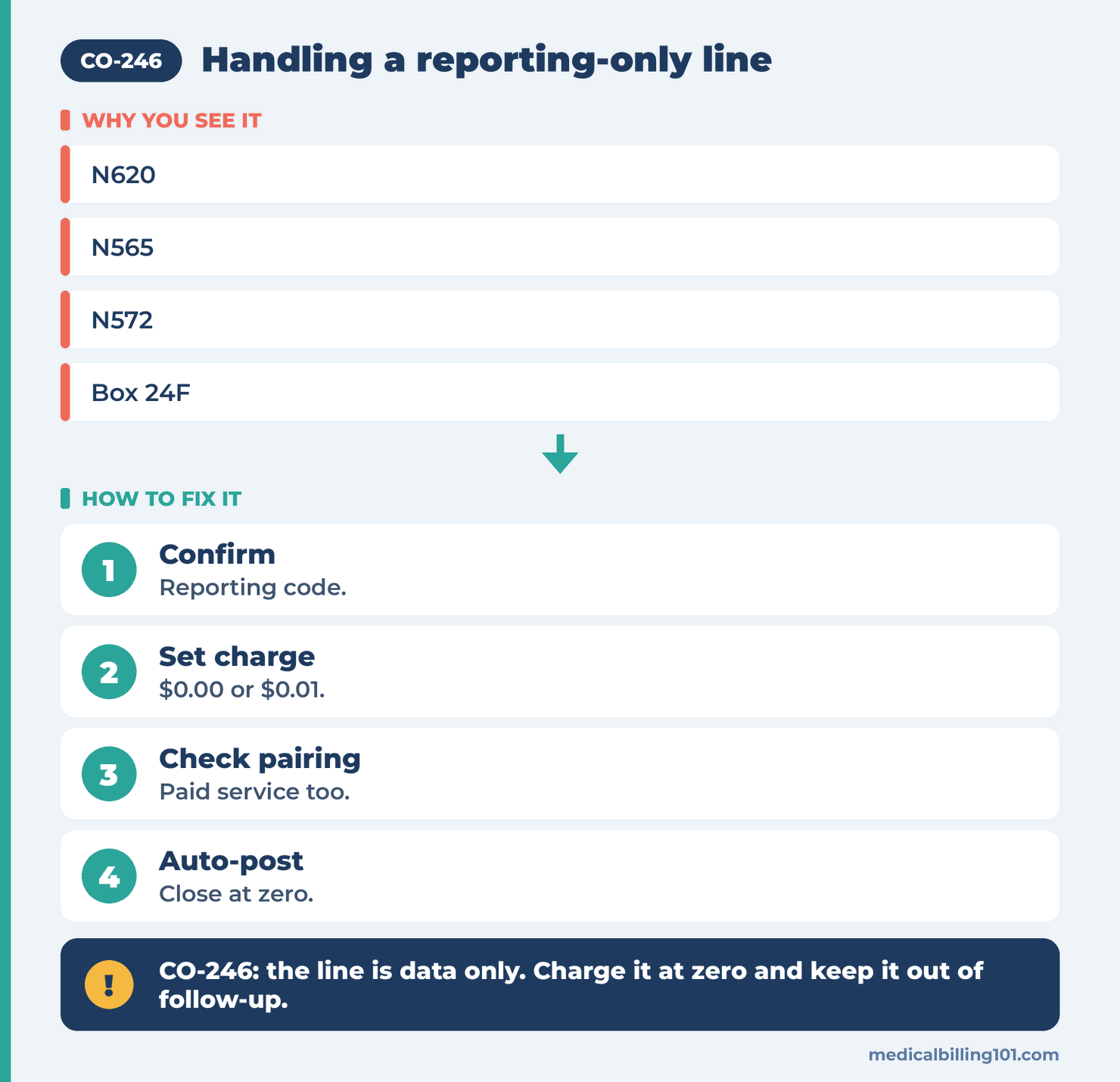
- Confirm it is a reporting code. Check the code set. CPT Category II codes end in F, and many quality G-codes are informational.
- Set the right charge. Follow the payer’s rule for reporting lines, usually $0.00, or $0.01 where a system cannot send zero. Enter it in Box 24F.
- Check modifiers and pairing. Make sure the measure modifier is right and that the paid service sits on the same claim.
- Act on N572 or N565. These mean the payer wants a reporting code or modifier added, so fix the next claims or send a corrected claim if a paid line was held.
- Route CO-246 to zero posting. Build a posting rule so CO-246 lines close without a follow-up task.
See our CO-97 guide for the opposite case, where a payable service is denied as included in another one.
Example scenario (fictional names), part 2
How the CO-246 Denial Was Resolved
Tomás checked the codes. 3074F and 3079F were valid Category II codes for the blood pressure measure, and the visits had paid in full, so the only problem was the $35.00 charge on each.
Fix: He changed both codes to $0.00 in the charge master, so Box 24F showed 0 00 on the next claims, and added a posting rule that closes CO-246 lines.
Outcome: The denial queue dropped by hundreds of lines a month. No corrected claims were needed, because nothing payable had been denied.
Names and details are illustrative; no real patient data.
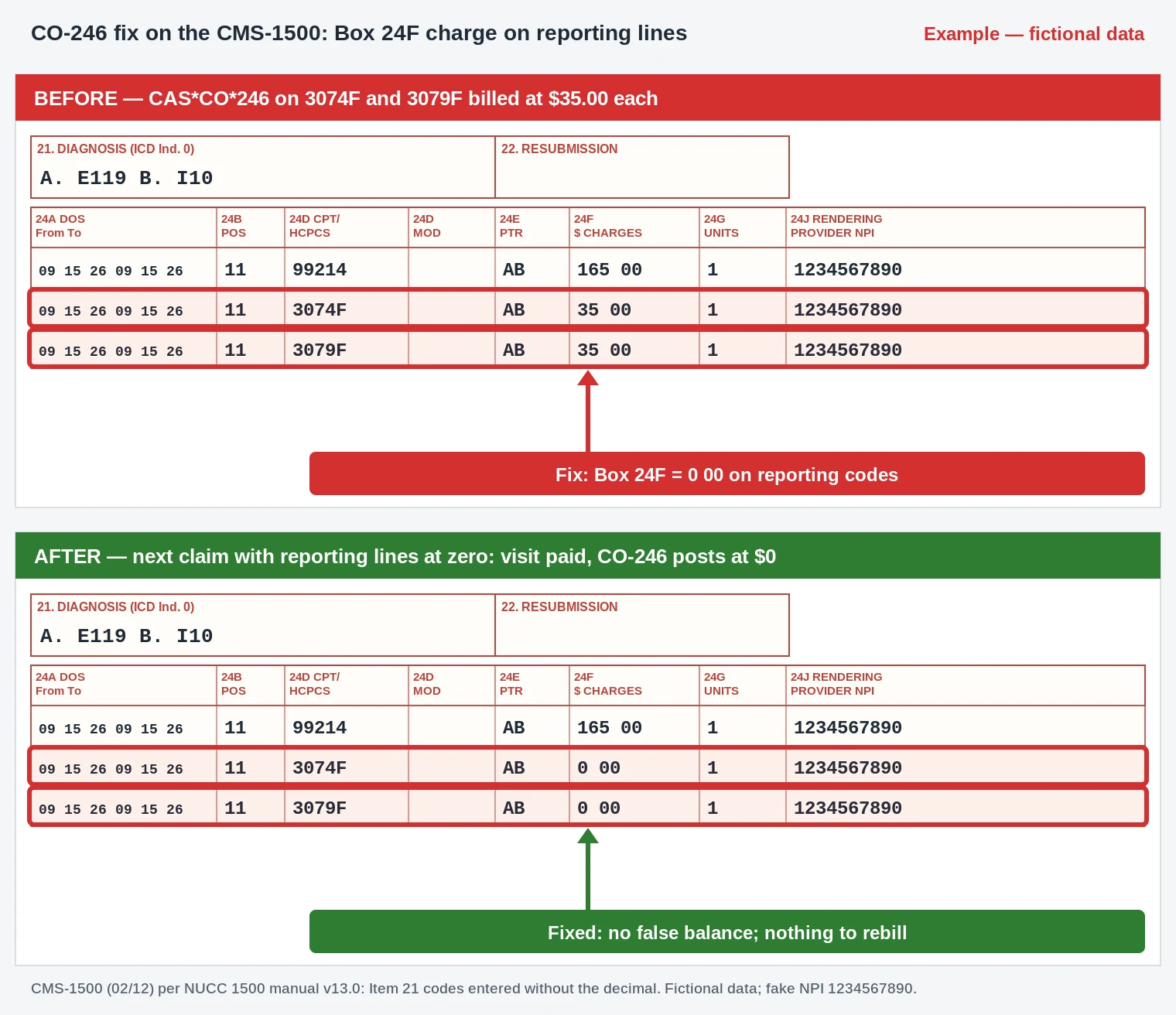
UB-04 not shown: the CPT Category II codes here are reported on the professional claim, not the hospital bill.
- Box 24F: 3074F and 3079F changed from 35 00 to 0 00 (payer rule for reporting codes).
- Box 24D: the 99214 visit line and its charge are unchanged; it had paid.
- Box 21: E11.9 and I10 (entered as E119 and I10) are unchanged.
- Box 22: left blank; no corrected claim, because nothing payable was denied.
- UB-04: not used; these quality codes are on the professional claim.
CO-246 compared with other zero-pay codes
| Code | Meaning | Action |
|---|---|---|
| CO-246 | Reporting-only code | Post at zero |
| CO-97 | Bundled into another service | Check modifiers |
| CO-234 | Procedure not paid separately | Review the edit |
| CO-16 | Missing information | Add the data and resend |
FAQ
Is CO-246 a denial?
Not really. The code was never payable, and the payer is confirming it received the data.
What charge should a reporting code have?
Most payers expect $0.00. Some systems need $0.01. Follow your payer’s billing rules.
Should I appeal CO-246?
No. There is nothing to recover on a reporting-only line.
Why did my visit deny when I left off a CPT II code?
Some plans require quality codes for certain services. The remark N572 flags that case.
Can I bill the patient for a CO-246 line?
No. Group code CO, and there is no charge to collect.
Sources
How we checked: each code quote on this page was matched word for word with the X12 CARC and RARC lists on 24 October 2026.
- X12, Claim Adjustment Reason Codes (CARC 246). Accessed 24 Oct 2026.
- X12, Remittance Advice Remark Codes (N620, N565, N572). Accessed 24 Oct 2026.
- CMS, Quality Payment Program. Accessed 24 Oct 2026.
- NUCC, 1500 claim form instructions. Accessed 24 Oct 2026.
Last updated: 24 October 2026 · Educational content; not legal advice.
Related denial codes
- CO-245: Provider Performance Withhold
- CO-253: Sequestration Reduction in Federal Payment
- CO-237: Legislated or Regulatory Penalty
- CO-256: Service Not Payable Per Contract
- CO-235: Sales Tax on the Remit
- CO-223: When a Law Sets the Payment
- CO-222: Provider Cap Explained
- CO-212: Administrative Surcharges Not Covered