
CO-269 is an anesthesia denial. The surgery or procedure may be covered, but the plan says it won’t pay for anesthesia with it. The usual reasons are a policy that treats the procedure as one that doesn’t need an anesthesia provider, or a procedure that isn’t covered at all. (Primary source: X12 Claim Adjustment Reason Codes)
In brief: CARC 269 reads “Anesthesia not covered for this service/procedure.” Find the payer policy behind it, check whether the patient’s case meets that policy’s exceptions, and appeal with records only when it does.
Part of our denial codes library. Written by Manikandan J, CPC, CRCR, who has worked anesthesia denials for payers and billing companies. Published 24 October 2026. Last updated: 24 October 2026. Code wording quoted word for word from X12. Read about the author and our editorial policy, or contact us to report an error.
The code, word for word
| Field | Value |
|---|---|
| Code | 269 |
| Description | “Anesthesia not covered for this service/procedure.” |
| Usage | Points to the policy ID in the 835 Healthcare Policy REF segment, if present |
| Start | 11/01/2014 |
Source: X12 Claim Adjustment Reason Codes, checked 24 October 2026.
Key terms: A CARC is a Claim Adjustment Reason Code from the X12 list, and it says why a line was paid differently than billed. A RARC is a Remittance Advice Remark Code that adds detail to the CARC. The group code is the two-letter prefix on the adjustment; CO means contractual obligation: the provider owns the balance and it cannot be billed to the patient.
Methodology: the code wording above is copied from the X12 list, and each fix step below links to the payer or CMS page it comes from.
Example scenario (fictional names), part 1
CO-269 Denial Example: What Happened
Rhea Collins bills for Summit Anesthesia, a fictional group. A CRNA gave monitored anesthesia care for an upper endoscopy.
The plan paid the gastroenterologist. The anesthesia claim came back with CAS*CO*269.
What should Rhea check before she appeals? Keep reading, or jump to how the CO-269 denial was resolved.
Where CO-269 comes from
- Policy says no anesthesia provider needed. For example, some commercial plans limit separate anesthesia for routine endoscopy unless the patient meets risk criteria.
- The procedure itself isn’t covered. If the surgery is excluded, its anesthesia is excluded too. That often pairs with CO-96.
- Missing medical need. The record doesn’t show why anesthesia was needed. See CO-50.
- Wrong link to the procedure. The anesthesia code or the procedure it points to doesn’t match what was done.
What to do, in order
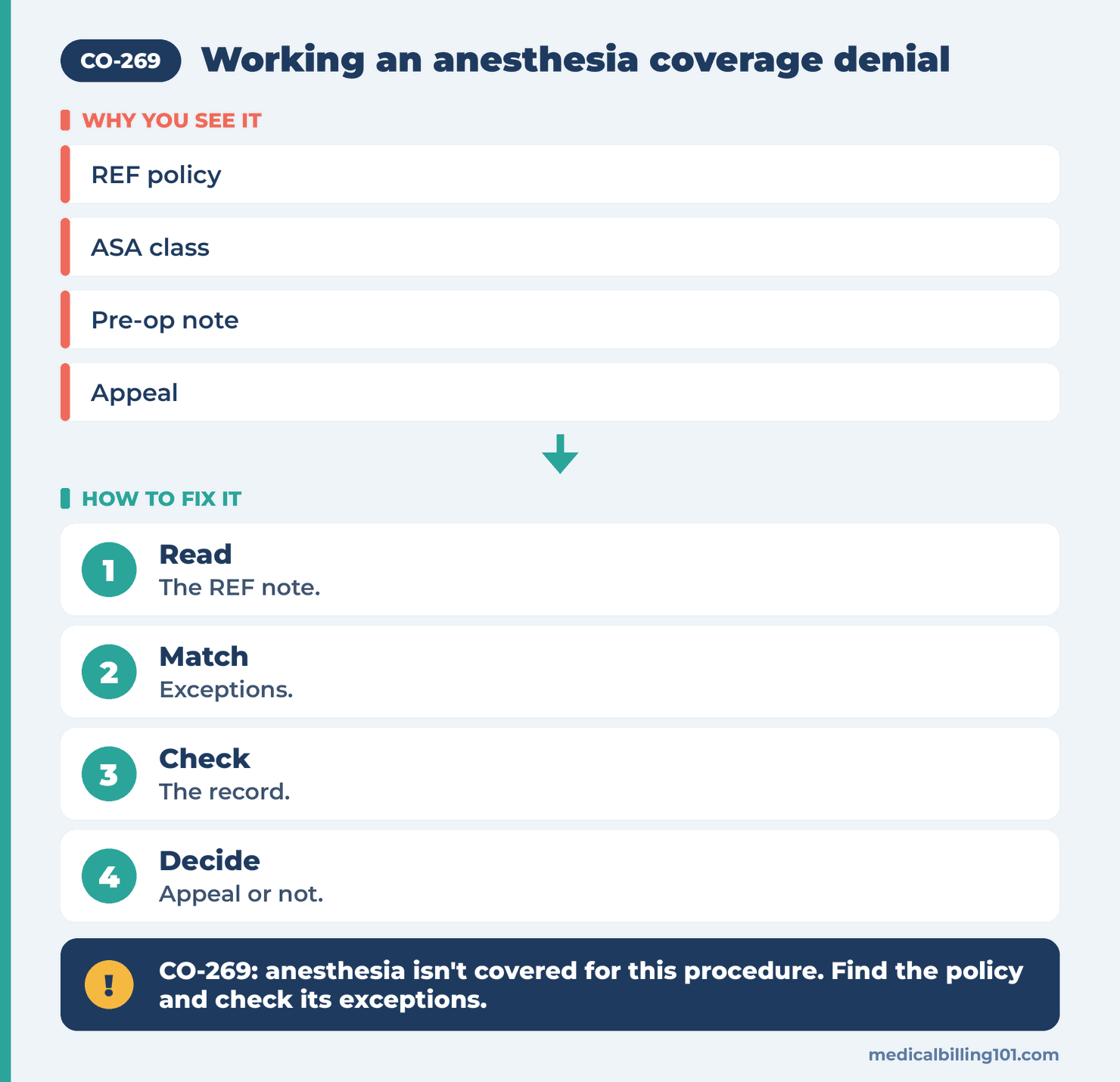
- Read the remit note. If the 835 has a policy ID in the REF segment, pull that policy.
- Match the policy’s exceptions. Many policies allow anesthesia when the patient has risk factors such as sleep apnea, a high ASA class or a failed past sedation.
- Check the record. The pre-anesthesia note should state those risk factors in plain words.
- Appeal or write off. If the patient meets an exception, appeal with the note. If not, follow the contract. A CO amount usually can’t go to the patient.
- Fix the front end. Check the plan’s anesthesia rule when the case is scheduled.
A plan’s records rules shape this step. Our guide on medical necessity documentation shows what reviewers look for.
Claim form note
No claim form visual is shown here. CO-269 is fixed with policy proof and records, not by changing a box on the claim.
Example scenario (fictional names), part 2
How the CO-269 Denial Was Resolved
Rhea pulled the plan’s anesthesia policy named in the REF segment.
Fix: The policy allowed anesthesia for patients with severe sleep apnea. The pre-anesthesia note listed it. She appealed with the note and the policy section.
Outcome: The plan paid the anesthesia claim. The group now runs a policy check for endoscopy cases at scheduling.
Names and details are illustrative; no real patient data.
Related denials
| Code | Meaning | First step |
|---|---|---|
| CO-269 | Anesthesia not covered | Find the policy |
| CO-96 | Non-covered charge | Check plan exclusions |
| CO-50 | Not medically necessary | Send records |
| CO-4 | Modifier problem | Check modifiers |
Anesthesia billing rules for Medicare are in the Medicare Claims Processing Manual, chapter 12.
FAQ
What does CO-269 mean?
The plan does not cover anesthesia for that procedure, even if the procedure itself was paid.
Can I bill the patient for CO-269?
Usually not. A CO amount is the provider’s to absorb unless the contract or a signed waiver allows billing.
Is CO-269 the same as CO-96?
No. CO-96 is a general non-covered charge. CO-269 points only at the anesthesia.
Can CO-269 be appealed?
Yes, when the patient meets the policy’s exceptions and the record shows it.
Where do I find the policy?
Look in the 835 REF segment for a policy ID, or check the payer’s anesthesia policy page.
Sources
How we checked: the code quote on this page was matched word for word with the X12 CARC list on 24 October 2026.
- X12, Claim Adjustment Reason Codes (CARC 269). Accessed 24 Oct 2026.
- CMS, Medicare Claims Processing Manual, chapter 12. Accessed 24 Oct 2026.
Last updated: 24 October 2026 · Educational content; not legal advice.
Related denial codes
- CO-270: Bill the Patient's Dental Plan
- CO-256: Service Not Payable Per Contract
- CO-254: Send It to the Medical Plan
- CO-212: Administrative Surcharges Not Covered
- PR-204: Not Covered Under the Patient's Current Benefit Plan
- PR-202: Non-Covered Personal Comfort or Convenience Services
- CO-188: Covered Only When Used per FDA Recommendations
- CO-169: Alternate Benefit Has Been Provided