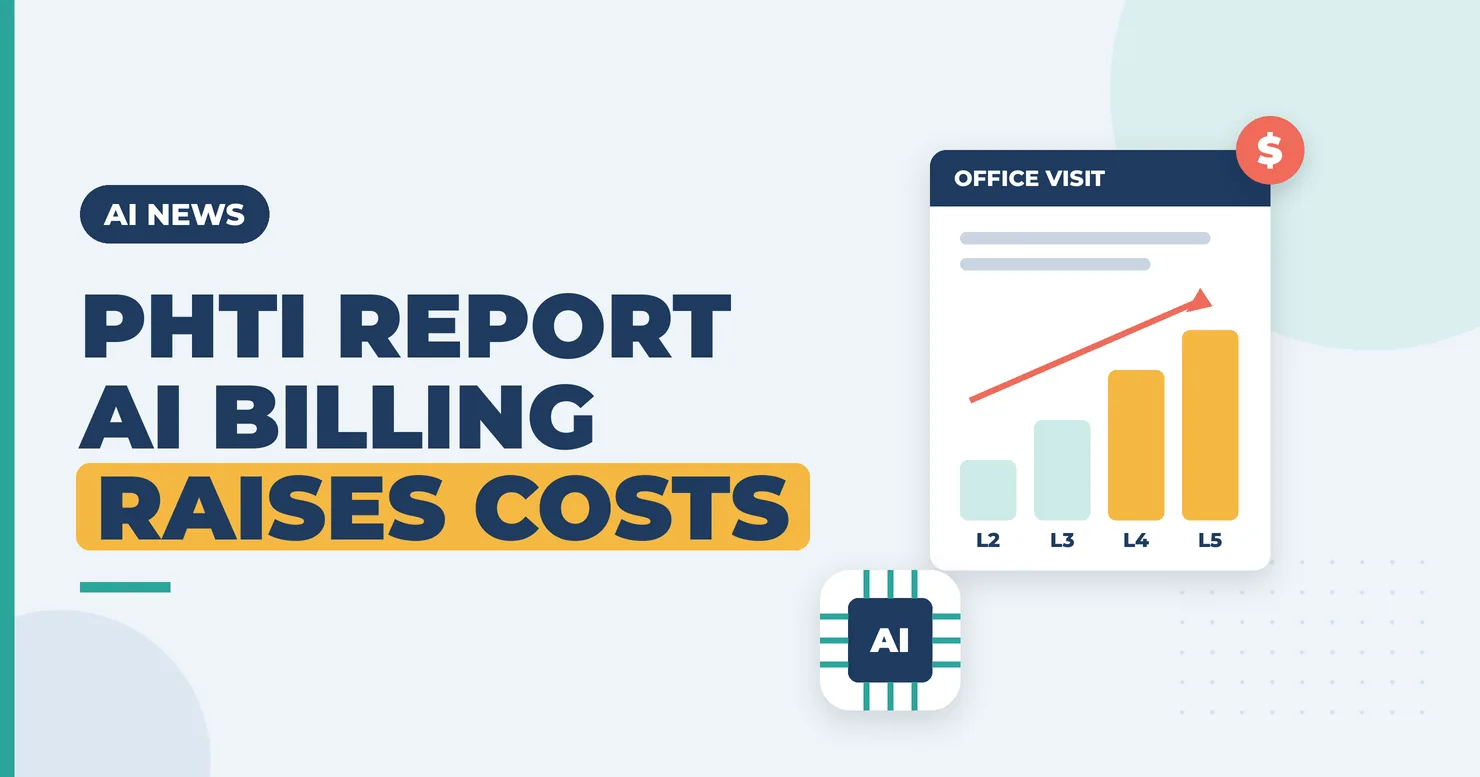
On October 14, 2026, the Peterson Health Technology Institute (PHTI) released a report called Driving Adoption of High-Value AI in Healthcare. Its core finding is blunt. The AI tools spreading fastest are the ones that fit fee-for-service pay: billing, coding and prior auth tools. PHTI says they make the system “more activity-intensive, rather than more efficient” under today’s incentives. At one health system, an AI scribe led to 5% more Level 5 visits and 7% more Level 4 visits for established patients (PHTI, Oct. 2026). Axios got the report first. For coders and billers, the message is clear. AI-driven coding gains will draw audits, and payers are building their own AI to push back.
The Peterson Health Technology Institute is a nonprofit group that rates digital health tools. This report is a policy paper, not a new claims study. It pulls together published data, vendor reports and expert interviews. It is still useful. It shows where the debate is going: toward new pay rules and more audits, and both will land on your claims.
Key takeaways
- The main claim: Administrative AI that automates billing, coding and prior auth is growing fastest because it pays off under fee-for-service. PHTI says it often adds activity and cost for the system as a whole.
- E/M intensity: At one multihospital system, an AI scribe was linked to 5% more Level 5 and 7% more Level 4 established-patient visits (KLAS, Jan. 2026, cited by PHTI). That came to about $1,004 more revenue per provider per month. The KLAS report studied Suki’s platform.
- Prior auth: About 60% of prior auth transactions still use phone or fax (CAQH Index, cited by PHTI in 2026). PHTI says insurers and vendors “have not yet reported evidence” that AI lowers the average cost per claim after paying for the AI.
- Payer response: Health plans describe “an immediate increase in coding intensity” when provider AI tools go live, and several are deploying algorithms to find coding outliers.
- Biller move: Audit your E/M level mix before and after any AI scribe or coding tool goes live. Make sure every higher level is backed by medical decision-making or time in the note.
How this article was checked: PHTI report PDF (Market Trend Report, October 2026), pages on administrative AI, prior authorization and medical billing; Axios (Oct. 14, 2026) for quotes from PHTI executive director Caroline Pearson; Becker’s Hospital Review coverage (Oct. 2026). Numbers are quoted as PHTI reported them, with PHTI’s own sources named. We did not invent data. Reviewed under our editorial policy. Educational only, not legal advice.
Table of Contents
What the PHTI report found
The report splits AI into two groups. Clinical AI is software that helps deliver care, such as blood pressure checks at home or mental health support. Administrative AI is software that handles payment and paperwork, such as notes, coding, appeals and prior auth. PHTI says the second group is growing faster because fee-for-service pays for it right away.
| Finding | What PHTI reported | Source PHTI cites | How to treat it |
|---|---|---|---|
| Administrative waste | About $350 billion a year, including $266 billion from administrative complexity | Shrank et al., JAMA (2019) | Peer-reviewed estimate, widely cited |
| AI scribe and E/M levels | 5% more Level 5 and 7% more Level 4 established-patient visits at one multihospital system | KLAS, “Suki ROI Validations 2026” (Jan. 2026) | One system, vendor-linked study. Not a national rate |
| Revenue per provider | Average $1,004 per month increase per provider using an AI scribe | Same KLAS report | Vendor ROI study. Check your own data |
| Prior auth channels | 60% of prior auth transactions rely on phone or fax | CAQH Index (2025 report) | Industry survey data |
| Cost per prior auth cycle | About $40 to $50 for plans and $20 to $30 for providers per submission cycle | Sahni et al., Health Affairs Scholar (2024) | Published estimate |
| Payer variation | More than 5,000 procedure codes need prior auth across four big insurers, but only 3% need it at all four | Jabri et al., medRxiv preprint (2025) | Preprint, not yet peer-reviewed |
| AI cost per claim | Insurers and vendors have not reported evidence AI lowers average cost per claim after AI costs | Mello et al., Health Affairs (2026), cited by PHTI | Absence of evidence, not proof of no savings |
| Real-time prior auth pilot | Optum Rx PreCheck with Cleveland Clinic: 88% fewer appeals and 68% fewer missing-info denials | Self-reported pilot results, in the PHTI report (2026) | Self-reported. PHTI says scaling is unproven |
The report also quotes an unnamed expert on prior auth. “AI tools are flooding the system,” the expert said. Bots “don’t get tired of asking questions,” so the review queue “keeps growing” as a result.
Why higher E/M levels after AI will draw audits
Coding intensity is the share of claims billed at higher-paying levels or with more diagnosis codes. For example, consider a primary care group that moves from mostly Level 3 to more Level 4 visits after turning on an AI scribe. The notes may be more complete. The patients may truly be complex. But the payer only sees the shift in the claims. PHTI says health plans notice “an immediate increase in coding intensity” when provider AI tools go live. Several plans now use algorithms “to identify coding outliers, adjust reimbursement, and scrutinize claims” (PHTI).
We covered the same fight in Blue Cross Blue Shield’s $942 million AI coding report and the hospital response. PHTI adds an outpatient E/M angle and a policy frame. The $1,004 figure also links back to Suki, whose $90M AI agents raise we covered on Oct. 13.
What coders should check before and after go-live
- Baseline. Pull your E/M level distribution by provider and specialty for 6 to 12 months before the AI tool starts.
- Compare. Re-run it 30, 60 and 90 days after go-live. Flag any provider whose Level 4 and 5 share jumps sharply.
- Sample. Audit a set of high-level visits. Confirm that medical decision-making (MDM) or total time supports the level.
- Watch the note. AI scribes can add history and review-of-systems detail. For office visits, CMS says history and exam must be medically appropriate but are not used to pick the level. MDM or time is (CMS MLN E/M guide).
- Fix fast. If the AI suggests codes, log who accepted each suggestion. Coach providers on any pattern before a payer finds it.
Want more? Our list of OIG audit triggers shows other red flags. Our medical necessity guide shows what reviewers look for in the note.
The prior auth “arms race” PHTI describes
PHTI says both sides now use AI. Provider tools write letters, fill forms and draft appeals. Payer tools sort requests, route them and help make decisions. Each side gets faster. But the hardest cases come from plan rules that differ and from fights over medical necessity. AI does not fix those. The result, PHTI says, is more back-and-forth, not less.
What that means for your team:
- Faster submissions can lead to faster denials. Expect more volume at the appeal stage, not less.
- Payer-by-payer rules still drive most rework. A tool that does not track each plan’s current code list will produce CO-197 denials quickly and at scale.
- When a prior auth is denied, the fix is still the same. Get the criteria, match the chart to them, and appeal on time. See what to do when a prior authorization is denied.
PHTI points to the CMS-0057 prior authorization API rule, due Jan. 1, 2027, as a needed step (CMS fact sheet; our CMS-0057 guide). It says the rule may help with simple requests, but it is too early to know the impact at scale. The report also suggests requiring payers to publish machine-readable medical policies and to give clear denial reasons with next steps.
What PHTI wants payers and policymakers to change
PHTI executive director Caroline Pearson told Axios the report “is meant to be a call to action” for the industry. Without change, she warned, “everything gets more expensive and we don’t get the benefits we hope for” from AI.
The report sets out three ideas for paying for AI:
- Payment should reward lower total spending with the same or better outcomes, not just use of the tool.
- Payment models need guardrails against overuse, such as withheld payments or price cuts as use grows.
- Outcome-based models are a good place to start. PHTI names the CMS ACCESS model, launched in July 2026 with more than 160 participating organizations.
For billing teams, the takeaway is that the policy debate is moving toward limits on AI-driven coding gains. Build your audit trail now.
What this means for insured patients
- If a visit was billed at a higher level than you expected, you can ask the office for an itemized bill and the visit code. See how to read your explanation of benefits.
- Higher visit levels can mean higher cost-sharing when you have a deductible or coinsurance. Ask before you pay if something looks off.
- Prior auth delays are still real. If care is held up, ask your clinic for the authorization status and the payer’s reason in writing.
FAQ
What did the PHTI report say about AI in medical billing?
PHTI said AI scribing and coding tools increase billing intensity. At one health system, an AI scribe led to 5% more Level 5 and 7% more Level 4 established-patient visits (KLAS, 2026). PHTI also said health plans see an immediate rise in coding intensity when provider AI tools go live.
Where does the $1,004 per provider figure come from?
PHTI cites a KLAS Research report from January 2026 on Suki’s AI scribe. At one health system, each provider using the scribe brought in about $1,004 more per month on average. It is a vendor-linked study, not a national average.
Does AI lower the cost of prior authorization?
Not yet, based on public data. PHTI says insurers and vendors have not reported evidence that AI lowers the average cost per claim once the cost of the AI tool is included. It says automation on both sides can add more back-and-forth.
Will payers audit AI-assisted E/M coding?
Yes, more of them will. PHTI says several health plans now use algorithms to find coding outliers and adjust pay. Coders should compare E/M levels before and after an AI tool goes live. Make sure MDM or time backs up each level.
Is the PHTI report against AI in healthcare?
No. PHTI says AI used in care could widen access and lower costs. Its warning is about how we pay. Fee-for-service rewards billing tools that add more work. PHTI wants payment that rewards better results and lower total spending.