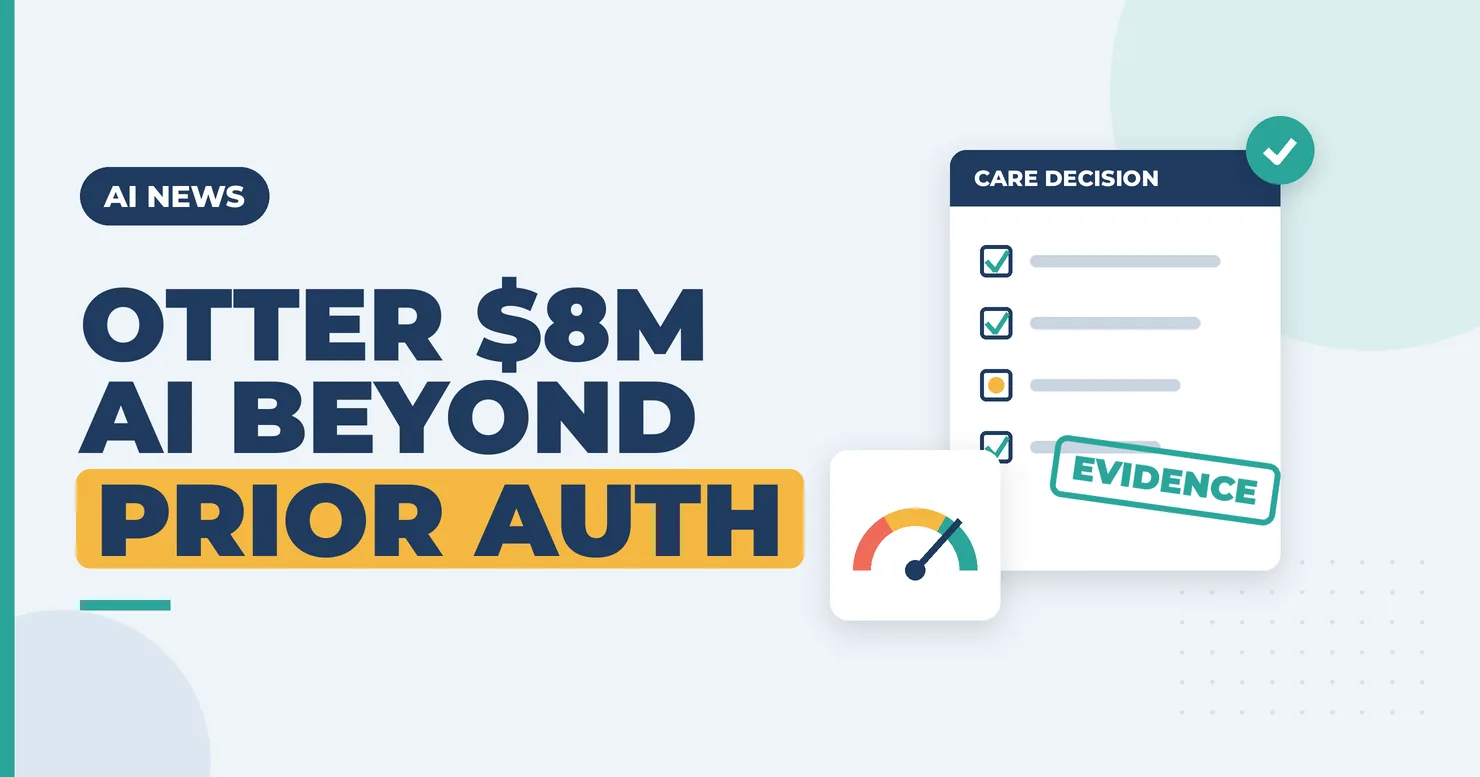
On October 15, 2026, Otter Health launched with $8 million in seed funding co-led by Fika Ventures and Evidenced. The startup sells an AI platform that compares clinical decisions with evidence-based care standards in real time. Its pitch is that a health plan can drop prior authorization for some services and still see, doctor by doctor, whether care stays appropriate. The company says early customers removed prior auth in some areas while keeping “non-concordant” decisions below 5% (Otter Health, Oct. 2026). That figure is company-reported and has not been independently published. Fierce Healthcare’s interview with CEO Keith Florance frames it as an exit from the prior auth “arms race.” For billers, the real question is simple. If the auth step goes away, what replaces it on the claim?
This lands in a busy week for prior auth reform. UnitedHealthcare told investors on Oct. 13 that it will cut total prior auths by 30% this year (our analysis). On Oct. 14, Centene announced a gold card program for high-performing providers. And a new Peterson Health Technology Institute report argued that AI on both sides of prior auth adds back-and-forth (our PHTI breakdown). Otter is betting on a different model: fewer gates, more measurement.
Key takeaways
- The raise: $8 million seed round, co-led by Fika Ventures and Evidenced. Six other firms joined.
- The product: An AI tool that works with any EHR. It checks referrals, outpatient procedures and care transitions against care standards. Doctors get peer comparisons and feedback.
- The claim: Customers that removed prior auth with Otter’s engagement kept non-concordant decisions under 5% (company-reported, Oct. 2026). Customers are not named and no study is public.
- What changes for billing: Fewer missing-auth denials on waived services, but more scoring of each doctor. Public materials do not say how “non-concordant” care is paid.
- Biller move: Get any prior auth waiver in writing, by code and plan. Keep showing why care was needed, even when no auth is required.
How this article was checked: Otter Health press release (PR Newswire, Oct. 15, 2026); Fierce Healthcare interview with CEO Keith Florance and investor Bryan Sivak (Oct. 15); Healthcare Dive on Centene’s gold card program (Oct. 14). Company performance claims are labeled as company-reported. We did not test the product. Reviewed under our editorial policy. Educational only, not legal or investment advice.
Table of Contents
What Otter Health announced (and what it did not)
Utilization management is the set of tools a health plan uses to decide which care it pays for. Prior auth is one tool. Reviews during a hospital stay and after a claim are others. Otter wants to replace part of that kit. Instead of asking first, its tool scores care choices against standards as they happen. Both the plan and the doctor see the same view.
| Claim | Source | Independently verified? |
|---|---|---|
| $8M seed co-led by Fika Ventures and Evidenced, plus six other investors | Press release; Fierce | Investor list matches in both |
| Founders include Amol Navathe, MD, PhD, Keith Florance, Ram Keralapura and Will Bartlett | Fierce | As reported |
| AI compares referrals, outpatient procedures, pathway adherence and care transitions with evidence-based standards | Press release | Product description from the company |
| Removing prior auth with Otter’s engagement kept non-concordant decisions under 5% | Press release; Fierce | Company-reported. No public study, customers unnamed |
| Customers “captured substantial savings on low-value care” | Press release | Company-reported. No dollar figure given |
| Over 60% (release) or roughly 60% (Fierce) of low-value spending happens outside prior auth controls | Otter estimate, via Fierce | Company estimate. Method not published |
| Platform already used by “major payers and provider groups” | Fierce | Company statement. No names |
| Physicians complete nearly 40 prior auths per week, and 93% say prior auth delays care | American Medical Association survey, cited by Otter | Third-party survey data |
Two notes for your due diligence. First, non-concordant means, in Otter’s usage, a care choice that does not match its standard. The release does not say who sets that standard or how often it changes. It also does not say what happens to the claim when a choice is flagged. Second, the under-5% figure has no denominator or time period in the release or other public materials.
Why billing teams should care
Florance told Fierce that making prior auth faster only makes it “taste better.” He wants to remove the workflow, not speed it up. He also said prior auth should work more like a “penalty box” for outliers. That idea is close to gold carding, where a payer exempts providers with strong approval histories. Centene, UnitedHealthcare and Humana all run versions of gold card programs, per Healthcare Dive.
A gold card program is a payer policy that exempts providers with strong approval records from routine prior auth. For a billing office, a “no prior auth” world changes the risk, not the workload. Here is what to expect.
Front end: fewer auth denials, more rule tracking
Say a plan waives prior auth for a service through a program like this. You should then see fewer CO-197 denials for missing precertification on that service. But waivers are often narrow. They may cover certain codes, certain sites or certain providers only. Centene’s new program, for example, still requires a pre-notification before the service.
What to do:
- Get every waiver in writing. List the plan, product line, CPT/HCPCS codes, start date and any notice step.
- Add the rules to your eligibility and auth checks. Staff should not ask for auths that are no longer needed, or skip ones that still are.
- Re-check quarterly. Investor Bryan Sivak told Fierce a customer could “begin with a particular procedure or referral pattern” and then expand. Scope will change over time.
Start that tracking sheet from our surgical prior auth checklist.
Back end: medical necessity still has to be in the chart
Removing the auth gate does not remove the payer’s right to review. For example, consider an outpatient MRI that no longer needs prior auth. If the platform flags the order as non-concordant, the plan may follow up with a record request, a scorecard note or a later review. Public materials do not say Otter’s program denies claims. But a plan using it could pair it with retrospective review.
So keep the same habits:
- Write down why the service was needed and which guideline it meets, even when no auth is needed. See what payers look for in medical necessity documentation.
- Track any new not medically necessary denials on services that left the prior auth list.
- If a denial does come, follow the steps in our prior authorization denied guide. The appeal logic is the same.
Provider scorecards become a revenue issue
If a payer uses real-time concordance scores, those scores may affect gold card status, network tiering or value-based contracts. Ask the plan:
- Will doctors see their own scores and the cases behind them?
- Can the practice dispute a “non-concordant” label? How?
- Is the score tied to pay, network status or prior auth waivers?
- Does a human clinician review the label before any action? Our Fitch human-review analysis and Alabama AI prior auth law guide explain why that matters.
What this means for providers and health systems
Otter says it works with health plans, health systems and risk-bearing provider groups. For risk-bearing groups, the tool may act like an internal care-variation dashboard. For fee-for-service practices, it will most likely show up as a payer program. Either way, treat it like any AI that scores clinical decisions:
- Ask for the evidence sources behind each standard and the update schedule.
- Ask for the false-flag rate, meaning how often a decision marked non-concordant turns out to be appropriate on review.
- Make sure the contract says who owns the data and how long scores are kept.
Also keep the federal timeline in view. The CMS-0057 rule still requires impacted payers to support prior auth APIs from Jan. 1, 2027, for services that still need auth (CMS fact sheet). Our CMS-0057 guide covers the details.
What this means for insured patients
- If your plan drops prior auth for a service, your care may start sooner. That is the main promise of these programs.
- You still have the right to appeal if a claim is later denied. Ask for the reason and the criteria in writing.
- If your doctor says a test was “flagged,” ask whether it affects your coverage or only the doctor’s quality score.
FAQ
What is Otter Health?
Otter Health is a health tech startup. It launched on Oct. 15, 2026, with $8 million in seed funding. Its AI tool checks care choices against care standards in real time. The goal is to let health plans drop prior auth for some services.
Does Otter Health eliminate prior authorization?
Not across the board. The company says some customers dropped prior auth in certain areas and used its tool to watch care instead. Each health plan decides which services, if any, no longer need prior auth.
Is the non-concordant decision figure verified?
No. It is a company-reported result (Oct. 2026) from unnamed early customers. Otter has not published a study, the number of cases or a time period. Ask for those details before relying on the figure.
Will removing prior authorization reduce claim denials?
It should mean fewer denials for a missing prior auth, such as CO-197, on waived services. It may not cut medical-necessity denials. Plans can still review claims after the visit, so good notes still matter.
How is this different from a gold card program?
A gold card program lets doctors with a strong track record skip routine prior auth. Otter’s tool checks care choices against care standards as they happen. Both cut the need to ask first. Otter also keeps scoring each doctor’s choices over time.