
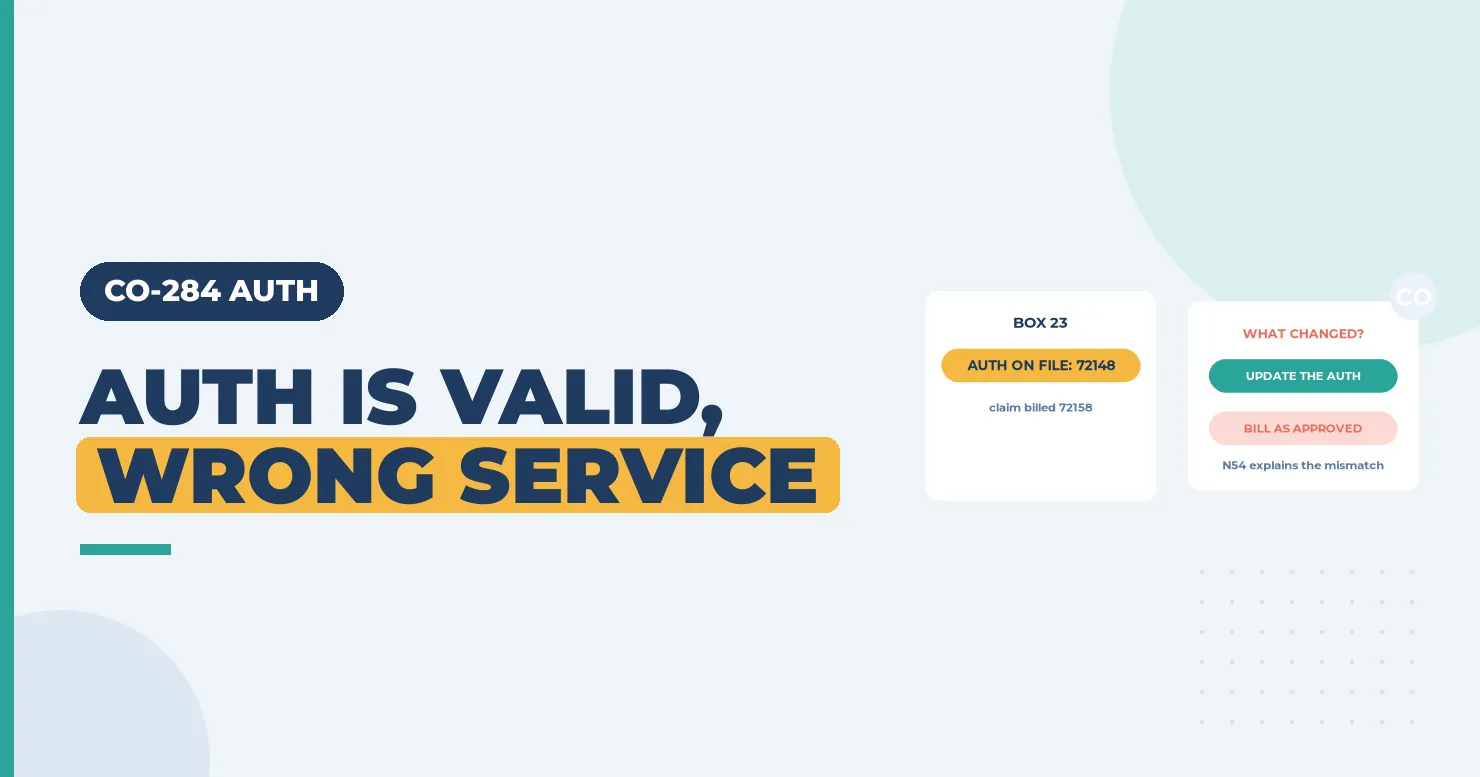
The CO-284 denial code means the plan found your authorization number, but it does not cover the service you billed. The number is real. The code, units, site or dates on the claim just fall outside it. The fix is to compare the claim with the approval, then update the authorization or correct the claim. (Primary source: X12 Claim Adjustment Reason Codes)
In brief: CARC 284 is a mismatch code, not a missing-auth code. A missing authorization usually comes back as CARC 197. CARC 284 says the number exists but was approved for something else. With CO, the provider cannot bill the patient for the line.
Part of our denial codes library. Written by Manikandan J, CPC, CRCR, who has worked authorization mismatch denials for imaging centers and outpatient surgery departments. Published 11 November 2026. Last updated: 11 November 2026. Code wording quoted word for word from X12. Read about the author and our editorial policy, or contact us to report an error.
What does denial code CO-284 mean?
Denial code CO-284 means the authorization on the claim does not apply to the billed services. The plan matched the number to an approval on file. Then it compared the approved service with the claim line, and the two did not agree.
| Field | Value |
|---|---|
| Code | 284 |
| Description | “Precertification/authorization/notification/pre-treatment number may be valid but does not apply to the billed services.” |
| Group codes | No X12 group restriction; CO is the most common |
| Start | 11/01/2017 |
Source: X12 Claim Adjustment Reason Codes, checked 11 November 2026.
Key terms: An authorization number is the reference the plan gives when it approves a service in advance. The approved scope is what the number covers: codes, units, dates and site. CO means contractual obligation, so the provider owns the denied amount.
Methodology: the code wording is copied from the X12 list, and the claim form fields follow the NUCC and NUBC instructions cited below.
CO-284 vs OA-284: what is the difference?
CO-284 means a contracted plan holds you to its authorization rules, so the mismatch is your loss unless you fix it. OA-284 reports the same mismatch without naming a contract, which you may see from a secondary plan or a payer you do not contract with. The fix steps are the same.
| Version | Who carries the denied line | Where you usually see it |
|---|---|---|
| CO-284 | Provider, under the payer contract | In-network imaging, surgery or therapy with a prior auth rule |
| OA-284 | No contract basis named | Secondary payer, out-of-network claim, or a crossover |
Neither version moves the balance to the patient. Read the remark code before you decide whether to correct or appeal.
Why does the authorization not match the claim?
The authorization does not match when the service changed after approval. For example, a radiologist adds contrast, a surgeon adds a procedure, or therapy runs past the approved visits. Each change creates a new code or unit count that the original number never covered.
Clerical errors cause the rest. The front desk may attach an auth from an earlier episode, or the claim may show a different site. If the billed provider is the mismatch, plans often use CARC 296 instead. Many payers also send N54, “Claim information is inconsistent with pre-certified/authorized services.”
Example scenario (fictional names), part 1
CO-284 Denial Example: What Happened
Rina Castillo bills for Lakeshore Imaging Center. Dr. Omar Velez ordered a lumbar spine MRI without contrast for low back pain with radiculopathy, M54.16, entered as M5416. The plan approved 72148 and gave an auth number.
During the scan, the radiologist saw a possible lesion and added contrast. The claim went out with 72158, the without-then-with study, and the same auth number in Box 23.
The 835 came back with CAS*CO*284 and N54 on the 72158 line. The auth number itself was valid.
So why did the plan reject a real authorization? Keep reading, or jump to how it was resolved. Keep reading, or jump to how the CO-284 denial was resolved.
How do I fix a CO-284 denial?
To fix a CO-284 denial, put the claim and the approval side by side. Compare fields such as the CPT or HCPCS code, units, dates, site and rendering provider. If the claim is wrong, send a corrected claim. If the service really changed, ask the plan to update the authorization, then rebill.
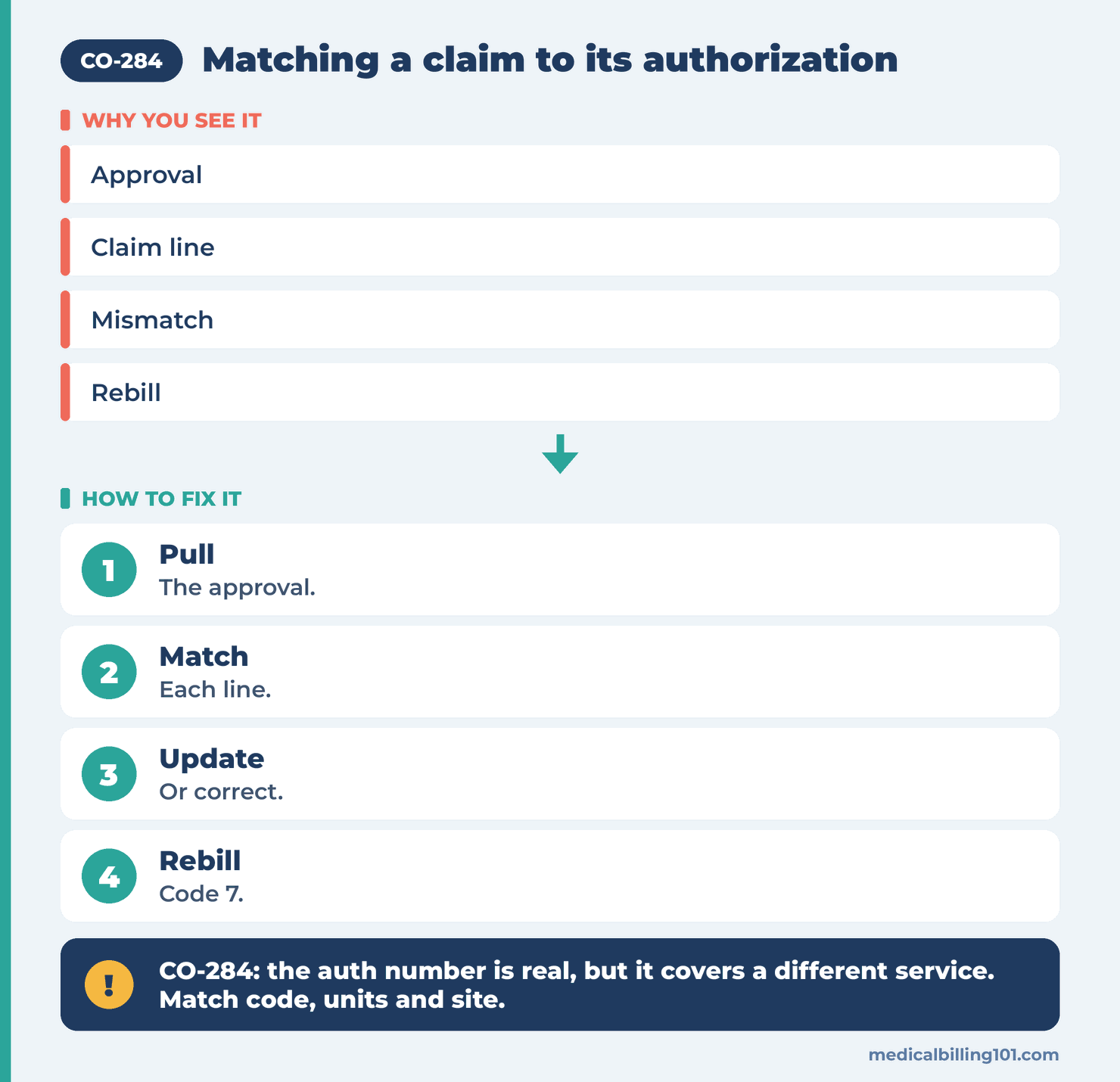
- Pull the approval letter. Note the exact codes, units, date span and site.
- Match each claim line. Mark every field that differs from the approval.
- Fix clerical errors. Correct the auth number, site or provider and send frequency code 7.
- Update a changed service. Call the plan’s utilization team and ask for a modification.
- Appeal if refused. Send the clinical note that explains why the service changed.
Example scenario (fictional names), part 2
How the CO-284 Denial Was Resolved
Rina pulled the approval. It listed 72148 only. The radiology report explained why contrast was added and named the possible lesion.
Fix: she called the plan’s utilization team the next morning. The plan added 72158 to the existing authorization after reviewing the report. Rina then sent a corrected claim with frequency code 7, the original claim number in Box 22 and the updated auth in Box 23.
Outcome: the plan reprocessed the line and paid 72158. Rina added a rule that flags any imaging claim where the billed code differs from the approved code.
Names and details are illustrative; no real patient data.
Names and details are illustrative; no real patient data.
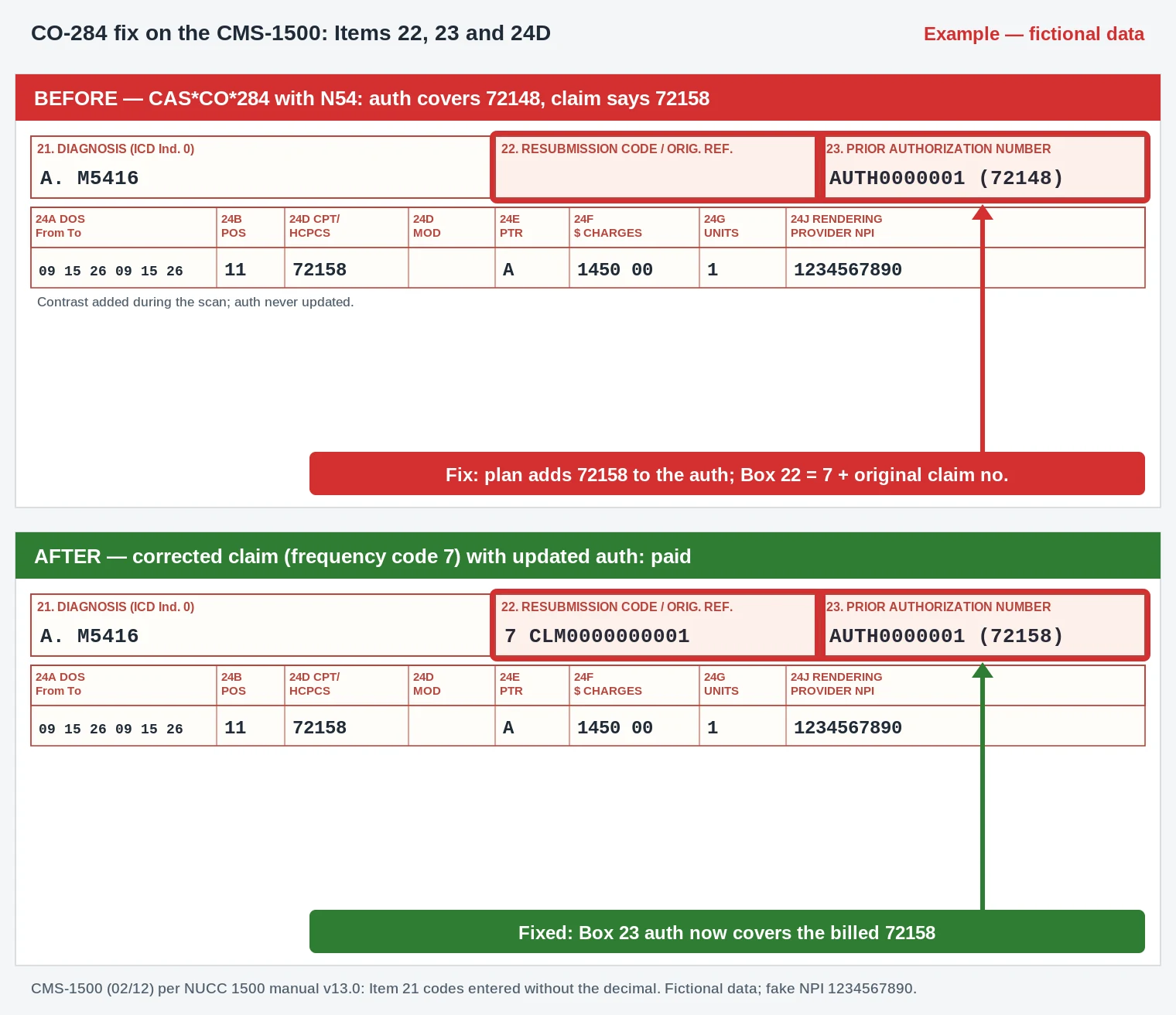
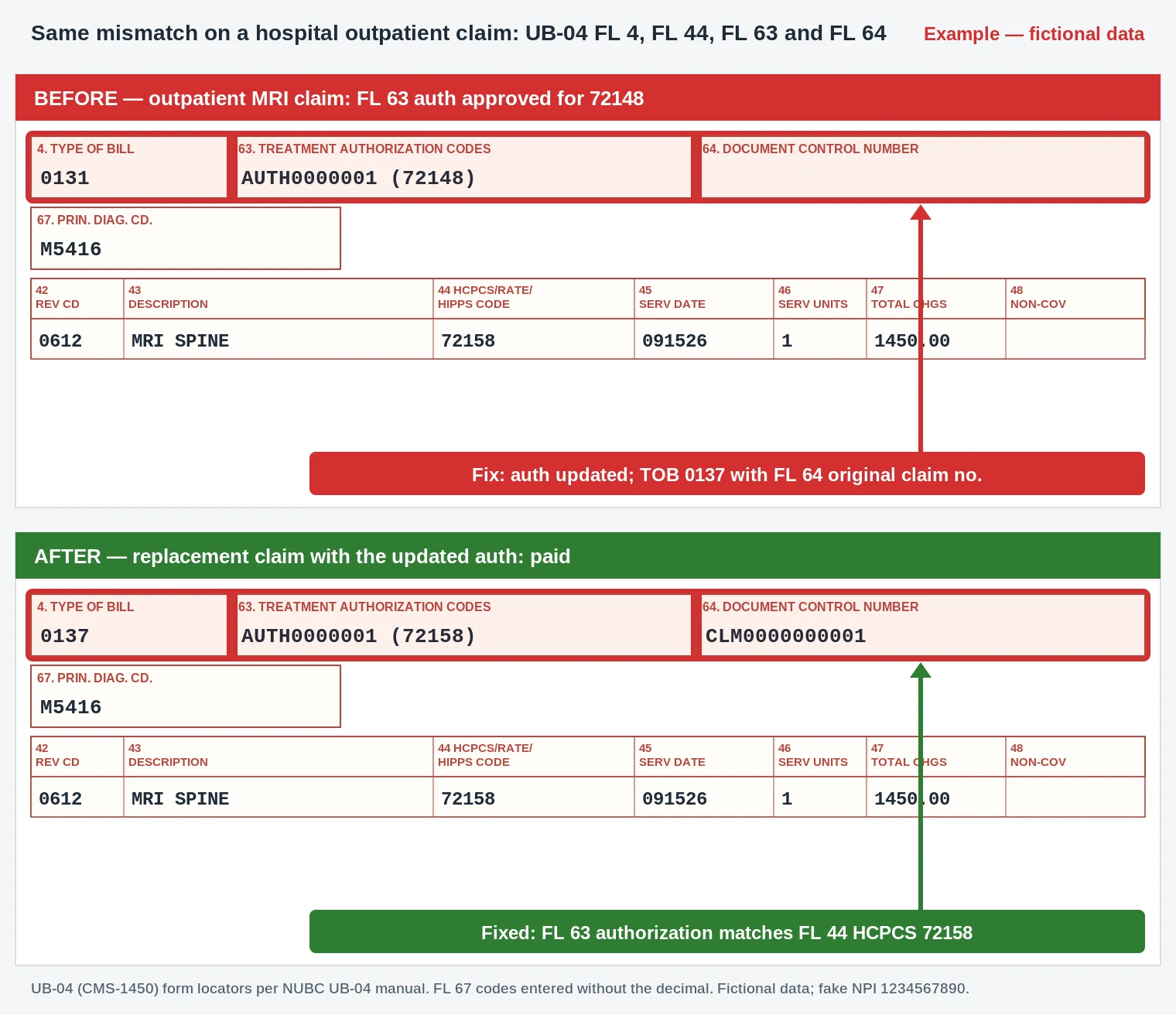
- Box 23 / FL 63: the plan updated the authorization to cover 72158, so the same number now matches the billed study.
- Box 24D / FL 44: 72158 stays; the service really changed, so the code was not edited to fit the old approval.
- Box 22 / FL 4 + FL 64: frequency code 7 with the original claim number (bill type 0137 on the UB-04).
- Box 21 / FL 67: M54.16 (entered as M5416) is unchanged.
Can I prevent CARC 284 when the service changes on the day?
Yes, you can prevent most CARC 284 denials with a same-day check. Train staff to flag any change in code, side, units or site before the patient leaves. Then contact the plan right away. Many plans allow a short window to update an authorization after an unplanned change.
Each plan sets its own window, so read your provider manual. Medicare Advantage plans must follow their own prior authorization rules under 42 CFR 422.138. Keep the call reference number with the claim.
Can I bill the patient for CO-284?
No, you cannot bill the patient for a CO-284 amount. CO means your contract with the payer puts the denied line on you. Getting authorization is usually the provider’s job under the contract. Fix the mismatch or appeal instead of sending a patient statement.
Related codes
| Code | Meaning |
|---|---|
| CO-197 | Precertification, authorization or notification absent |
| CO-198 | Precertification or authorization exceeded |
| CO-15 | Older auth code, stopped by X12 on 05/01/2018 |
| CO-16 | Claim lacks information needed for adjudication |
FAQ
What does CO-284 mean?
The authorization number may be valid, but it does not cover the service on the claim.
Is CO-284 the same as CO-197?
No. CO-197 means no authorization was found. CO-284 means one was found, but for a different service.
Is CO-284 the same as CO-15?
No. X12 stopped CARC 15 on 05/01/2018. Today CARC 284 covers a service mismatch, and CARC 296 covers a provider mismatch.
Should I send a corrected claim for CO-284?
Yes, if a claim field was wrong. If the service changed, update the authorization first.
Does the patient owe a CO-284 amount?
No. CO puts the amount on the provider under the contract.
Sources
How we checked: the CARC 284 quote was matched word for word with the X12 CARC list on 11 November 2026, and N54 with the X12 RARC list.
- X12, Claim Adjustment Reason Codes (CARC 284, 197, 15). Accessed 11 Nov 2026.
- X12, Remittance Advice Remark Codes (N54). Accessed 11 Nov 2026.
- eCFR, 42 CFR 422.138 (Medicare Advantage prior authorization). Accessed 11 Nov 2026.
- NUCC, 1500 claim form instructions (Items 22, 23). Accessed 11 Nov 2026.
- HealthCare.gov, preauthorization definition. Accessed 11 Nov 2026.
Last updated: 11 November 2026 · Educational content; not legal advice.
Related denial codes
- CO-279: Services Not From a Preferred Network Provider
- CO-243: Services Not Authorized by the PCP
- PR-242: Services Not Provided by Network or Primary Care Providers
- CO-210: Authorization Received Too Late
- CO-198: Precertification or Authorization Exceeded
- CO-197: Precertification or Authorization Absent
- CO-183: Referring Provider Not Eligible to Refer
- CO-95: Plan Procedures Not Followed