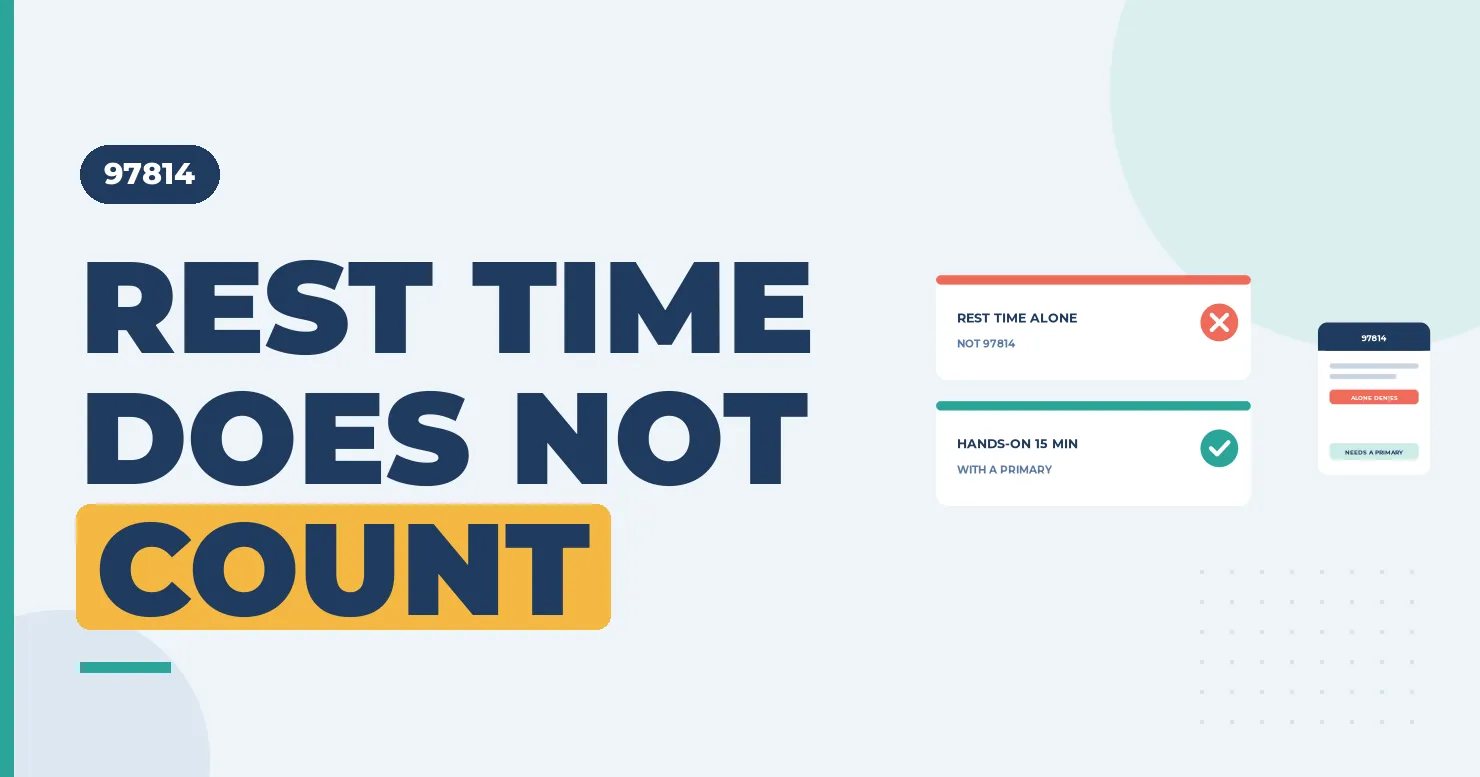
Is 97814 billed alone for extra needle time? No. It needs 97810 or 97813 first, plus 15 more minutes of hands-on contact.
The fix: count only the minutes the practitioner spends with the patient doing acupuncture work. Time the patient rests alone with needles in is not billable.
TL;DR: CPT 97814 is an add-on code for each additional 15 minutes of electroacupuncture with personal one-on-one contact and re-insertion of needles. It cannot stand alone on a claim. It also cannot be billed for retention time while the patient lies on the table without the practitioner. Bill 97810 or 97813 for the first 15 minutes, then add 97811 or 97814 only for documented hands-on time.
Written by Manikandan J, CPC, CRCR, a certified coder and revenue cycle specialist. Published 25 November 2026. Last updated: 25 November 2026.
Table of Contents
Can 97814 be billed for time the needles stay in?
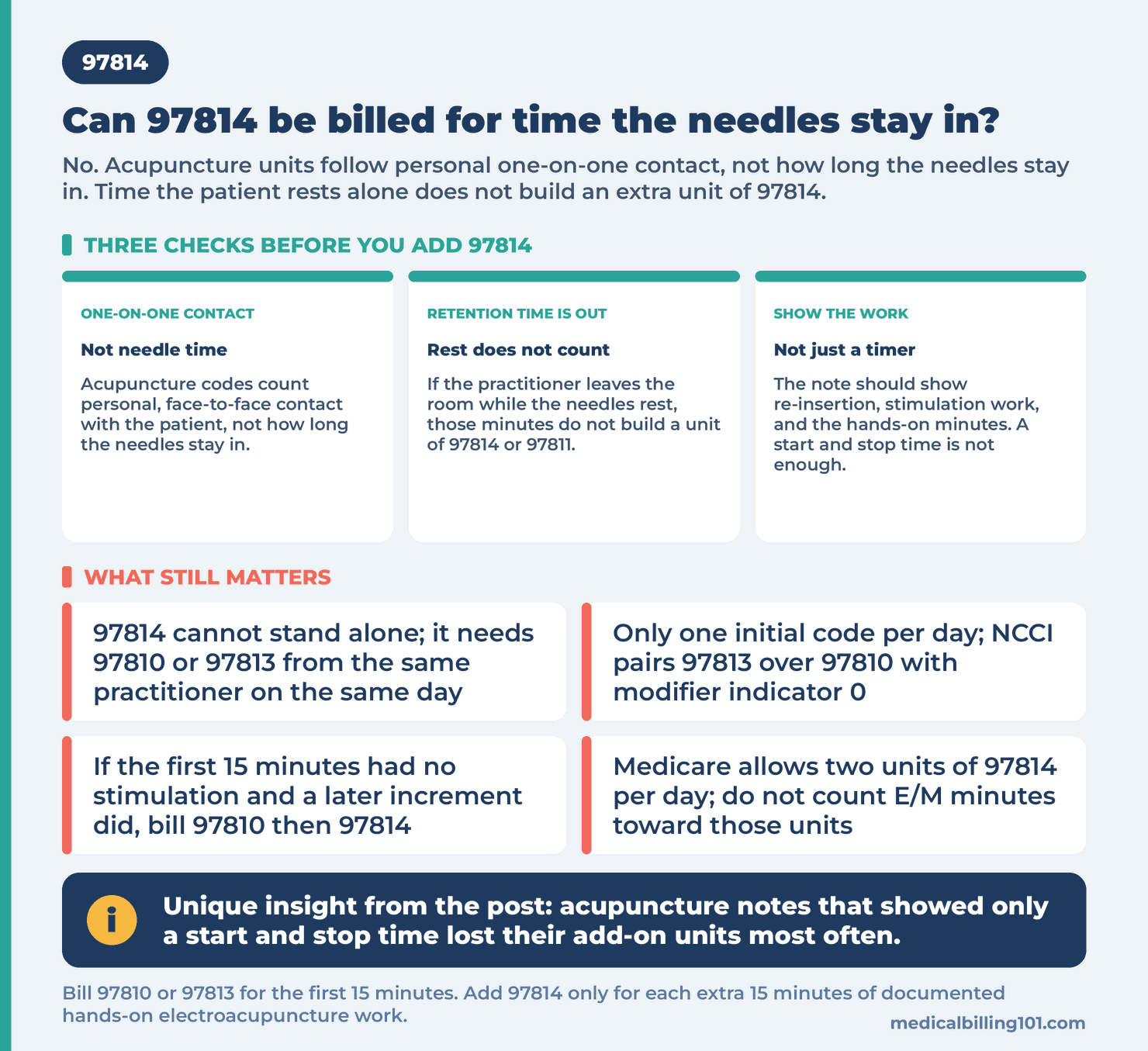
No. Acupuncture codes count personal, face-to-face contact with the patient, not how long the needles stay in. If the practitioner leaves the room while the needles rest, those minutes do not build an extra unit of 97814 or 97811.
The CPT acupuncture guidelines say this before the codes begin. Each code descriptor repeats the phrase “personal one-on-one contact with the patient.” Payers enforce the same rule in writing.
The UnitedHealthcare acupuncture reimbursement policy states that units follow face-to-face time, not the duration of needle placement. Its Q&A says time away from the patient never counts.
Example scenario (fictional names), part 1
97814 billed alone example: what happened
- Clinic: Lantern Creek Integrative Care, a fictional clinic in Oregon. Halina Brandvold handles the billing.
- Visit: Dr. Rafael Ostrowski treated chronic low back pain (M54.50). He placed needles, connected electrical stimulation and checked the patient over 15 minutes.
- Then: he left the room for 30 minutes while the needles stayed in. He returned and removed them.
- Claim: 97813 plus two units of 97814 to a fictional commercial plan.
After a records review, the plan paid 97813 and denied both 97814 units with the CO-151 denial code.
Should Halina appeal those two units? Keep reading, or jump to how the case was resolved.
What do CPT codes 97810 to 97814 describe?
The four codes split by electrical stimulation and by time. 97810 and 97813 cover the initial 15 minutes. 97811 and 97814 are add-ons for each additional 15 minutes of personal one-on-one contact, with re-insertion of needles.
- 97810: acupuncture, 1 or more needles, without electrical stimulation, initial 15 minutes of personal one-on-one contact.
- 97811: the same, without electrical stimulation, each additional 15 minutes, with re-insertion of needles.
- 97813: acupuncture with electrical stimulation, initial 15 minutes of personal one-on-one contact.
- 97814: with electrical stimulation, each additional 15 minutes of personal one-on-one contact, with re-insertion of needles.
CMS quotes these descriptors in MLN Matters MM13288. Electroacupuncture means a current runs through at least one needle. Re-insertion means needles go back in during the added time. Retention time is the period the needles simply stay in place. So the note should show active work, not a timer.
Can 97814 be billed without 97810 or 97813?
No. 97814 is an add-on code, so it needs a primary code from the same practitioner on the same day. Its only primary codes are 97810 and 97813. A claim with 97814 alone will deny.
The CMS NCCI add-on code edits list 97811 and 97814 as Type 1 add-ons with those two primaries. Type 1 add-ons are never paid unless a listed primary is also paid. The 2026 Medicare fee schedule file also gives both add-ons the global indicator ZZZ.
Only one initial code is reported per day. The 2026 Q4 Medicare practitioner edits pair 97813 over 97810 with modifier indicator 0, so no modifier can unbundle them. You can confirm pairs on the CMS NCCI PTP edits page or with our NCCI edit checker.
Codes can mix across increments. If the first 15 minutes had no stimulation and a later increment did, bill 97810 and then 97814. The UnitedHealthcare policy gives this exact example.
What time counts toward an extra unit of 97814?
Only active, one-on-one acupuncture work counts. For example, re-inserting needles, adjusting the stimulation and caring for the patient during treatment all count. Rest time without the practitioner, and time spent on a separate visit, do not count.
| Activity during the session. | Counts toward 97811 or 97814? |
|---|---|
| Re-inserting needles and running the stimulation with the patient. | Yes, this is the added work the descriptor names. |
| Staying with a patient who becomes ill after insertion. | Yes, UnitedHealthcare cites this as billable time. |
| Patient rests with needles in, practitioner out of the room. | No, retention time is excluded. |
| Assessment before and after needling, and home instructions. | No, it is part of the initial code. |
| A significant, separate E/M service. | No, bill it apart with modifier 25 and keep its time out. |
When I worked payer-side claim reviews, acupuncture notes that showed only a start and stop time lost their add-on units most often.
How many units of 97814 can you bill in one day?
Medicare allows two units of 97814 per day. The 2026 Q4 practitioner MUE table sets 97811 and 97814 at 2, and 97810 and 97813 at 1. So one day carries at most one initial code and two add-on units.
The add-on MUEs use adjudication indicator 3, a clinical date-of-service edit. The initial codes use indicator 2, a policy edit. Check the current values on the CMS MUE page or our MUE lookup tool.
UnitedHealthcare applies the same per-day maximums on commercial claims. It also denies needle supply codes A4212 and A4215 billed with acupuncture.
Does Medicare pay for 97814?
Only for chronic low back pain. NCD 30.3.3 covers up to 12 visits in 90 days, 8 more if the patient improves, and no more than 20 treatments a year. Acupuncture for any other condition is non-covered.
The NCD defines chronic low back pain as lasting 12 weeks or longer, nonspecific, and not tied to surgery or pregnancy. Licensed acupuncturists may furnish it as auxiliary personnel under the required supervision of a physician, PA, NP or CNS.
MM13288 counts one session as one initial code, with or without the add-ons, on a date of service. Medicare will not accept dry needling, 20560 or 20561, on the same date as 97810 through 97814. Chiropractic care has a similarly narrow benefit, as our answer on chiropractic maintenance care under Medicare explains.
Can you bill an E/M visit with acupuncture on the same day?
Yes, but only for a significant, separately identifiable E/M service, such as a new problem worked up that day. Add modifier 25 to the E/M code. The usual check before and after needling is already part of 97810 or 97813, so it does not justify a visit.
Medicare edits pair each acupuncture code with office E/M codes under modifier indicator 1. Our answer on a sick visit billed with modifier 25 on the same day walks through the same test. Remember that minutes spent on the E/M visit cannot also count toward acupuncture units.
How do you fix a denied 97814 line?
Start with the note, not the remittance. If 97814 denied because no primary code paid, correct the claim. If it denied for units, compare documented hands-on minutes with the units billed. Appeal only when the note proves the time.
- Read the CARC on the denied line. A CO-151 denial means the payer found the records do not support that many services.
- Add up only face-to-face minutes, with re-insertion and stimulation work clearly noted.
- If the claim was coded wrong, send a corrected claim with frequency code 7. Use our appeal letter generator only when the record supports every unit.
Timed codes from the 97000 range draw the same unit questions. Our answer on 97750 billing for Humana Medicare Advantage shows another timed-code review.
Example scenario (fictional names), part 2
How the 97814 case was resolved
- Halina read the note line by line. Dr. Ostrowski spent 15 minutes with the patient, then 30 minutes away while the needles rested.
- No needles were re-inserted, and no stimulation was adjusted in the added time. Neither 97814 unit had support.
- She did not appeal. She posted the CO-151 adjustment and kept 97813 as paid.
Fix: the clinic changed its template to log each block of hands-on minutes and every re-insertion.
Outcome: later claims billed 97814 only when the note showed another 15 minutes of active work.
Names and details are illustrative; no real patient data.
3-step checklist
- Bill one initial code per day: 97810 without stimulation or 97813 with it.
- Add 97811 or 97814 only for each extra 15 minutes of documented one-on-one work.
- Leave out retention time, E/M time and anything above two add-on units a day.
FAQ
Can 97814 be billed alone?
No. 97814 is an add-on code. It is paid only with 97810 or 97813 billed by the same practitioner on the same day.
Does needle retention time count for 97814?
No. Acupuncture units follow personal one-on-one contact with the patient. Time the patient rests alone with needles in does not count.
Can 97810 and 97813 be billed on the same day?
No. Only one initial acupuncture code is reported per day, and NCCI pairs 97813 over 97810 with modifier indicator 0.
How many units of 97814 does Medicare allow per day?
Two. The 2026 Q4 Medicare practitioner MUE for 97814 is 2 units per date of service.
Can 97810 be billed with 97814?
Yes. If the first 15 minutes had no electrical stimulation and a later increment did, bill 97810 and then 97814.
Sources
My methodology was simple. I checked the CPT descriptors as quoted by CMS, the coverage decision, the Medicare NCCI edit files and one national payer policy.
- AMA, CPT 2026 Professional, Acupuncture guidelines and codes 97810 to 97814. Accessed 25 Nov 2026.
- CMS, MLN Matters MM13288, NCD 30.3.3 Acupuncture for Chronic Low Back Pain (linked above). Accessed 25 Nov 2026.
- CMS, NCD 30.3.3, Acupuncture for Chronic Lower Back Pain (linked above). Accessed 25 Nov 2026.
- CMS, Medicare NCCI add-on code edits effective 1 October 2026, and 2026 Q4 practitioner PTP file v323r0, pair 97813/97810 (linked above). Accessed 25 Nov 2026.
- CMS, Medicare NCCI practitioner MUE table effective 1 October 2026 (linked above). Accessed 25 Nov 2026.
- CMS, 2026 Medicare Physician Fee Schedule RVU file, October release, global indicators for 97811 and 97814. Accessed 25 Nov 2026.
- UnitedHealthcare, Acupuncture Policy, Professional, 2026R6006A (linked above). Accessed 25 Nov 2026.
Read about the author, or contact us with a question. See our editorial policy.
Last updated: 25 November 2026 · Educational content for U.S. coding and billing teams. Code descriptions are plain-language summaries; check the current CPT code set for full wording.