
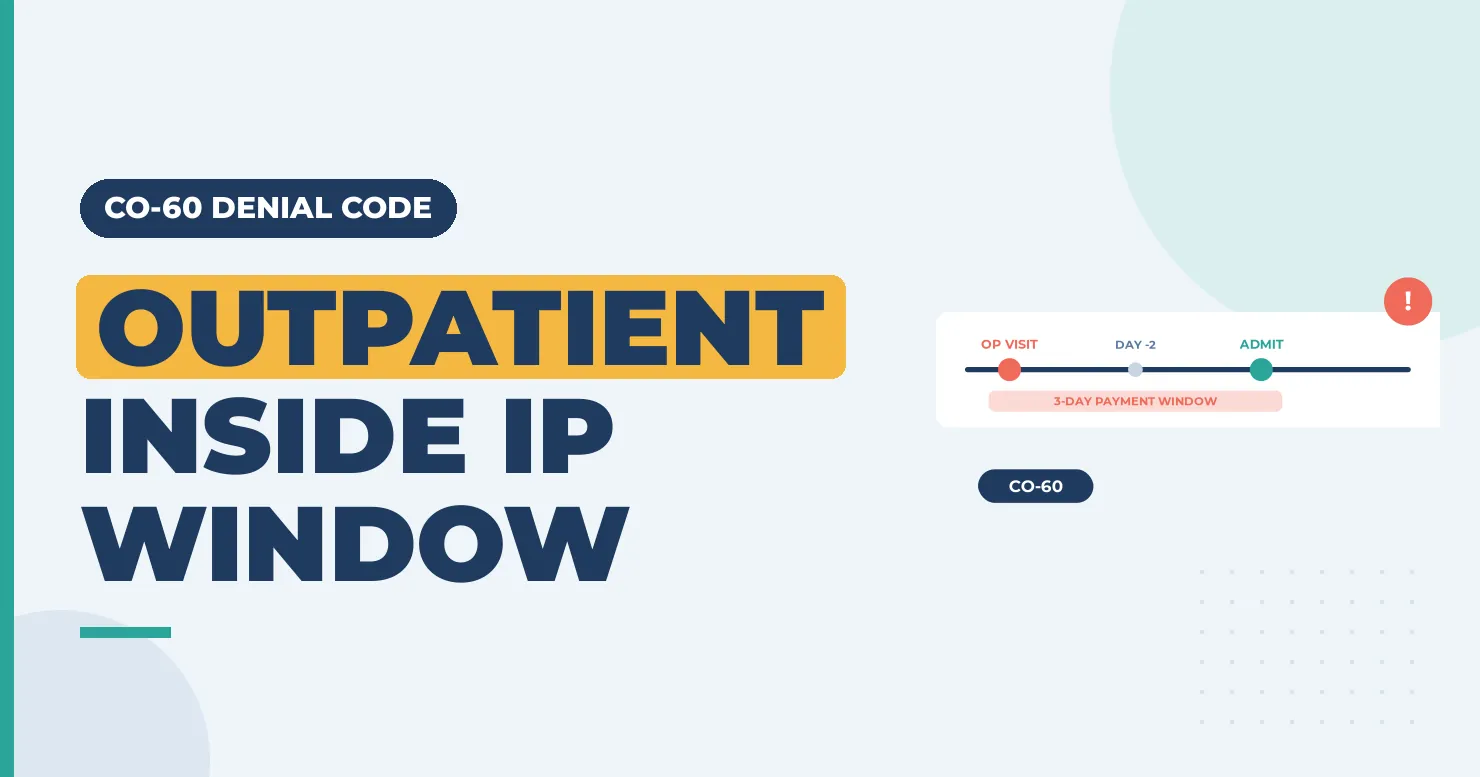
CO-60 is a Claim Adjustment Reason Code that means outpatient charges are not covered when they fall in a defined period before or after inpatient services. On Medicare hospital claims that period is the 3-day (or 1-day) payment window: outpatient diagnostic services and admission-related non-diagnostic services must be bundled onto the inpatient claim. (Primary sources: X12 Claim Adjustment Reason Codes · CMS, Three Day Payment Window · CMS CR 7502 FAQs)
Quick answer: CO-60 means the outpatient services sit inside the inpatient payment window, so they aren’t paid separately. For Medicare IPPS hospitals, bundle diagnostic and related nondiagnostic outpatient services from the admission day and the three prior calendar days onto the inpatient claim. Wholly owned Part B entities use modifier PD. Correct the bill type and resubmit; don’t keep appealing a correctly bundled window.
Part of our denial codes library. Written by Manikandan, a revenue cycle management specialist with more than 10 years of US medical billing experience. Last reviewed: 9 October 2026. Official code wording is quoted word for word from X12; Medicare rules link to their CMS or Medicare contractor source.
CO-60 denial code description (official X12 wording)
X12 Claim Adjustment Reason Code 60, verbatim:
“Charges for outpatient services are not covered when performed within a period of time prior to or after inpatient services.”
Source: X12 Claim Adjustment Reason Codes, checked 9 October 2026. Start: 01/01/1995 | Last Modified: 06/01/2008.
The phrase that matters is within a period of time prior to or after inpatient services. X12 leaves the exact period to the payer. Medicare defines it in the 3-day / 1-day payment window policy.
What CO-60 means in plain English
Each part of the code answers a different question:
- CO (Contractual Obligation) is the payer’s classification of who carries the amount. CMS says these adjustments are “Generally… considered a write off for the provider and are not billed to the patient” (Medicare Claims Processing Manual, Ch. 22, §60.1).
- CARC 60 tells you why: outpatient charges in the inpatient window aren’t separately payable.
For example, on Medicare, CMS’s payment-window policy requires a hospital to include on the inpatient claim “the diagnoses, procedures, and charges for all outpatient diagnostic services and admission-related outpatient non-diagnostic services” furnished during the window (CMS Three Day Payment Window). Detailed manual guidance is in the Medicare Claims Processing Manual, Chapter 3, §40.3.
In plain terms: if the outpatient visit sits too close to the inpatient stay, Medicare pays it as part of the inpatient claim.
CO-60 vs CO-97, CO-234, CO-18 and CO-B15
| Code | Official X12 text | What it tells you |
|---|---|---|
| 60 | “Charges for outpatient services are not covered when performed within a period of time prior to or after inpatient services.” | Outpatient care fell inside the inpatient window |
| 97 | “The benefit for this service is included in the payment/allowance for another service/procedure that has already been adjudicated. …” | Bundled into another payment (broader). See CO-97 |
| 234 | “This procedure is not paid separately. At least one Remark Code must be provided …” | Not paid separately; needs a remark |
| 18 | Exact duplicate claim/service (see OA-18 on our hub) | Duplicate billing, not window bundling. See OA-18 |
| B15 | “This service/procedure requires that a qualifying service/procedure be received and covered. …” | Missing qualifying service. See CO-B15 |
CO-60 is specifically about outpatient timing relative to an inpatient stay, not about NCCI procedure-to-procedure bundling in general.
CO-60 vs PR-60 vs OA-60 vs PI-60
| Group + 60 | Who carries the amount | Can you bill the patient? | When you’ll typically see it |
|---|---|---|---|
| CO-60 | Provider | No — services belong on the inpatient claim or aren’t separately payable | Typical Medicare/hospital remit |
| PR-60 | Patient | Only if truly patient liability | Rare for window bundling |
| OA-60 | Neither group fits | Check remark codes | When no other group code applies |
| PI-60 | Payer-initiated reduction | No | Non-Medicare remits only |
Remark codes that help with CARC 60
| RARC | Official X12 text | What it adds |
|---|---|---|
| M15 | “Separately billed services/tests have been bundled as they are considered components of the same procedure. Separate payment is not allowed.” | Bundling explanation |
| M144 | “Pre-/post-operative care payment is included in the allowance for the surgery/procedure.” | Global/pre-post packaging (different issue; don’t confuse with the 3-day window) |
| N130 | “Consult plan benefit documents/guidelines for information about restrictions for this service.” | Plan-specific window or bundling rule |
RARC wording is quoted from the X12 RARC list, checked 9 October 2026.
Where CO-60 shows up in the 835
Here’s a trimmed, illustrative example for an outpatient diagnostic line denied after an inpatient admission:
CLP*PT20260920A*4*850.00*0.00**MB*2626000777888~
SVC*HC:70450*850.00*0.00~
CAS*CO*60*850.00~
CLPstatus4means denied.CAS*CO*60*850.00adjusts the outpatient CT that fell inside the inpatient window.
This 835 snippet is illustrative only.
How to fix CO-60: decision path
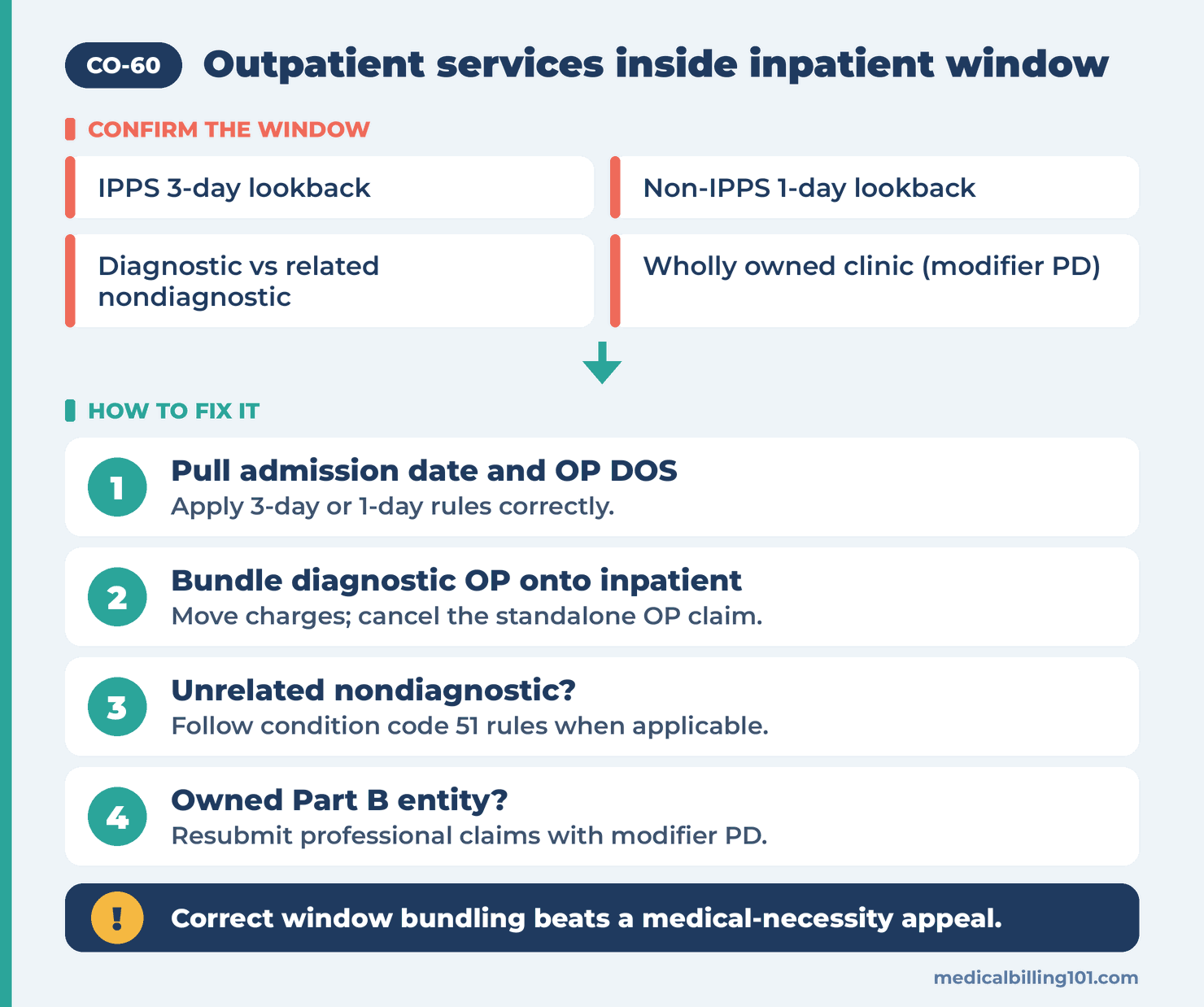
- Confirm the inpatient admission date. Pull the inpatient claim and calendar the admission day plus the look-back window.
- Apply the right window length. For IPPS hospitals, count the admit day and the three days before it. For non-IPPS hospitals, count the admit day and one day before it (CMS Three Day Payment Window; CR 7502 FAQ Q.1).
- Classify the outpatient services. Put diagnostic outpatient tests from the window on the inpatient claim. Related treatment services also go there. On the admit date, CMS treats almost all hospital services as related. The usual exceptions are ambulance and maintenance renal dialysis.
- Unrelated non-diagnostic services. CMS allows separate Part B billing for non-diagnostic services unrelated to the admission when billed with condition code 51 (hospital) as described in CMS payment-window materials — follow the current Claims Processing Manual instructions for your bill type.
- Hospital-owned Part B entities. Use modifier PD on physician/entity claims for diagnostic and related non-diagnostic services in the window; Medicare pays the professional component / facility rate as applicable (CR 7502 FAQs).
- Cancel or adjust the standalone outpatient claim and move charges onto the inpatient claim (or rebill with PD/condition code as appropriate).
- Commercial payers. Review the contract — some use a similar pre-admission bundling window with different day counts.
Medicare and major payer notes
CMS 3-day / 1-day payment window. For IPPS hospitals the look-back is three days. For non-IPPS hospitals it is one day. The rules sit in 42 CFR 412.2(c)(5), 413.40(c)(2) and 412.540. The Claims Processing Manual explains the steps in Chapter 3, §40.3 (CMS page).
Modifier PD. Use PD on claims from a hospital-owned clinic when the patient is admitted inside the window. The hospital should tell the clinic about the admission. CMS set this up so the clinic can bill the doctor part the right way.
Ambulance and maintenance renal dialysis. CMS treats these as special cases on the admit date. Check the current manual before you leave other services off the inpatient claim.
OPPS note. Outpatient packaging can cut lines for other reasons (see CO-97). CO-60 is only about the inpatient timing window.
Worked example (illustrative)
A beneficiary has an outpatient CT and labs on Monday at Hospital A. She is admitted to the same IPPS hospital Wednesday. The outpatient claim is still open and comes back CAS*CO*60.
Reading it: Monday is within three calendar days before the Wednesday admission, and the CT is diagnostic — it belongs on the inpatient claim.
Fix: cancel/adjust the outpatient claim, add the diagnostic charges and diagnoses to the inpatient UB-04, and resubmit the inpatient claim. If a wholly owned clinic billed the professional piece, append modifier PD.
Prevention: run a same-hospital admission check for the prior three days before dropping outpatient bills, and automate PD notification from the hospital to owned clinics.
CO-60 corrected-claim / rebilling template
[Date]
[MAC / payer] Claims / Provider Services
[Address, fax or portal reference]

Re: CO-60 outpatient services within inpatient window — corrected billing
Patient: [Name]   MBI / ID: [ID]   DOB: [MM/DD/YYYY]
Outpatient claim #: [Claim #]   Outpatient DOS: [MM/DD/YYYY]
Inpatient claim # / admit date: [Claim #] / [MM/DD/YYYY]
Provider: [Name, NPI, PTAN]

The remittance shows CAS*CO*60 for outpatient services inside the
[3-day / 1-day] payment window. Please:
[ ] Accept cancellation / adjustment of outpatient claim [number].
[ ] Accept corrected inpatient claim [number] that now includes the
    outpatient diagnostic / related nondiagnostic charges.
[ ] For wholly owned entity claim [number], accept resubmission with
    modifier PD per CMS CR 7502.

Enclosed: remittances, original and corrected claims, admission face
sheet, itemized outpatient charges.

[Name, credentials]  [Facility, NPI]  [Phone / email]
CO-60 prevention checklist
- Flag admissions and look back 3 days (1 day for non-IPPS) before finalizing outpatient bills.
- Bundle diagnostic outpatient services in the window onto the inpatient claim.
- Evaluate non-diagnostic services for “related” vs unrelated (condition code 51 when applicable).
- Notify wholly owned clinics of admissions; require modifier PD.
- Exclude only CMS-listed exceptions (for example ambulance, maintenance renal dialysis) after checking the current manual.
- Train outpatient and inpatient billers on shared account matching.
- Audit CO-60 monthly by facility and clinic.
- For commercial plans, document each payer’s pre-admit window rule.
Related denial codes
- CO-97: benefit included in payment for another service.
- OA-18: exact duplicate claim/service.
- CO-B15: qualifying service not received/covered.
- CO-24: charges covered under a capitation arrangement / MA plan.
- CO-109: claim must go to a different payer/contractor.
- CO-16: claim lacks information.
Easy rule of thumb
Count back from the admit date. For most hospitals, that means the admit day plus three days before it. If the outpatient visit falls in that span, put it on the inpatient claim.
In short
CO-60 means outpatient care sat inside the inpatient window. Move those charges to the inpatient claim. Use modifier PD for a hospital-owned clinic. Do not keep appealing a correct window edit.
FAQ
What is the CO-60 denial code description?
X12 describes CARC 60 as “Charges for outpatient services are not covered when performed within a period of time prior to or after inpatient services.” Medicare implements that idea through the 3-day / 1-day payment window.
How long is the Medicare payment window?
For IPPS hospitals, the window is the admission day plus the three preceding calendar days. For non-IPPS hospitals, it is the admission day plus one preceding calendar day (CMS Three Day Payment Window; CR 7502 FAQ).
What is modifier PD?
Modifier PD identifies diagnostic or related non-diagnostic services from a hospital-owned Part B entity when the patient is admitted within the payment window. CMS pays those claims under the rules in CR 7502.
Are all outpatient services in the window bundled?
All outpatient diagnostic services in the window are bundled. Admission-related non-diagnostic services are also bundled. CMS deems services on the admission date related except for ambulance and maintenance renal dialysis (confirm current manual text). Unrelated non-diagnostic services may be billed separately when rules (including condition code 51) are met.
Can I appeal a correct CO-60 window denial?
If the services truly belong in the window, rebilling onto the inpatient claim (or with PD) is the fix — not a medical-necessity appeal. Appeal only if the admission dates or ownership relationship were wrong.
How is CO-60 different from CO-97?
CO-97 is a general “included in the payment for another service” adjustment. CO-60 specifically means outpatient charges fell inside a pre/post-inpatient time window. Key named sources on this page include Claim Adjustment Reason Codes, Three Day Payment Window rules, Acute Inpatient Systems pages, Claims Processing Manual chapter notes and Centers For Medicare CR 7502 FAQ answers.
Quick facts
| Item | Value |
|---|---|
| X12 code | 60 |
| X12 start | 01/01/1995 |
| Last reviewed | 9 October 2026 |
| Page type | WordPress Page under Denial Codes hub 183 |
| Primary keyword | co-60 denial code |
Named contractor sources include First Coast Service Options materials where linked, plus Novitas Solutions and Noridian Healthcare Solutions pages cited above.
Sources
- X12, Claim Adjustment Reason Codes (CARC 60). Start 01/01/1995, Last Modified 06/01/2008. Accessed 9 Oct 2026.
- X12, Remittance Advice Remark Codes (M15, M144, N130). Accessed 9 Oct 2026.
- CMS, Three Day Payment Window
- CMS, CR 7502 Frequently Asked Questions (PDF)
- CMS, Medicare Claims Processing Manual (IOM 100-04), Ch. 3, §40.3 (see clm104c03.pdf)
- CMS, Medicare Claims Processing Manual (IOM 100-04), Ch. 22, §60.1 Group Codes
Last reviewed: 9 October 2026 · This page is educational and doesn’t replace payer-specific instructions.
Related denial codes
- CO-69: Day Outlier Amount on an Inpatient Claim
- CO-70: Cost Outlier Adjustment
- CO-74: Indirect Medical Education (IME) Adjustment
- CO-75: Direct Medical Education (DGME) Adjustment
- CO-76: Disproportionate Share (DSH) Adjustment
- CO-78: Non-Covered Days or Room Charge Adjustment
- CO-B9: Patient Is Enrolled in a Hospice
- CO-117: Transport Only Covered to the Closest Appropriate Facility