
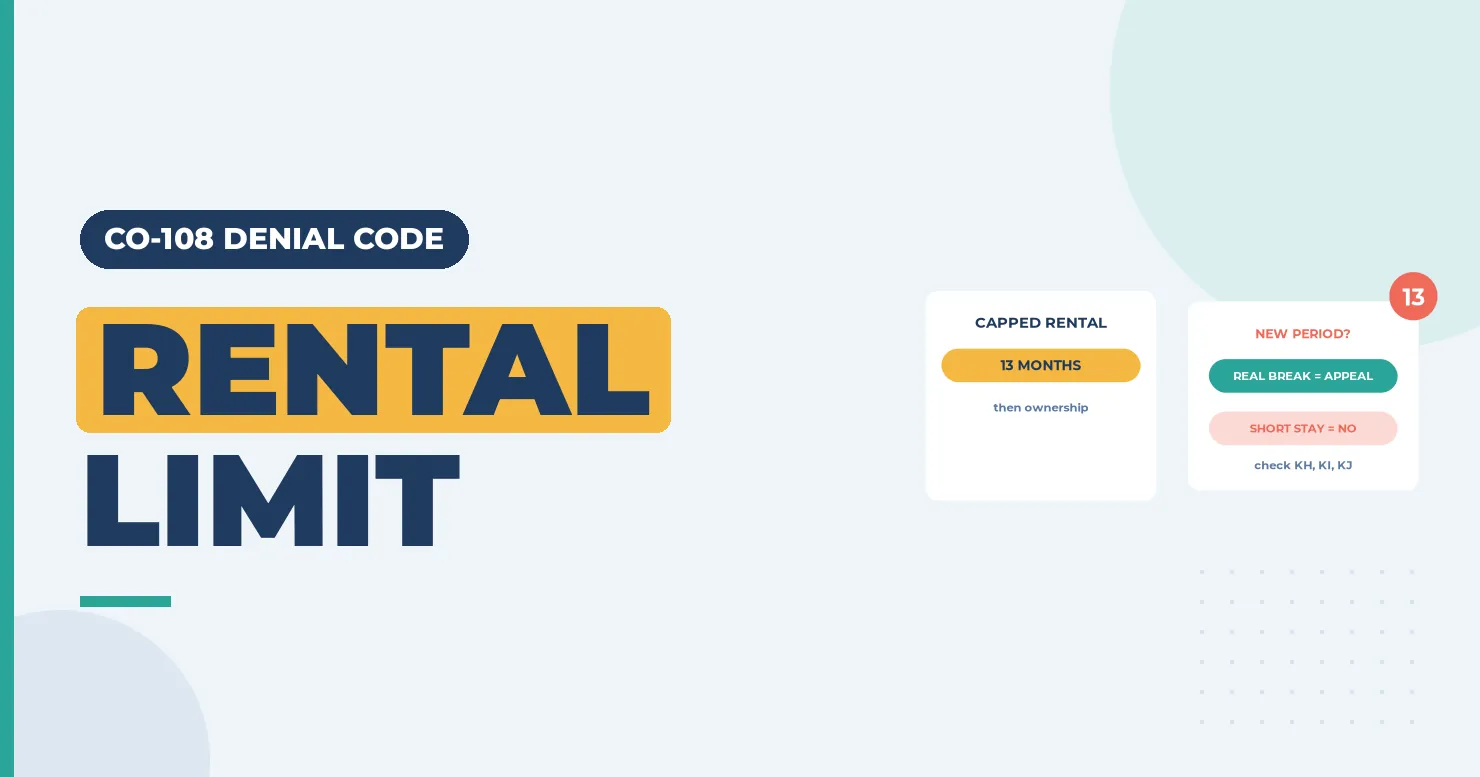
CO-108 is a durable medical equipment denial. It means the claim broke the payer’s rules on renting versus buying the item. The most common case is a capped rental billed after the rental limit, or a new rental period the payer doesn’t accept. The CO group makes it a supplier write-off unless you fix the claim. CO-108 claims are rarely about the item itself. They’re about the rental month count, the modifiers and the dates. (Primary source: X12 Claim Adjustment Reason Codes)
In brief: CARC 108 reads “Rent/purchase guidelines were not met.” Count the rental months the payer has on file, check the modifiers, and look for a break in need. If you have proof of a real break, send it. If the rental limit was reached, stop billing rental.
Part of our denial codes library. Written by Manikandan J, CPC, CRCR, who has worked DME rental denials for home medical suppliers. Published 21 October 2026. Last updated: 21 October 2026. Code wording is quoted word for word from X12.
X12 text for CARC 108
| Field | X12 text |
|---|---|
| Code | 108 |
| Description | “Rent/purchase guidelines were not met.” |
| Usage | “Refer to the 835 Healthcare Policy Identification Segment (loop 2110 Service Payment Information REF), if present.” |
| Start | 01/01/1995 |
| Last modified | 07/01/2017 |
Source: X12 Claim Adjustment Reason Codes, checked 21 October 2026. The usage note matters: check the remit’s policy REF for the rule the payer applied.
Example scenario (fictional names), part 1
CO-108 Denial Example: What Happened
Hannah Price works claims at Bluebird Home Medical. A patient with multiple sclerosis (G35) needed a semi-electric hospital bed again after months away. Bluebird billed E0260 with RR and KH, as month one of a new rental, to Maple Grove Health Plan. It’s a fictional commercial plan that follows Medicare-style capped rental rules.
The 835 came back with CAS*CO*108 and remark LQ*HE*N370. The plan had counted the claim as rental month 14. Bluebird had picked the old bed up long ago.
Would the plan ever treat this bed as a fresh rental? Keep reading, or jump to how the CO-108 denial was resolved.
How capped rentals work
A capped rental item is equipment paid as monthly rent for a set number of months, such as hospital beds and many wheelchairs. Under Medicare’s rules in 42 CFR 414.229, rental payments stop after 13 months of continuous use, and the beneficiary then owns most items. A break in need is a gap in medical need long enough to restart the count. Commercial plans often copy these rules, but check each contract.
| Modifier | Meaning |
|---|---|
| RR | Rental |
| KH | First month of a capped rental |
| KI | Second or third month |
| KJ | Fourth through 13th month |
| NU | New equipment bought outright |
Medicare’s full DMEPOS billing rules are in the Medicare Claims Processing Manual, Chapter 20.
Remark codes that explain CARC 108
| RARC | X12 wording |
|---|---|
| N370 | “Billing exceeds the rental months covered/approved by the payer.” |
| M7 | “No rental payments after the item is purchased, returned or after the total of issued rental payments equals the purchase price.” |
| M93 | “Information supplied supports a break in therapy. A new capped rental period began with delivery of this equipment.” |
| M94 | “Information supplied does not support a break in therapy. A new capped rental period will not begin.” |
See the X12 RARC list for others.
How to fix a CO-108 denial
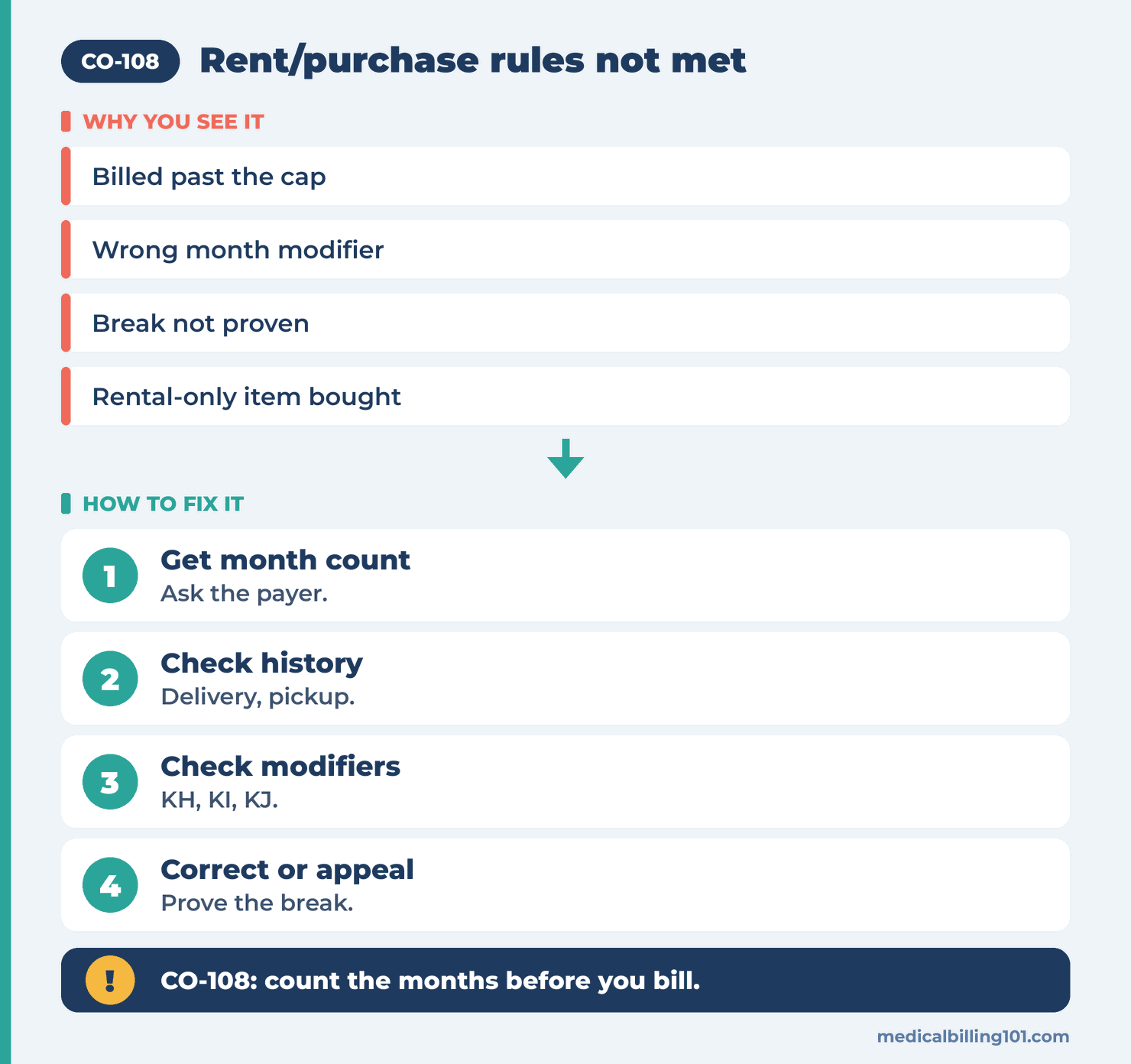
- Get the payer’s month count. Ask how many rental months it has paid, and for which dates.
- Check your own history. Compare delivery, pickup and billing dates with the payer’s count.
- Check the modifiers. KH, KI and KJ must match the month you’re billing.
- Look for a break in need. Gather the pickup ticket, hospital or facility stay dates and a new order.
- Correct or appeal. Fix wrong modifiers with a corrected claim (frequency code 7). Appeal with proof when a real break started a new period.
- Stop billing rental when the cap is reached. After the limit, bill only what the rules allow, such as certain maintenance or repairs.
Example scenario (fictional names), part 2
How the CO-108 Denial Was Resolved
Hannah asked the plan for its rental history. N370 meant the plan saw the bed as past its months. Its count ran straight from the first rental, with no gap. Bluebird’s pickup ticket showed the old bed came back when the patient entered a nursing facility. The new order came months later.
Fix: Hannah filed an appeal with the pickup ticket, the facility stay dates and the new order. She asked the plan to start a new rental period.
Outcome: the plan approved the break and paid month one with M93 on the remit. Bluebird now scans every pickup ticket into the patient file the same day.
Names and details are illustrative; no real patient data.
Worked example (illustrative)
A supplier bills a manual wheelchair as rental month 5 with KJ. The remit shows CARC 108 with M94. The patient had a short hospital stay, and the supplier thought that reset the count. It didn’t, because the chair stayed in the home. The supplier keeps billing the original rental count and drops the new-period claim.
Mistakes that cause CO-108
- Treating a short stay as a break. A hospital stay alone often doesn’t restart a rental.
- Wrong month modifier. A KH on month 6 tells the payer you think it’s a new rental.
- Billing purchase for a rental-only item. Some items can only be rented.
- No pickup proof. Without it, a break in need is hard to prove.
Related codes
- CO-16: claim lacks information needed for adjudication.
- M5: monthly rental payments remark.
- CO-50: not deemed a medical necessity.
- CO-4: procedure code inconsistent with the modifier used.
Key takeaways
CO-108 is a rent or purchase rule problem, almost always about month counts. Get the payer’s history, match it with your delivery and pickup records, and check the modifiers. Appeal with proof when a real break in need started a new rental. Stop billing rental once the cap is reached.
FAQ
What does CO-108 mean?
It means “Rent/purchase guidelines were not met.” The DME claim broke the payer’s rental or purchase rules.
What is a capped rental?
Equipment paid as monthly rent for a set time. Under Medicare, payments stop after 13 months of continuous use.
What does N370 mean with CARC 108?
N370 means “Billing exceeds the rental months covered/approved by the payer.”
Does a hospital stay restart a rental?
Not by itself. You need a real break in medical need, with proof, under the payer’s rules.
Which modifiers go on capped rental claims?
RR for rental, plus KH, KI or KJ for the month in the rental period.
Can I bill the patient for CO-108?
No. The CO group makes it a supplier write-off unless the claim is fixed.
Sources
How we checked: each code quote on this page was compared word for word with the X12 CARC and RARC lists on 21 October 2026.
- X12, Claim Adjustment Reason Codes (CARC 108). Accessed 21 Oct 2026.
- X12, Remittance Advice Remark Codes (N370, M7, M93, M94). Accessed 21 Oct 2026.
- eCFR, 42 CFR 414.229, Other durable medical equipment: capped rental items. Accessed 21 Oct 2026.
- CMS, Medicare Claims Processing Manual, Chapter 20. Accessed 21 Oct 2026.
Last updated: 21 October 2026 · This page is educational and doesn’t replace payer policies or Medicare rules.
Related denial codes
- CO-153: Information Submitted Does Not Support This Dosage
- CO-154: Information Submitted Does Not Support This Day’s Supply
- PR-119: Benefit Maximum for This Time Period or Occurrence
- CO-91: Dispensing Fee Adjustment
- CO-90: Ingredient Cost Adjustment
- PR-149: Lifetime Benefit Maximum Reached
- CO-150: Information Submitted Does Not Support This Level of Service
- CO-151: Frequency or Units of Service Not Supported