
The CO-260 denial code is a pricing note, not a denial. Reason code 260 tells you a Medicaid payer priced the service on the enhanced primary care fee schedule created by the Affordable Care Act, which paid many evaluation and management visits at Medicare rates. The adjustment amount is the gap between your charge and that enhanced allowed amount, and it stays with the provider. (Primary source: X12 Claim Adjustment Reason Codes)
In brief: CARC 260 reads “Processed under Medicaid ACA Enhanced Fee Schedule”. Post it as a contractual write-off, then check that the allowed amount matches the enhanced rate your state publishes. A lower allowed amount is the only thing worth disputing.
Part of our denial codes library. Written by Manikandan J, CPC, CRCR, who has reconciled Medicaid primary care rate tables against remits for pediatric and family medicine groups. Published 27 October 2026. Last updated: 27 October 2026. Code wording quoted word for word from X12. Read about the author and our editorial policy, or contact us to report an error.
Official CARC 260 description
| Field | Value |
|---|---|
| Code | 260 |
| Description | “Processed under Medicaid ACA Enhanced Fee Schedule” |
| Start | 01/26/2014 |
| Type | Payment adjustment, informational |
Source: X12 Claim Adjustment Reason Codes, checked 27 October 2026. Medicare listed it as a new code in CMS CR 8703, in the same update as CARC 259.
Key terms: A CARC is a Claim Adjustment Reason Code from the X12 list, and it says why a line was paid differently than billed. A RARC is a Remittance Advice Remark Code that adds detail to the CARC. The group code is the two-letter prefix on the adjustment; CO means contractual obligation: the provider owns the balance and it cannot be billed to the patient.
Methodology: the code wording above is copied from the X12 list, and each fix step below links to the payer or CMS page it comes from.
Example scenario (fictional names), part 1
CO-260 Denial Example: What Happened
Priya Okafor posts payments for Willow Creek Pediatrics, a fictional clinic. A state Medicaid remit for a sick visit, CPT 99214, shows CAS*CO*260*41.60. A new biller flagged the line as a denial and drafted an appeal.
Priya noticed something odd on a second claim. Two visits by the same group, billed the same way, came back with different allowed amounts. One had CARC 260. The other had the usual CO-45 and a lower allowed amount.
Is CO-260 a problem, and why did the two visits pay differently? Keep reading, or jump to how it was resolved. Keep reading, or jump to how the CO-260 denial was resolved.
Where the enhanced fee schedule came from
Section 1202 of the Health Care and Education Reconciliation Act required states to pay Medicaid primary care services at no less than Medicare rates in 2013 and 2014 (CMS fact sheet). The final rule set the details (Federal Register, 77 FR 66670):
- Who qualified: physicians with a specialty designation of family medicine, general internal medicine or pediatric medicine, plus related subspecialists, who self-attested (42 CFR 447.400).
- Which codes: E/M codes 99201 to 99499 and certain vaccine administration codes.
- Who paid the difference: the federal government paid 100 percent of the increase above the state’s July 1, 2009 rate.
The federal mandate ended on December 31, 2014. Rhode Island, for example, told providers its increased rates ended that day (RI EOHHS notice). Others kept paying more. MACPAC reports that 19 states had fully or partially continued the increase as of July 2016 (MACPAC 2025 report).
CO-260 compared with CO-45
| Question | CO-260 | CO-45 |
|---|---|---|
| What set the allowed amount | Enhanced primary care schedule | Standard fee schedule or contract |
| Who owns the adjustment | Provider | Provider |
| Bill the patient? | No | No |
| Action | Check the rate | Check the rate |
Both are write-offs. The code only tells you which rate table was used. That is useful, because it lets you audit two schedules separately.
How to work a CO-260 line
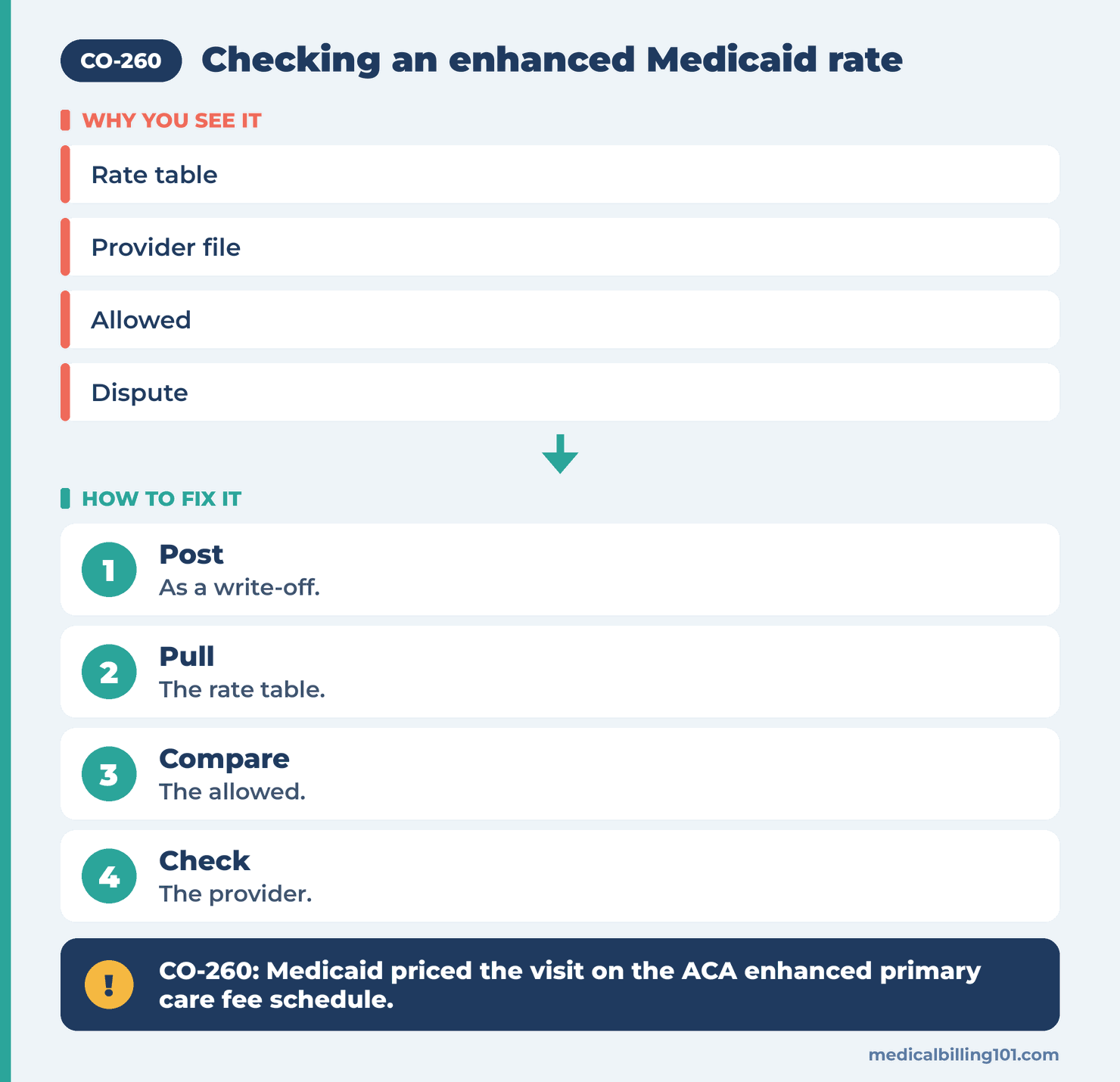
- Post it as a contractual adjustment. Do not appeal the code itself and do not move the amount to the patient.
- Find the right rate table. Pull your state Medicaid agency’s or plan’s enhanced primary care schedule for the date of service. Use the schedule in effect on the date of service, not today’s.
- Compare the allowed amount. Match the CPT, the site of service and the locality the state uses.
- Check the rendering provider. Ask the payer what it needs on file, such as a specialty attestation or a taxonomy, for the enhanced rate to apply.
- Dispute only a short payment. If the allowed amount is below the published enhanced rate, send a payment dispute with the schedule attached.
Claim form note
No claim form visual is shown here. CO-260 does not point to a wrong field on the CMS-1500 or UB-04. It is a pricing note on a claim that was paid. The work is in posting and rate checks.
Example scenario (fictional names), part 2
How the CO-260 Denial Was Resolved
Priya pulled both remits and the payer’s provider file. The CO-260 visit was billed under a family physician who was on the payer’s enhanced-rate list. The CO-45 visit was billed under a pediatrician who had joined in August, and the payer had not linked her to the clinic’s enhanced-rate group.
Fix: she deleted the draft appeal for the CO-260 line, posted it as a contractual adjustment, and asked the payer’s provider services team what was needed to add the new pediatrician. The plan asked for the clinic’s signed rate amendment and the doctor’s board certification.
Outcome: the plan updated the provider file and reprocessed the CO-45 claims from August forward at the enhanced rate. Priya now checks the rate group in the first week after any new hire is enrolled.
Names and details are illustrative; no real patient data.
Names and details are illustrative; no real patient data.
Related codes
| Code | Meaning | Where to start |
|---|---|---|
| CO-45 | Charge over fee schedule | Contract rate |
| CO-172 | Specialty-based pricing | Provider specialty |
| CO-B7 | Provider not certified for service | Enrollment |
FAQ
What does CO-260 mean?
The Medicaid payer priced the line on the ACA enhanced primary care fee schedule.
Is CO-260 a denial?
No. It is a pricing adjustment on a paid line. Post it as a write-off.
Can I bill the patient for CO-260?
No. CO means the provider owns the amount, and Medicaid patients are protected from balance billing.
Does the ACA fee bump still exist in 2026?
The federal mandate ended in 2014. Some states and plans kept higher primary care rates, so check your own state.
Why did one visit get CO-260 and another did not?
Usually the provider or code did not qualify for the enhanced rate. Check the rendering provider’s file and the code list.
Sources
How we checked: the CARC 260 quote was matched word for word with the X12 CARC list on 27 October 2026.
- X12, Claim Adjustment Reason Codes (CARC 260). Accessed 27 Oct 2026.
- CMS, CR 8703 code update adding CARC 259 and 260. Accessed 27 Oct 2026.
- Federal Register, Medicaid payments for primary care services final rule (2012). Accessed 27 Oct 2026.
- eCFR, 42 CFR 447.400. Accessed 27 Oct 2026.
- CMS, Increased Medicaid payment for primary care fact sheet. Accessed 27 Oct 2026.
- MACPAC, Evaluating the effects of Medicaid payment changes (2025). Accessed 27 Oct 2026.
- Rhode Island EOHHS, Medicaid primary care fee increase. Accessed 27 Oct 2026.
Last updated: 27 October 2026 · Educational content; not legal advice.
Related denial codes
- CO-259: Added Payment for Dental or Vision Use
- CO-256: Service Not Payable Per Contract
- CO-253: Sequestration Reduction in Federal Payment
- CO-246: Non-Payable Reporting Code
- CO-245: Provider Performance Withhold
- CO-237: Legislated or Regulatory Penalty
- CO-235: Sales Tax on the Remit
- CO-223: When a Law Sets the Payment