
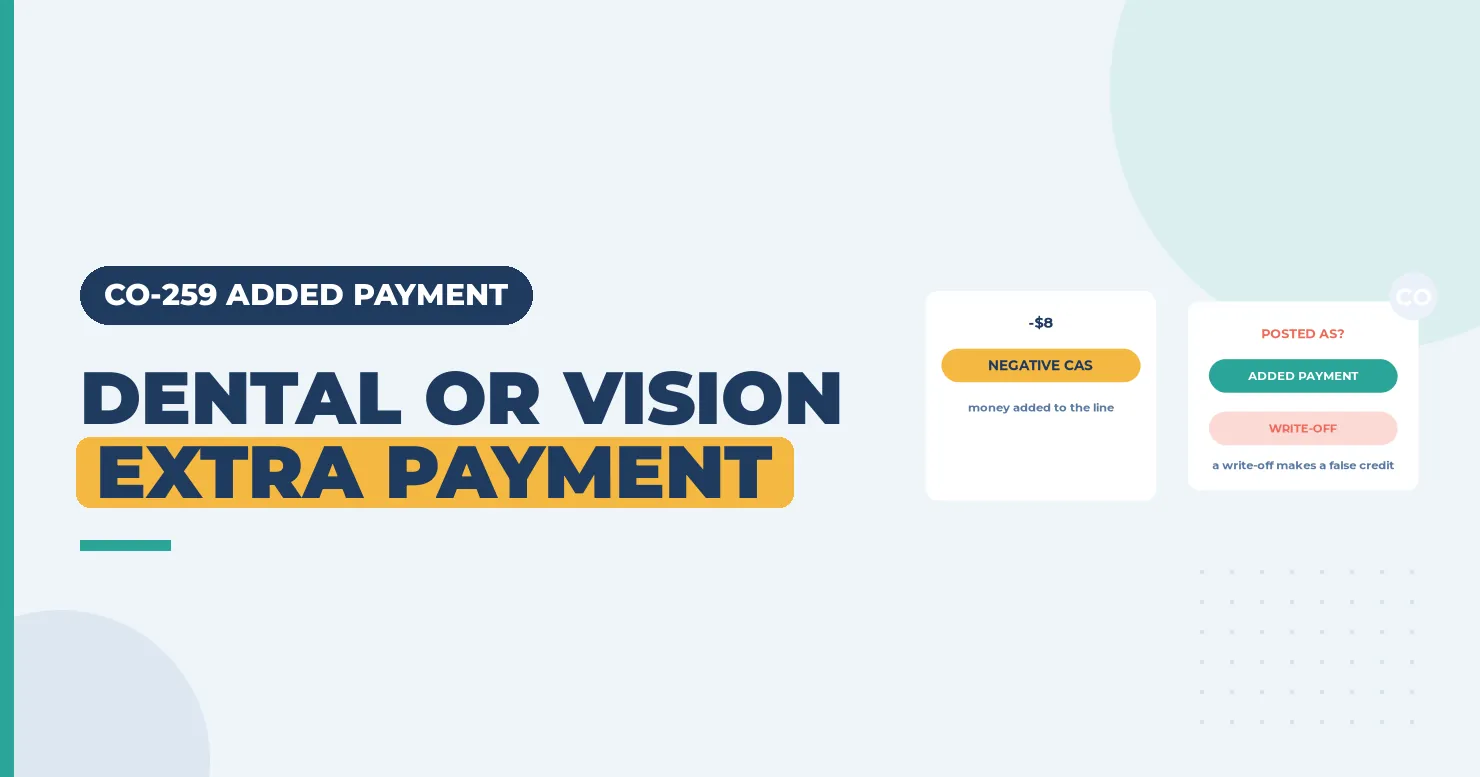
The CO-259 denial code is good news dressed up as an adjustment. Reason code 259 tells you the payer added money to a dental or vision service because of how the service was used, so the line pays more than the normal allowed amount. On an electronic remit the amount usually shows as a negative number. (Primary source: X12 Claim Adjustment Reason Codes)
In brief: CARC 259 reads “Additional payment for Dental/Vision service utilization.” A negative CAS amount raises what you are paid. Post it as an added payment, not a write-off, or your system will show a false balance.
Part of our denial codes library. Written by Manikandan J, CPC, CRCR, who has set up posting rules for negative adjustments in dental and multispecialty billing systems. Published 27 October 2026. Last updated: 27 October 2026. Code wording quoted word for word from X12. Read about the author and our editorial policy, or contact us to report an error.
Official CARC 259 description
| Field | Value |
|---|---|
| Code | 259 |
| Description | “Additional payment for Dental/Vision service utilization.” |
| Start | 01/26/2014 |
| Type | Payment adjustment that adds money |
Source: X12 Claim Adjustment Reason Codes, checked 27 October 2026. CMS listed CARC 259 as new in CR 8703, together with CARC 260.
Key terms: A CARC is a Claim Adjustment Reason Code from the X12 list, and it says why a line was paid differently than billed. A RARC is a Remittance Advice Remark Code that adds detail to the CARC. The group code is the two-letter prefix on the adjustment; CO means contractual obligation: the provider owns the balance and it cannot be billed to the patient.
Methodology: the code wording above is copied from the X12 list, and each fix step below links to the payer or CMS page it comes from.
Example scenario (fictional names), part 1
CO-259 Denial Example: What Happened
Dana Whitfield posts payments for Brightside Family Dental, a fictional practice. A dental plan remit for a child’s sealant, CDT D1351, shows an allowed amount of $32, then a second line in the same group: CAS*CO*259*-8.00. The check paid $40 for the tooth.
The practice software read every CO amount as a write-off. It wrote off another $8, and the account showed an $8 credit. A refund request for the “overpayment” was waiting for approval.
Was the $8 an overpayment, and should Dana send it back? Keep reading, or jump to how it was resolved. Keep reading, or jump to how the CO-259 denial was resolved.
Why the amount is negative
Every 835 remit must balance: billed charge minus all adjustments equals the amount paid. CMS states the sign rule plainly: a positive adjustment amount reduces the payment, and a negative one increases it (Medicare Claims Processing Manual, chapter 22). Payer companion guides say the same, for example the Indiana Department of Health guide for the CAS segment (Indiana 835 companion guide).
A worked line looks like this:
| Item | Amount |
|---|---|
| Billed charge | $60.00 |
| CO-45 reduction | $28.00 |
| CO-259 added payment | -$8.00 |
| Paid | $40.00 |
$60 minus $28 minus (-$8) equals $40. The math only works if the CO-259 amount is treated as money in.
CO-259 compared with similar codes
| Code | What it says | Money direction |
|---|---|---|
| CO-259 | Extra pay for dental or vision use | Adds to payment |
| CO-144 | Incentive adjustment | Often adds |
| OA-94 | Paid more than charges | Adds |
| CO-45 | Charge over the fee schedule | Reduces |
How to post a CO-259 line
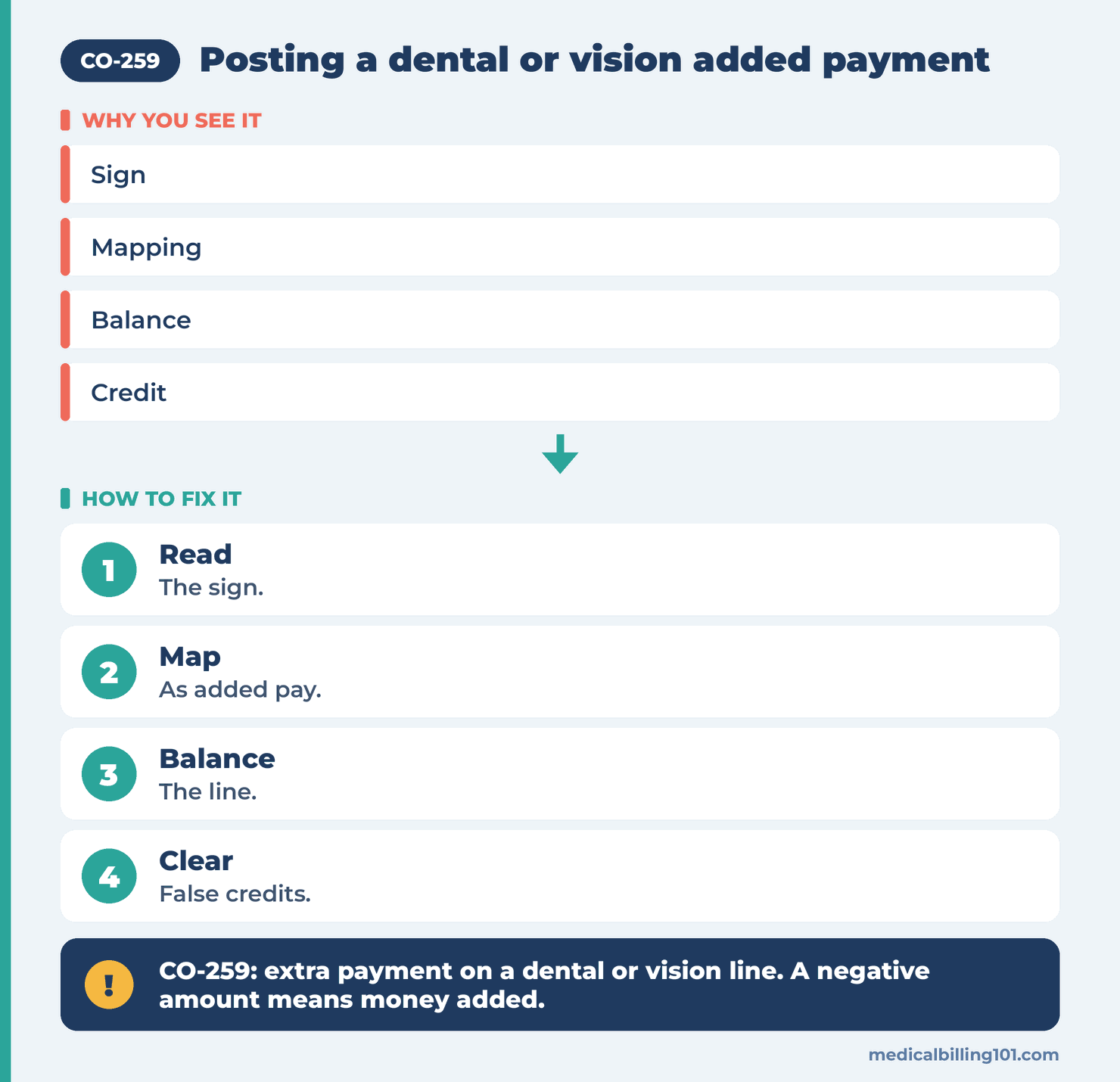
- Read the sign first. A minus sign on the CAS amount means the payer added money. A positive CO-259 amount is unusual, so ask the payer what it means before you post.
- Map CARC 259 to an added-payment code. In your posting table, set 259 to a debit (charge-type) adjustment, not to a contractual write-off.
- Balance the line. Check that charge minus adjustments equals the paid amount on the line.
- Clear any false credit. Reverse the wrong write-off before anyone refunds money that was owed to you.
- Keep the patient share unchanged. The added payment does not change copays or coinsurance on the line.
Claim form note
No claim form visual is shown here. Dental services are billed on the ADA dental claim form, and CARC 259 is an added payment on a claim that was billed correctly, so no CMS-1500 box or UB-04 form locator needs a fix.
Example scenario (fictional names), part 2
How the CO-259 Denial Was Resolved
Dana compared the remit with the plan’s provider bulletin. The plan paid a bonus for sealants on children in its member population, and it reported the bonus on the claim line with CARC 259 and a negative amount.
Fix: she canceled the refund request, reversed the $8 write-off, and posted the $8 as an added-payment adjustment. The account balanced at $0.
Outcome: her vendor added a rule that maps any negative CAS amount to a debit adjustment. The practice found eleven more sealant claims with the same false credit and fixed them before month end.
Names and details are illustrative; no real patient data.
Names and details are illustrative; no real patient data.
FAQ
What does CO-259 mean?
The payer added money to a dental or vision service line because of service use.
Why is the CO-259 amount negative?
In an 835, a negative adjustment increases payment. It is money added to the line.
Do I need to appeal CO-259?
No. It is not a denial. Post it as an added payment.
Should I refund a CO-259 amount?
No, unless the payer later takes it back. A credit balance from CO-259 is usually a posting error.
Can a medical practice see CO-259?
Rarely. The X12 wording ties it to dental and vision services.
Sources
How we checked: the CARC 259 quote was matched word for word with the X12 CARC list on 27 October 2026, and the sign rule with the CMS manual.
- X12, Claim Adjustment Reason Codes (CARC 259). Accessed 27 Oct 2026.
- CMS, CR 8703 code update adding CARC 259 and 260. Accessed 27 Oct 2026.
- CMS, Medicare Claims Processing Manual, chapter 22 (remittance advice). Accessed 27 Oct 2026.
- Indiana Department of Health, 835 companion guide. Accessed 27 Oct 2026.
- Blue Cross NC, 835 companion guide. Accessed 27 Oct 2026.
Last updated: 27 October 2026 · Educational content; not legal advice.
Related denial codes
- CO-260: Medicaid ACA Enhanced Fee Schedule
- CO-256: Service Not Payable Per Contract
- CO-253: Sequestration Reduction in Federal Payment
- CO-246: Non-Payable Reporting Code
- CO-245: Provider Performance Withhold
- CO-237: Legislated or Regulatory Penalty
- CO-235: Sales Tax on the Remit
- CO-223: When a Law Sets the Payment