
Choose the denial code and payer, add the claim details, and get an editable appeal letter in about 60 seconds.
Key takeaways
- Strong appeals make one documented argument tied to the exact denial code on the remittance.
- Fix and resubmit when the claim had an error. Appeal when the claim was right and the payer was wrong.
- For Original Medicare, a redetermination must be filed within 120 days of receiving the notice (42 CFR 405.942).
How to use the appeal letter generator
- Pick the denial code. Search by number or keyword (for example 97, CO-50 or auth). The tool sets a matching argument type and links the code guide.
- Add the payer, plan type and appeal level. For Original Medicare the letter switches to reopening, redetermination or reconsideration wording.
- Fill in the provider, patient and claim details. Use the remittance (835/ERA or EOB) for the claim number, denial date and amounts.
- Tick the arguments that are true for this claim. Each one adds a paragraph. Add case-specific facts in Additional details.
- Check the enclosures. The tool suggests documents for each argument; untick anything you aren’t sending.
- Copy, download (.docx) or print. Replace every [bracketed] item, review the letter against the medical record, sign it and send it the way the payer requires.
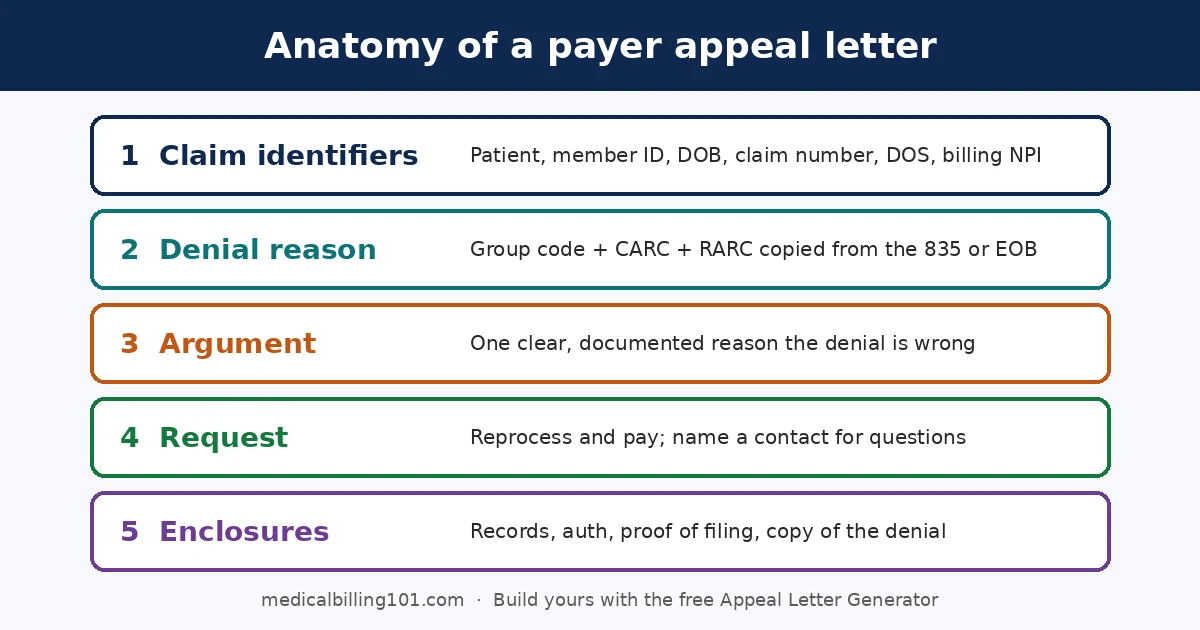
What a strong appeal letter includes
- The details the payer needs to find the claim: patient name, member ID, date of birth, claim number, dates of service and the billing NPI.
- The exact denial reason from the remittance: group code, CARC and any remark code (RARC).
- A short, fact-based argument tied to the record, not opinion. One clear reason beats five vague ones.
- A specific request (reprocess and pay the claim) and a contact for questions.
- The documents that back you up, listed as enclosures, plus a copy of the denial.
Before you appeal, make sure it’s a denial and not a rejection. If the claim had an error you can fix, a corrected claim is often faster. See denial codes for code-by-code fixes, and check your filing window with the Timely Filing & Appeal Deadline Calculator.
Sample appeal letters by denial type
These five samples show the layout the generator builds. Open one to read it in full. Replace every [bracketed] item. Keep only what the medical record supports. Each sample is for a commercial plan. For Original Medicare, use the generator’s redetermination wording or the CMS-20027 redetermination request form.
Sample 1: Medical necessity denial (CO-50)
[Date]
[Payer name], Appeals Department
[Payer appeals address]
Re: First-level appeal. Patient: [Name]. Member ID: [ID]. DOB: [DOB]. Claim number: [Claim #]. Date of service: [DOS]. CPT: [Code]. Billing NPI: [NPI].
We ask you to review this claim. It was denied with code CO-50, not medically necessary.
The service was needed. [Patient] came in with [symptoms and findings], as the enclosed note dated [date] shows. [Other care, such as six weeks of physical therapy, was tried from (date) to (date) and did not help.] Your policy [policy name and number], section [X], lists [criteria]. We have marked each one in the records.
Please reprocess and pay the claim. For questions, contact [Name] at [phone] or [email].
Sincerely,
[Name, credentials]
[Practice name]
Enclosures: remittance or EOB showing the denial; office notes; test results; payer policy excerpt; letter of medical necessity from the treating provider.
More help: CO-50 denial guide.
Sample 2: Timely filing denial with proof of submission (CO-29)
[Date]
[Payer name], Appeals Department
[Payer appeals address]
Re: Appeal of timely filing denial. Patient: [Name]. Member ID: [ID]. Claim number: [Claim #]. Date of service: [DOS]. Billing NPI: [NPI].
This claim was denied with code CO-29, the time limit for filing has expired. We filed it on time.
Your [EDI gateway] accepted the first claim on [date]. That is within the [X]-day limit in our contract. The enclosed 277CA report shows the claim as accepted, with claim number [#]. The current claim is a [resubmission or corrected claim] of that original claim.
Please overturn the timely filing denial and process the claim for payment. For questions, contact [Name] at [phone].
Sincerely,
[Name, credentials]
[Practice name]
Enclosures: 277CA acceptance report; clearinghouse transmission report; original and current remittance; contract page showing the filing limit.
More help: CO-29 denial guide and the timely filing calculator.
Sample 3: Bundled service denial, separate procedure (CO-97)
[Date]
[Payer name], Appeals Department
[Payer appeals address]
Re: Appeal. Patient: [Name]. Member ID: [ID]. Claim number: [Claim #]. Date of service: [DOS]. Codes: [Code 1] and [Code 2] with modifier [59, XS or other].
Line [#] was denied with code CO-97, paid as part of another service.
The second service was separate. It was done on [a different site, a separate lesion, or in a separate session], as page [#] of the enclosed note shows. We added modifier [59 or XS] because the services meet the NCCI policy manual rules for a distinct service, chapter [#].
Please reprocess line [#] for payment. For questions, contact [Name] at [phone].
Sincerely,
[Name, credentials]
[Practice name]
Enclosures: remittance; operative or procedure note with the separate site marked; NCCI policy excerpt.
More help: CO-97 denial guide.
Sample 4: Authorization denial when an auth was on file (CO-197)
[Date]
[Payer name], Appeals Department
[Payer appeals address]
Re: Appeal. Patient: [Name]. Member ID: [ID]. Claim number: [Claim #]. Date of service: [DOS]. CPT: [Code].
This claim was denied with code CO-197, no prior authorization on file.
We got approval before the service. Your number is [Auth #], approved on [date] for [CPT code(s)] from [start date] to [end date]. The service date falls inside that period. [If the code changed during the procedure: the approved code was (code); the procedure performed was (code) for the reason documented in the enclosed note.]
Please link the authorization to this claim and reprocess it for payment. For questions, contact [Name] at [phone].
Sincerely,
[Name, credentials]
[Practice name]
Enclosures: authorization approval letter or portal screenshot; remittance; procedure note if the code changed.
More help: CO-197 denial guide.
Sample 5: Coordination of benefits denial (CO-22)
[Date]
[Payer name], Appeals Department
[Payer appeals address]
Re: Appeal. Patient: [Name]. Member ID: [ID]. Claim number: [Claim #]. Date of service: [DOS].
This claim was denied with code CO-22, care may be covered by another payer.
[Your plan was the patient’s primary coverage on the date of service.] The other plan, [plan name], [ended on (date); see the enclosed letter] or [paid as secondary; see the enclosed EOB]. The patient confirmed the coverage update with your member services on [date], reference [#].
Please update the patient’s other-coverage record and pay the claim as primary. For questions, contact [Name] at [phone].
Sincerely,
[Name, credentials]
[Practice name]
Enclosures: remittance; other plan’s termination letter or EOB; patient’s COB questionnaire if your payer uses one.
More help: CO-22 denial guide.
Denial codes that usually need clinical notes
Some denials can’t be won with billing data alone. For these codes, send the clinical record with the appeal. The left column links to each code guide.
| Code | Why it denied | Clinical notes to send |
|---|---|---|
| CO-50 | Not deemed medically necessary | Visit or progress notes, test results, prior treatments tried, the payer policy criteria marked |
| CO-97 | Bundled into another service | Operative or procedure note showing a separate site, session or lesion |
| CO-11 | Diagnosis doesn’t match the procedure | The note that documents the diagnosis behind the service |
| CO-197 | No authorization on file | Auth approval, or ER and triage notes if the service was an emergency |
| CO-4 | Modifier doesn’t fit the code | The note that supports the modifier, such as a separate E/M for modifier 25 |
| CO-151 | Payer thinks the frequency or units are too high | Notes for each date of service showing why the extra services were needed |
For example, a CO-50 appeal for an MRI should include the notes showing weeks of failed therapy if the payer policy requires it. Codes like CO-16 or CO-29 rarely need clinical notes; they need corrected data or proof of filing.
Appeal, corrected claim or reopening?
The wrong route costs time. Use this table to pick one before you write.
- An appeal is a written request asking the payer to look again at a decision you think is wrong.
- A corrected claim is a new copy of the claim that fixes your own error. On an electronic claim, frequency code 7 replaces the first claim and code 8 voids it.
- A reopening is how Medicare fixes simple errors without a formal appeal. The contractor may reopen a claim for any reason within 1 year of the first decision (42 CFR 405.980).
| Situation | Best route | Example |
|---|---|---|
| Your claim had a coding or data error | Corrected claim | Missing modifier, wrong member ID, wrong place of service |
| Simple clerical error on an Original Medicare claim | Reopening | Transposed date of service or wrong units |
| Claim was right and the payer disagrees on coverage | Appeal | CO-50 medical necessity with documentation |
| Payer ignored information it already had | Appeal or reconsideration | Auth on file but CO-197 denial |
| Claim was rejected and never processed | Fix and resubmit as a new claim | 277CA rejection for an invalid NPI |
Frequently asked questions
Is this appeal letter generator free?
Yes. It’s free, needs no sign-up, and you can download as many letters as you need.
Is the information I type saved or sent anywhere?
No. The letter is built in your browser. Nothing you type is stored or sent to a server. If you’re unsure, use sample data and add the patient details in your own system.
Which denial codes does it cover?
More than 50 common reason codes (CARCs), including every code with a guide on Medical Billing 101, such as CO-16, CO-29, CO-50, CO-97, CO-197 and OA-18. Each code is matched to a type of argument. Examples include medical need, timely filing, duplicates, bundling, eligibility, prior auth and other coverage.
Should I send an appeal or a corrected claim?
If the denial came from an error you can fix, such as a missing modifier or a wrong member ID, a corrected claim is usually faster. Appeal when the claim was right and you disagree with the payer. For Original Medicare, a claim returned as unprocessable has no appeal rights. Fix it and send a new claim.
What should I include with an appeal letter?
Send a copy of the denial (EOB or remittance) and a copy of the claim. Add the documents that prove your point, such as visit notes, the auth approval, proof of timely filing or the primary payer’s EOB. Follow the payer’s rules for its appeal form, address and documents.
Can I use it for Original Medicare appeals?
Yes. Choose Original Medicare as the plan type and the letter uses Medicare terms. That means a reopening for simple errors, a redetermination by the Medicare contractor (MAC), or a reconsideration by the QIC. A redetermination request must list the patient’s name, Medicare number, the services and dates you are appealing, and the name and signature of the person asking (42 CFR 405.944). You can also use form CMS-20027.
How long do I have to file an appeal?
It depends on the payer. For Original Medicare, you have 120 days from the day you get the first decision. Medicare assumes you got it 5 days after the date on the notice. Commercial and Medicaid deadlines are set by the contract, plan or state. Use the Timely Filing & Appeal Deadline Calculator to work out the date.
Sources
- X12, Claim Adjustment Reason Codes
- eCFR, 42 CFR 405.942 and 405.944 (Medicare redetermination)
- CMS, Medicare Parts A & B appeals process
