
CO-132 means your payment was changed because the claim fell under a demonstration project or pilot program you or the patient take part in. Medicare runs many of these through the CMS Innovation Center, and they can change payment rates, cost sharing or billing rules. The adjustment is often correct. It’s worth a check when the patient wasn’t in the program or the amount doesn’t match the program’s terms. The CO group means the patient doesn’t owe the adjusted amount. (Primary source: X12 Claim Adjustment Reason Codes)
Quick take: CARC 132 reads “Prearranged demonstration project adjustment.” Confirm the program, the patient’s enrollment and the payment terms. Accept it when they line up; question it when they don’t.
From our denial codes library. Written by Manikandan J, CPC, CRCR, who has reconciled Medicare remits for specialty groups in payment models. Published 21 October 2026. Last updated: 21 October 2026. Code wording quoted word for word from X12.
X12 entry for CARC 132
| Field | X12 text |
|---|---|
| Code | 132 |
| Description | “Prearranged demonstration project adjustment.” |
| Start | 02/28/1997 |
Source: X12 Claim Adjustment Reason Codes, checked 21 October 2026.
What a demonstration project is
A demonstration project is a time-limited program that tests a new way to pay for or deliver care. The CMS Innovation Center is the CMS office that designs and runs most Medicare payment models. Its models page lists current and past ones.
A demonstration can change:
- Payment rates, such as a bundled or adjusted fee.
- Cost sharing, such as a different coinsurance.
- Billing rules, such as special codes or claim formats.
Remark codes that pair with CARC 132
| RARC | X12 wording |
|---|---|
| M114 | “This service was processed in accordance with rules and guidelines under the DMEPOS Competitive Bidding Program or a Demonstration Project. For more information regarding these projects, contact your local contractor.” |
| M116 | “Processed under a demonstration project or program. Project or program is ending and additional services may not be paid under this project or program.” |
| M137 | “Part B coinsurance under a demonstration project or pilot program.” |
| M138 | “Patient identified as a demonstration participant but the patient was not enrolled in the demonstration at the time services were rendered. Coverage is limited to demonstration participants.” |
The full list is on the X12 RARC page.
Example scenario (fictional names), part 1
CO-132 Denial Example: What Happened
Marcus Bell manages billing for Ridgeview Cardiology, a six-physician group. The group joined a fictional Medicare payment model, the Heart Care Pathways Demonstration, at the start of the year.
In June, payments on several office visits came in lower than the fee schedule. Each 835 line showed CAS*CO*132 with remark M114. Two lines also showed M138.
Were these cuts the model working as planned, or errors? Keep reading, or jump to how the CO-132 denial was resolved.
Read the remark before you react
| Remark | What it tells you | Next step |
|---|---|---|
| M114 | Processed under program rules | Compare to model terms |
| M116 | Program is ending | Plan for normal billing |
| M137 | Coinsurance set by the program | Bill the patient that amount only |
| M138 | Patient not enrolled on that date | Check enrollment dates |
Steps for a CO-132 adjustment
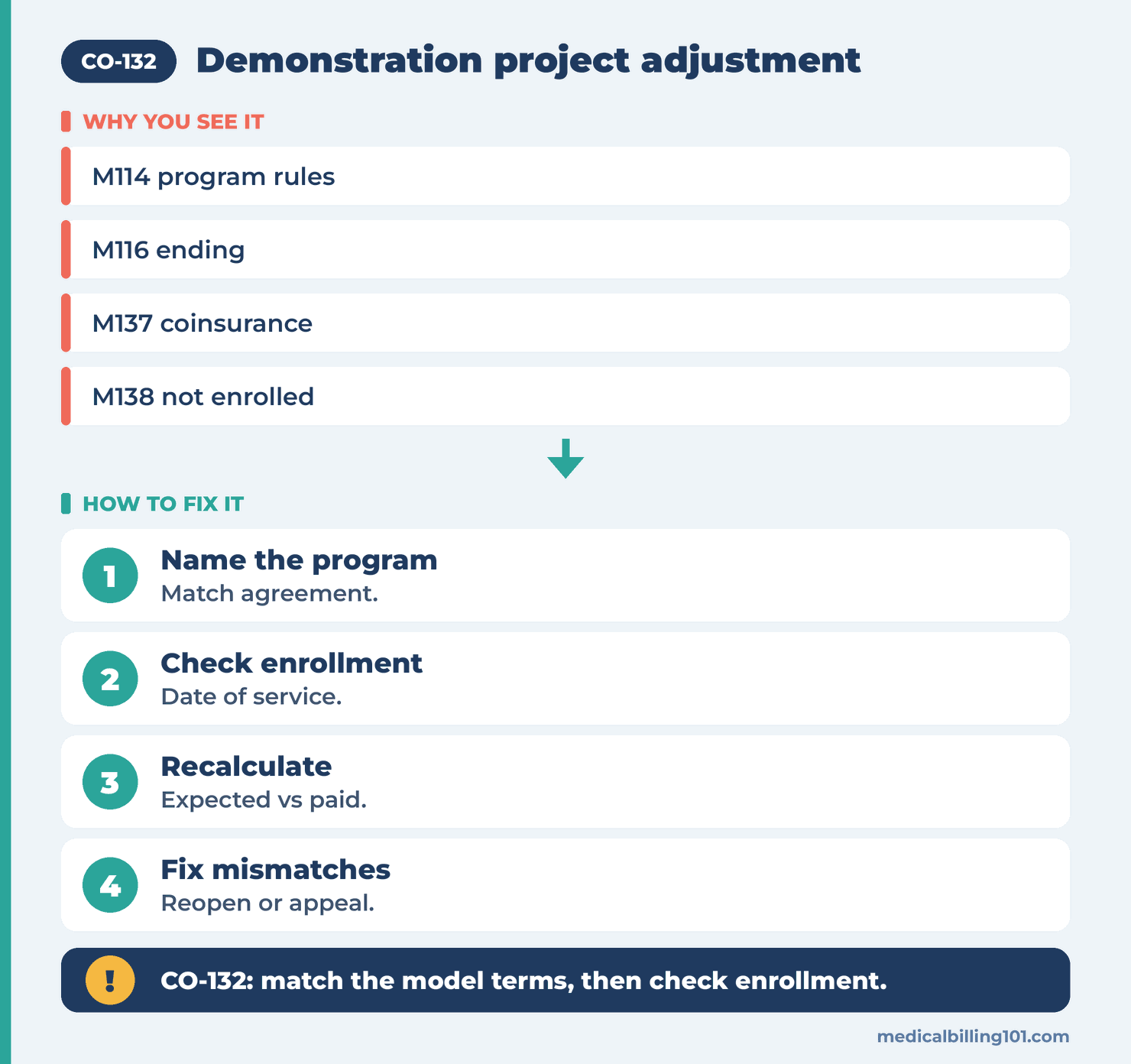
- Name the program. Match it to your participation agreement.
- Check the patient. Confirm enrollment or alignment on the date of service.
- Find the payment terms. For example, the model’s rate sheet or methods paper.
- Recalculate. Compare expected and paid amounts.
- Question mismatches. Call the contractor, then reopen or appeal if needed.
- Load expected rates. Set your system to expect the model payment.
Example scenario (fictional names), part 2
How the CO-132 Denial Was Resolved
Marcus compared the M114 lines to the model’s rate sheet. The lower payments matched the model’s adjusted rates exactly. The two M138 lines were different. Both patients had joined the model a month after their visits.
Fix: Marcus loaded the model rates into the practice system. For the two M138 lines, he asked the contractor to reprocess them outside the model, since the patients weren’t enrolled yet.
Outcome: The contractor reprocessed both visits at the regular rate. The rest stood as correct model payments.
Names and details are illustrative; no real patient data.
Worked example (illustrative)
A home health agency sees CARC 132 with M137 on a Medicare remit. The program set a different coinsurance amount for the visit. The biller updates the patient statement to the M137 amount, not the usual 20 percent. Billing the old amount would have overcharged the patient.
Common mistakes
- Treating every CO-132 as an underpayment. Many are correct model rates.
- Ignoring M138. It often means a date or enrollment mismatch you can fix.
- Billing patients the usual coinsurance when M137 sets a different one.
- Missing M116 notices. A program end changes how you bill.
Related codes
- CO-45: charge exceeds the fee schedule.
- CO-253: sequestration reduction.
- CO-24: charges covered under a capitation agreement or managed care plan.
Recap
CO-132 is a demonstration project adjustment. Name the program, confirm enrollment and match the payment to the model’s terms. Accept correct adjustments, and fix enrollment mismatches flagged with M138.
FAQ
What does CO-132 mean?
It means “Prearranged demonstration project adjustment.” Payment changed because a program or pilot applied.
Can I bill the patient for CO-132?
No. The CO group makes it a provider adjustment. Bill only the cost sharing the remit shows.
What does M138 mean with CARC 132?
The patient wasn’t enrolled in the program on the date of service. Ask for the claim to be processed normally.
Where do I find a model’s payment terms?
Start with your participation agreement and the CMS Innovation Center model page.
Is CO-132 a denial?
Usually not. It’s a payment change under program rules.
What happens when a demonstration ends?
M116 warns that the program is ending. After it ends, bill under normal rules.
Sources
How we checked: each code quote here was matched word for word with the X12 CARC and RARC lists on 21 October 2026.
- X12, Claim Adjustment Reason Codes (CARC 132, 45, 253, 24). Accessed 21 Oct 2026.
- X12, Remittance Advice Remark Codes (M114, M116, M137, M138). Accessed 21 Oct 2026.
- CMS Innovation Center, Models. Accessed 21 Oct 2026.
Last updated: 21 October 2026 · Educational content; not legal advice.
Related denial codes
- CO-131: Claim-Specific Negotiated Discount
- CO-134: Technical Fees Removed From Charges
- CO-130: Claim Submission Fee
- CO-137: Regulatory Surcharges, Assessments, Allowances or Health Related Taxes
- CO-139: Contracted Funding Agreement, Subscriber Employed by the Provider
- CO-143: Portion of Payment Deferred
- CO-144: Incentive Adjustment, e.g. Preferred Product/Service
- CO-147: Provider Contracted/Negotiated Rate Expired or Not on File