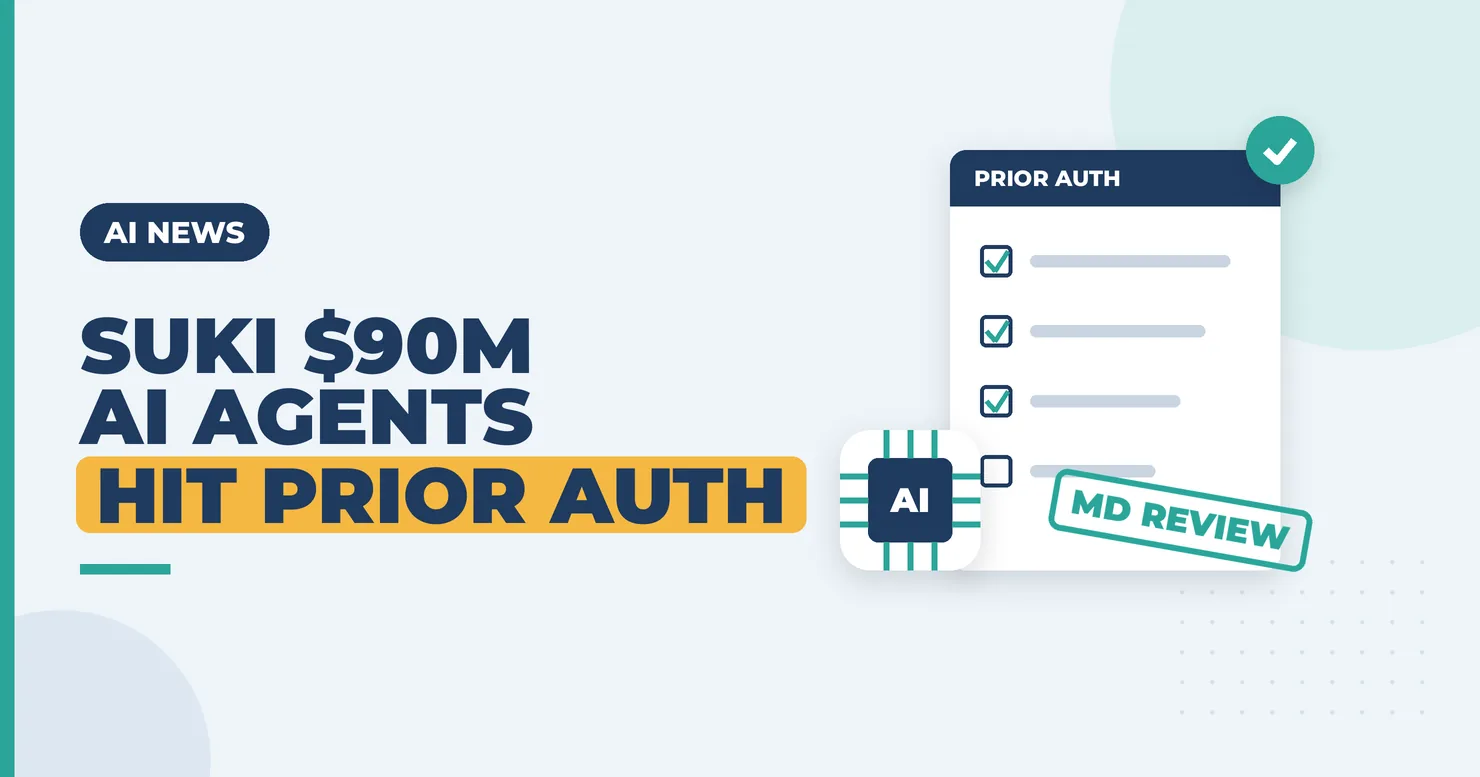
On October 13, 2026, ambient clinical intelligence company Suki announced $90 million in Series E financing. New investors include Healthier Capital, Crosslink Capital and Hercules Capital, with existing backers such as Venrock, Flare Capital Partners, Hedosophia, Philips Ventures and Zoom Ventures participating. Healthcare Dive reported the same day that Suki will use the capital to build AI agents that handle post-visit work — including referrals and prior authorizations for new medications — and to deepen embeds with more than 30 technology partners. Fierce Healthcare covered the raise and CEO Punit Soni’s comments on connecting clinical, financial and operational AI. For billing and authorization staff, this is not another scribe headline. It is ambient AI moving into the same prior-auth and coding queues your team already works.
Company materials also say Suki has expanded beyond documentation into clinical reasoning, revenue cycle and operational workflows, and that it already offers billing code suggestions alongside ambient notes. That places the product in the same mid-cycle lane as autonomous coding and AI prior-auth tools we have covered for AKASA inpatient coding, WISeR Original Medicare prior auth and Alabama’s AI prior-auth law.
Key takeaways
- Series E: $90 million announced Oct. 13, 2026 (Business Wire / Fierce / Healthcare Dive). Suki says it has raised more than $250 million across five rounds (Healthcare Dive citing CEO Punit Soni).
- Agent roadmap: CEO told Healthcare Dive agents will complete post-visit tasks such as referrals and prior authorizations for new medications, using data from existing Suki tools.
- Already mid-cycle adjacent: Company describes billing code suggestions, revenue-cycle expansion and partner embeds (athenahealth Ambient Notes, Zoom telehealth ambient documentation per Healthcare Dive).
- Independent accuracy for PA agents is not in this announcement. Treat vendor volume and financial-impact claims as company-reported until your health system audits them.
- Biller ask list: Which payers and channels (API vs portal vs fax), who owns exceptions, how coding suggestions are logged, and where a human stops an auto-submit before it becomes a CO-197 or medical-necessity denial.
How this article was checked: Suki Business Wire release (Oct. 13, 2026); Healthcare Dive interview with CEO Punit Soni (Oct. 13); Fierce Healthcare (Oct. 13); Axios Pro exclusive on the raise (Oct. 12). Growth and financial-impact figures are attributed to the company or KLAS as cited by Suki — we did not invent numbers. Last reviewed 13 October 2026. Educational only — not legal or investment advice.
Table of Contents
What was announced (and what was not)
| Claim | Source | Independently verified in this piece? |
|---|---|---|
| $90M Series E with named new and existing investors | Business Wire / Fierce / Healthcare Dive | Investor list matches across those outlets |
| Funds for AI advancement, commercial team and partner ecosystem | Fierce interview with Soni | Company statement |
| AI agents for referrals and prior auth for new medications | Healthcare Dive citing Soni | Company statement — no public accuracy study in this news |
| Patient encounters supported by Suki grew >190% YoY in 2026 | Business Wire / Fierce | Company-reported |
| Revenue doubled in 2025; on track for similar growth in 2026 | Business Wire / Fierce | Company-reported |
| Serves 450+ healthcare organizations (Business Wire) / 250+ (Fierce) | Press materials | Figures conflict across outlets — flag for vendor diligence |
| >30 tech partners embed Suki (Optum, Zoom, athenahealth named in Dive) | Healthcare Dive / Business Wire | Partnership names as reported |
| KLAS-validated >$2,600 average monthly financial impact per provider | Suki “About” in Business Wire | Company citing KLAS — read the underlying KLAS study before contracting |
| Suki Ask with Wolters Kluwer UpToDate Expert AI | Fierce / Business Wire | Product launch claim; clinical, not a PA accuracy claim |
Two diligence notes matter for RCM leaders. First, Fierce and Business Wire disagree on organization count (250+ vs 450+). Ask which definition Suki uses (logo customers, live clinicians, partner-embedded seats). Second, nothing in the funding news publishes a blinded study of prior-authorization approval rates, denial overturn rates or coding accuracy for the planned agents. Ambient documentation success does not automatically transfer to utilization management packets.
Why this lands on the billing desk
Ambient scribes used to stop at the note. Suki’s own framing now includes coding suggestions and revenue-cycle workflows, and the funded agent roadmap explicitly names prior authorization and referrals. That means:
- Authorization work may start inside the exam-room transcript. An agent that drafts a PA from the visit note still needs the correct payer plan, CPT/HCPCS, diagnosis linkage, clinical criteria and channel. Incomplete agent packets become your denials.
- Medication PA is a distinct lane. Healthcare Dive quotes Soni on prior authorizations for new medications. CMS-0057-F’s Prior Authorization API requirements still exclude drugs per the CMS fact sheet (see our companion analysis of the Jan. 1, 2027 electronic prior auth deadline). Do not assume an ambient agent can clear pharmacy or medical-benefit drug PA through the same FHIR rails as imaging or procedures.
- Coding suggestions sit next to CDI risk. If the same stack that drafts the note also suggests ICD-10 or E/M levels, your audit plan needs the same rigor payers now apply to AI-assisted coding (see BCBSA’s $942M AI coding report and AHA pushback).
- Partner embeds multiply the surface area. When athenahealth or Zoom surfaces Suki features, the “owner” of a bad PA submit can be the EHR vendor, the ambient partner or your RCM team. Contracts should name who remediates failed submissions.
What billing and authorization teams should demand before go-live
Use this as a vendor and internal checklist — not marketing copy.
Channel and payer readiness
- Payer-by-payer map: API (Da Vinci CRD/DTR/PAS), portal, fax or phone for your top 20 plans.
- Explicit drug vs non-drug behavior. Medication PA should not be sold as “CMS-0057 ready” unless the product uses the correct drug pathway.
- Status write-back into the EHR work queue with timestamps, denial reason text and who (human or agent) last touched the case.
Clinical packet quality
- Required attachments pulled from the chart with a human-visible checklist before submit.
- Criteria citation (LCD/NCD/payer policy ID) stored with the request — the same discipline we recommend after prior authorization denials and for medical necessity documentation.
- Hard stop when required elements are missing. Silent submit is how you seed CO-197 and related auth failures.
Coding and CDI controls
- Every suggested code logged with supporting note span.
- Coder or CDI review thresholds by specialty and denial risk — especially secondary diagnoses that change DRG or HCC weight.
- Sample audit plan (for example 100% for 30 days, then risk-based) before “autonomous” language enters the SOW.
Human override and liability
- Named role who can pause or cancel an agent action.
- Alignment with state human-review rules where they apply (Alabama SB 63 and similar) and with CMS expectations that adverse MA coverage decisions need clinician review (Fitch human-review analysis).
- Retention of prompts, model version and packet snapshot for appeals and payer disputes — the same evidence trail useful in nH Predict-style fights.
Metrics that matter to finance
- First-pass PA approval rate by payer and service line (baseline vs agent).
- Time-to-decision and staff minutes per request.
- Denial reason mix and overturn rate on appeal.
- Coding query rate and payer takebacks tied to agent-touched charts.
What this means for providers and health systems
Ambient AI that only saves documentation time is a clinician-satisfaction buy. Ambient AI that submits prior auths and suggests codes is a revenue-integrity buy. Budget the second category like other mid-cycle AI: governance committee, coding compliance, UM leadership and payer contracting in the room before a limited pilot expands. Soni told Fierce that health systems do not need another pile of disconnected point solutions; that is also the failure mode if Suki agents, a separate PA bot and a coding engine all touch the same claim without a single exception owner.
Competitive context from Healthcare Dive: Ambience raised $243 million and Abridge $300 million in prior mega-rounds. Capital intensity does not equal accuracy. Require outcome data on your case mix.
What this means for insured patients
- Ask whether an AI tool helped prepare or submit your prior authorization, and request the decision letter with the clinical reason — not a generic denial.
- For new prescriptions, confirm whether the hold is pharmacy-benefit PA, medical-benefit drug PA or something else; ambient agents do not change your appeal rights.
- If care is delayed, document dates and ask the clinic for the authorization ID and status. Electronic or agent-driven submissions still fail; the appeal path is still yours.
FAQ
Did Suki raise $90 million specifically for prior authorization?
No. The Series E funds AI technology, commercial growth and partner embeds. Prior-authorization and referral agents are part of the post-visit roadmap CEO Punit Soni described to Healthcare Dive, not a stand-alone PA product announcement with published accuracy metrics.
Does this replace human prior-auth staff?
Not based on public materials. The company describes agents that complete tasks using existing tool data. Complex denials, peer-to-peer reviews and medical-necessity disputes still need human ownership — consistent with the human-review direction we covered from Fitch and state AI prior-auth laws.
Is Suki already doing medical coding?
Suki materials describe billing code suggestions and revenue-cycle expansion. That is not the same as published autonomous inpatient coding with third-party accuracy studies (compare to AKASA’s claims). Ask for specialty-specific accuracy and audit methods.
How does this relate to CMS electronic prior auth in 2027?
CMS-0057-F requires impacted payers to offer Prior Authorization APIs beginning Jan. 1, 2027 for covered non-drug items and services. Ambient agents will only be as good as the payer connections and documentation templates behind them. Separate drug PA rules are still evolving under CMS-0062-P. See our CMS-0057 biller guide.
Should patients worry about AI submitting their authorizations?
Patients should ask who reviewed the request and what criteria were used. An agent that speeds a complete, accurate packet can help; an agent that submits incomplete criteria can delay care. Demand transparency from the clinic, then use standard appeal rights if denied.